
Sambor Prei Kuk
Ten of the towers here have eight sides. That reads as a footnote until you go looking for another octagonal brick temple anywhere in Southeast Asia and come up empty - these are the only ones of their kind, standing in a patch of old forest in Kampong Thom Province among more than a hundred sanctuaries that have been quietly coming apart for thirteen centuries. The Khmer name is a description rather than a title: Sambor Prei Kuk, the temple in the richness of the forest. Undergrowth stays thin beneath the canopy, so you walk in filtered green light between walls of dark brick, and the towers arrive one at a time instead of all at once.
Eight Sides
The octagon was not a whim. Laid out according to principles set down in Indian architectural treatises, the eight-sided shrines are understood as representations of the flying palace of Indra - Vimana Trivishtapa, the heaven of Indra and the thirty-three gods. A square tower is a mountain: solid, rooted, going nowhere. An eight-sided one is meant to read as something that arrived, hovering, and might yet leave.
Whether a seventh-century worshipper standing in front of one actually felt that is beyond recovering. What survives is the intention, held in the geometry. Builders elsewhere in the region stayed with the square, which is easier to raise and easier to keep standing. Here somebody committed to the harder form, in brick, ten separate times - and the results have outlasted every wooden palace their patrons actually lived in.
Palaces That Fly
Six of the temples carry the site's most extraordinary decoration: sculpted flying palaces, cut directly into the outer brickwork. They show multi-storeyed buildings with tiered roofs and small figures looking out from the windows - architecture depicted on architecture, apparently unmoored and drifting across the wall. Nothing else in Cambodia does quite this.
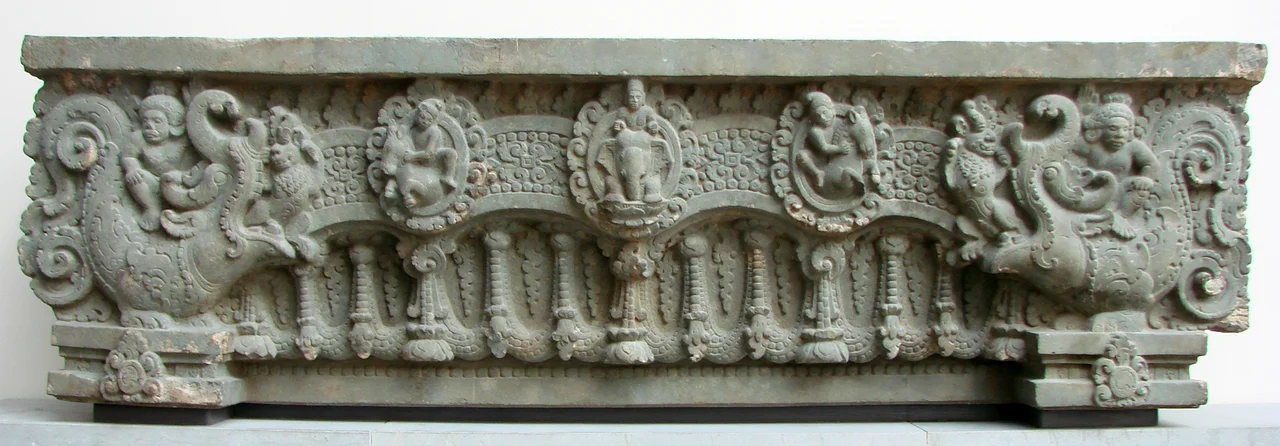
The rest of the exterior work rewards slowing down for. Hindu iconography runs along walls and door frames, and the lintels and pedestals carry motif combinations that occur nowhere else, which is precisely why art historians speak of a Sambor Prei Kuk style at all. Some of the best of it has left the country. A carved lintel and a horse-headed Vajimukha from temple N7 are in the Musee Guimet in Paris.
Three Walled Groups
The heart of the site is three enclosures, each square, each ringed by its own brick wall, set inside a larger double-walled precinct of roughly a thousand acres.
The northern group centres on Prasat Sambor, seventh century, dedicated to Gambhireshvara - a form of Shiva whose name carries the sense of the deep and the solemn. The southern group, Prasat Yeai Poeun, packs in twenty-two sanctuaries built in a remarkably tight window in the first decades of the 600s, again for Shiva. The central group is the latecomer. It holds Prasat Boram, better known by the nickname earned from the pair of sandstone lions at its steps: Prasat Tao, the temple of the lions. Brick does the structural work throughout, with sandstone reserved for what had to be carved or had to bear weight. Scattered between the towers lie lingams and yonis, ponds and reservoirs - the plumbing of a religious capital, still legible in the ground.
What Fell From the Sky
In 1970 Lon Nol deposed Prince Norodom Sihanouk, and Cambodia was pulled fully into the war next door. President Richard Nixon had ordered a bombing campaign against Khmer Rouge and North Vietnamese positions inside the country, and American aircraft struck positions within this archaeological site. The craters remain beside the temples, filling with water in the wet season, easy to mistake for old reservoirs until someone points out which is which.
The guerrillas left something behind as well. Mines were sown across this ground and were not fully cleared until 2008 - thirty-eight years in which the villages around the temples lived with a hazard they had no hand in creating, and in which the safest way to visit a seventh-century shrine was not to. Parts of the wider area are still flagged for unexploded ordnance.
The Drafts for Angkor
On 8 July 2017 the World Heritage Committee, meeting in Krakow, inscribed the site under a name that gives both halves of its identity: the Temple Zone of Sambor Prei Kuk, Archaeological Site of Ancient Ishanapura. It became Cambodia's third World Heritage property, after Angkor and Preah Vihear.
The listing rests on a claim worth taking seriously. What was worked out here in brick and sandstone during the seventh century - the enclosed sanctuary, the decorated lintel, the tower built as a house for a god - became the vocabulary later builders used across the region, and the foundation of the Khmer style that Angkor made famous three centuries afterward. Angkor draws the crowds. This forest holds the drafts.
From the Air
Sambor Prei Kuk lies at 12.867 N, 105.040 E in Kampong Thom Province, Cambodia, 30 km north of the provincial capital of Kampong Thom, 176 km east of Angkor and 206 km north of Phnom Penh. The surrounding plain is flat and intensively farmed, so from the air the temple zone reads as an island of mature subtropical forest in open rice country - the single most reliable visual cue. The Stung Sen River runs nearby and the Tonle Sap lake dominates the horizon to the west. Techo International (VDTI), the main airport for Phnom Penh since 2025, is roughly 220 km south; Siem Reap-Angkor International (VDSA) lies to the northwest. Best viewed from 3,000-5,000 ft. Dry-season burning between February and April fills the basin with haze; visibility is best late in the wet season. On the ground, stay on marked paths - unexploded ordnance has been cleared from the temple zone but the wider area is still flagged.
Nearby Stories
- Boeng Tonle Chhmar 19 km away
- Phnom Santuk 28 km away
- Preah Khan Kompong Svay 33 km away
- Beng Mealea 38 km away
- Cambodian Genocide 47 km away
- Chinit River 53 km away
- Pursat 56 km away
- Democratic Kampuchea 85 km away