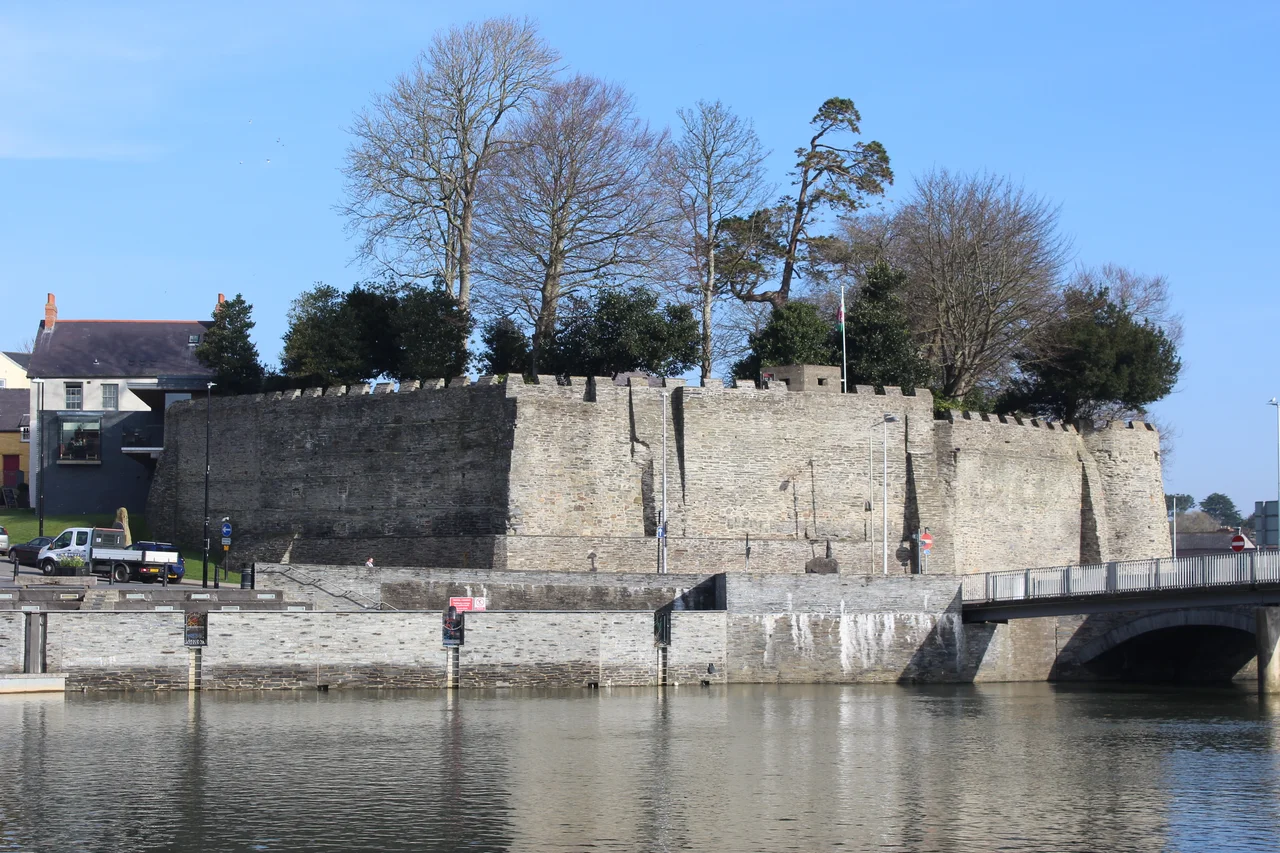

Cardigan Castle
Picture the great hall at Christmas, 1176. Lord Rhys ap Gruffydd, ruler of Deheubarth, has rebuilt Cardigan Castle in stone and is showing it off. He has sent heralds across the British Isles a year in advance, inviting poets and musicians from Wales, England, Scotland, and Ireland to compete for two chairs — one in song, one in poetry. The winners will sit beside him at the feast. The losers will go home with a story. This, the first competitive eisteddfod in recorded history, is the moment Welsh literature acquired its annual stage. Eight hundred and fifty years later, the National Eisteddfod of Wales is still using the same idea.
Norman, Welsh, Norman, Welsh
The castle that watches the River Teifi from a low cliff above the old bridge has changed hands so often that the masonry itself reads like a family argument. The first castle here was a motte-and-bailey, built around 1093 a mile from the present site by Roger de Montgomery, one of William the Conqueror's most powerful Marcher lords. In 1110 King Henry I took Cardigan from the Welsh prince Owain ap Cadwgan as punishment for a kidnapping and handed it to Gilbert Fitz Richard de Clare. In 1136, after the Welsh victory at the Battle of Crug Mawr just outside the town, Owain Gwynedd and his brother Cadwaladr captured Cardigan and burned it; the castle itself held out under Robert FitzMartin and his Norman defenders. The Normans recovered the town. In 1166, Rhys ap Gruffydd took it back. In 1171 he rebuilt the castle in stone on the present site. It is his castle, more than anyone else's, that you are looking at today.
The First Eisteddfod
Eisteddfod is the Welsh word for a session — literally a sitting — and bardic competitions had been a feature of Welsh court culture for centuries before 1176. What Rhys did at Cardigan was different in scale and form. He turned a court entertainment into a public competition, advertised it widely, formalised it with chairs as prizes, and made it open to all the British Isles. The Brut y Tywysogion, the medieval Welsh chronicle, records his triumph: the poet's chair went to a man from Gwynedd, the musician's to a man from Rhys's own household. Wales had invented the literary festival. The format passed into hibernation for several centuries after the Norman conquest of Wales in 1283, but it never disappeared, and it was revived in 1789 at the Bull Inn at Corwen — leading directly to the modern National Eisteddfod, which travels to a different Welsh town each year and has been continuously held since 1861. The restaurant at Cardigan Castle is called 1176, which is the kind of plaque you put on a building when you mean it.
Sack, Decay, Ruin
Cardigan suffered the usual castle problems. In 1199 Rhys's grandson Maelgwn razed it and sacked the town during a war of succession. The Normans rebuilt it. The town wall went up in the 1240s. The castle ceased to be the administrative centre of Cardiganshire after the Laws in Wales Act 1536 transferred functions to Cardigan town itself, and by the early seventeenth century the structure was already falling into ruin. It was held briefly by Royalists during the English Civil War, then largely abandoned. In the early 1800s, somebody built a Regency mansion called Castle Green House inside the medieval curtain wall — recycling the stones, again, as English builders had done with every other monastery and castle on the islands. The grand new house slowly decayed in turn.
The Woman Who Would Not Leave
From around 1940 until 2003, Castle Green House and the castle ruins surrounding it were the home of Barbara Wood and, later, of her alone. The owner allowed the property to decay so completely that the outer castle walls had to be propped up to stop them collapsing into Bridge Street. Miss Wood occupied the castle for almost sixty years. The local authority tried repeatedly from 1971 onwards to take the property into public ownership; she refused to sell, refused to leave, refused to repair. In 2002 the BBC featured Castle Green House on the second series of Restoration, presented by Griff Rhys Jones, as one of Britain's most endangered buildings. In April 2003 Ceredigion County Council finally bought the castle. Miss Wood died not long after.
Open Again, After Eight Hundred Years
Restoration ran from 2003 to 2015, cost £12 million, and was paid for largely by the Heritage Lottery Fund. The opening on 15 April 2015 turned the castle back into a place the public could walk into for the first time in living memory. The new facilities are not what a twelfth-century Welsh prince would recognise — luxury bed-and-breakfast accommodation, a heritage centre with education facilities, an open-air concert area, rooms for hire — but the bones are unchanged. Lord Rhys's stone curtain wall is the same wall. The view down to the Teifi bridge is the view the eisteddfod competitors had when they arrived in 1176. In July 2015 the castle reopened with a concert. Bellowhead headlined. Eight hundred and thirty-nine years after the first eisteddfod, Cardigan Castle was once again a stage.
From the Air
Coordinates 52.082°N, 4.661°W mark Cardigan Castle, on a low cliff above the south side of the River Teifi at the head of the old stone bridge. Best viewed from 1,000-2,000 ft AGL approaching from the west along the Teifi estuary; the curtain wall and Castle Green House inside it are clearly legible. The town of Cardigan (Aberteifi) sits immediately east of the castle. Nearest airport: Haverfordwest (EGFE) approximately 20 nm south; Aberporth (EGFA) about 12 nm north along the coast.
Nearby Stories
- HMS H47 4.6 km away
- National Botanic Garden of Wales 5 km away
- Narberth 6.3 km away
- Aberystwyth Lifeboat Station 9.3 km away
- Skomer 13 km away
- Diamond (1823 ship) 21 km away
- Talley Abbey 22 km away
- HMS Tyler 32 km away