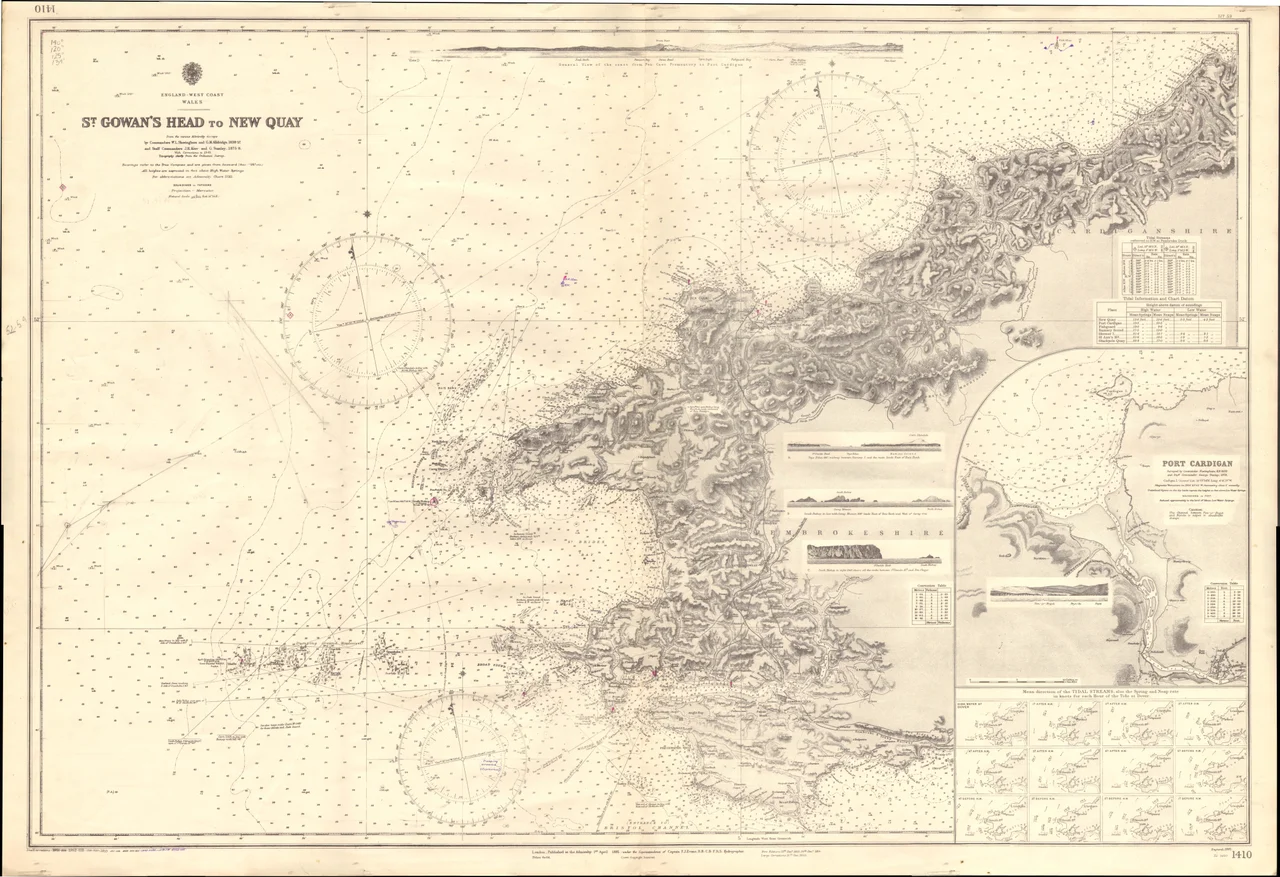

Cardigan, Ceredigion
In 1815, Cardigan had 314 ships registered to its port. That was seven times as many as Cardiff and three times as many as Swansea. The Welsh town that gives its name to the cardigan sweater — by way of the seventh Earl of Cardigan, the cavalry officer at the Battle of Balaclava — was, at the start of the nineteenth century, the most important port in South Wales. By the start of the twentieth, the river had silted, the railway had won, and the ships were gone. The town stayed, smaller and quieter, and learned new things to do.
Aberteifi at the Mouth of the Teifi
The Welsh name for Cardigan is Aberteifi — the mouth of the Teifi — and that is exactly where the town sits, at the tidal head of the river three miles inland from the open sea. The English name is an anglicisation of Ceredigion, meaning Ceredig's land, after the legendary son of Cunedda Wledig who, in the Welsh foundation stories, led his people south from the old north to recover lands lost to Irish raiders in the late Roman period. The town today is the second largest in Ceredigion, with about 4,184 people at the 2011 census, and remains substantially Welsh-speaking — 54.6 percent of residents could speak the language at the same census. It is bypassed now by the A487 coastal trunk road; before the bypass was built in 1989-90, every car heading from Aberystwyth to Pembrokeshire had to thread through the medieval street pattern by the old bridge.
The Eisteddfod and the Castle
The town grew up around the Norman castle that Roger de Montgomery built in 1093, and it took its shape in the twelfth century when the Welsh prince Rhys ap Gruffydd recaptured Cardigan in 1166 and rebuilt the castle in stone. In 1176, in that same castle, Rhys hosted the first competitive eisteddfod in recorded history — a bardic contest he had advertised across the British Isles a year in advance, with chairs for the winning poet and the winning musician. Wales has been holding eisteddfodau on more or less the same model ever since. Cardigan hosted the National Eisteddfod of Wales again in 1942, and again in 1976 — eight hundred years after the original. The town has held its own annual eisteddfod since 1953, now called Gwyl Fawr Aberteifi (Cardigan Big Festival). The castle itself reopened to the public in 2015 after a £12 million restoration.
The Port That Was
Cardigan's eighteenth and nineteenth-century prosperity came from herring. The fishery off Cardigan Bay was rich; the town processed the catch, salted and exported it, and built ships to carry it. By 1815 the registered fleet of 314 vessels handled exports of slate, oats, barley, butter, and salt fish, and imported oranges, manufactured goods, building materials, and coal. Shipbuilding became a major local industry — more than 200 vessels were built in Cardigan itself and downstream at Llandudoch (St Dogmaels). Above sixty taverns operated in the town centre by the mid-nineteenth century, serving sailors, shipwrights, and the agricultural workers who came in for Barley Saturday and the regular fairs. Then the river silted. The bigger ships could no longer reach the quay. The Whitland and Cardigan Railway arrived in 1886 and made the slow remaining trade with Bristol uncompetitive. By the 1920s the port was finished.
Jeans, Earthquakes, and a Duchess
For four decades from the 1960s to 2002, Cardigan was a jeans town. A factory in the centre produced 35,000 pairs of denim trousers a week for Marks & Spencer — until M&S moved its sourcing overseas in 2002 and 400 jobs disappeared. Ten years later, a small new operation called the Hiut Denim Company opened in part of the same building, employing some of the original cutters and sewing machinists who had been made redundant a decade earlier. Hiut made expensive, slowly-produced jeans for an export market. In January 2018, Meghan Markle, then engaged to Prince Harry, was photographed wearing a pair of Hiut jeans in Cardiff. The company's website fell over. The town's name went around the world again, briefly. On 17 February 2018 — the same year — Cardigan was the centre of a magnitude-4.4 earthquake, the largest in the United Kingdom for a decade. The locals went outside to check the chimneys.
What Cardigan Is Now
The Cardigan that survives today is a small, working Welsh market town with a coordinated programme of restored shopfronts, a refurbished nineteenth-century guildhall, a renovated castle, a denim company, the lifeboat station out at Poppit Sands, and an annual schedule of festivals that runs from Barley Saturday in late April through the food and wine festival in August to the Dream of Dr. Sardonicus festival of psychedelia in the Cellar Bar. The Cardigan Town Council, after the 2017 election, was unique in Wales for having a female majority — seven women and six men. The high street keeps independent shops alive in a way that most English towns of similar size cannot. In 2017, the Sunday Times named Cardigan one of the best places to live in Wales. A town that had spent the twentieth century watching itself shrink had spent the twenty-first finding new reasons to stay.
From the Air
Coordinates 52.084°N, 4.658°W mark the centre of Cardigan town on the tidal Teifi, three miles inland from Cardigan Bay. The castle on the south bank of the old bridge and the Gothic guildhall on Pendre are the most visible landmarks from above. Best viewed from 1,500-3,000 ft AGL approaching from the west along the river. Nearest airport: Aberporth (EGFA, civil use limited) approximately 12 nm north up the coast; Haverfordwest (EGFE) approximately 20 nm south; Welshpool (EGCW) approximately 70 nm east. The Teifi estuary at Poppit Sands sits 2 nm northwest of the town.
Nearby Stories
- HMS H47 4.6 km away
- National Botanic Garden of Wales 5 km away
- Narberth 6.3 km away
- Aberystwyth Lifeboat Station 9.3 km away
- Skomer 13 km away
- Diamond (1823 ship) 21 km away
- Talley Abbey 22 km away
- HMS Tyler 32 km away