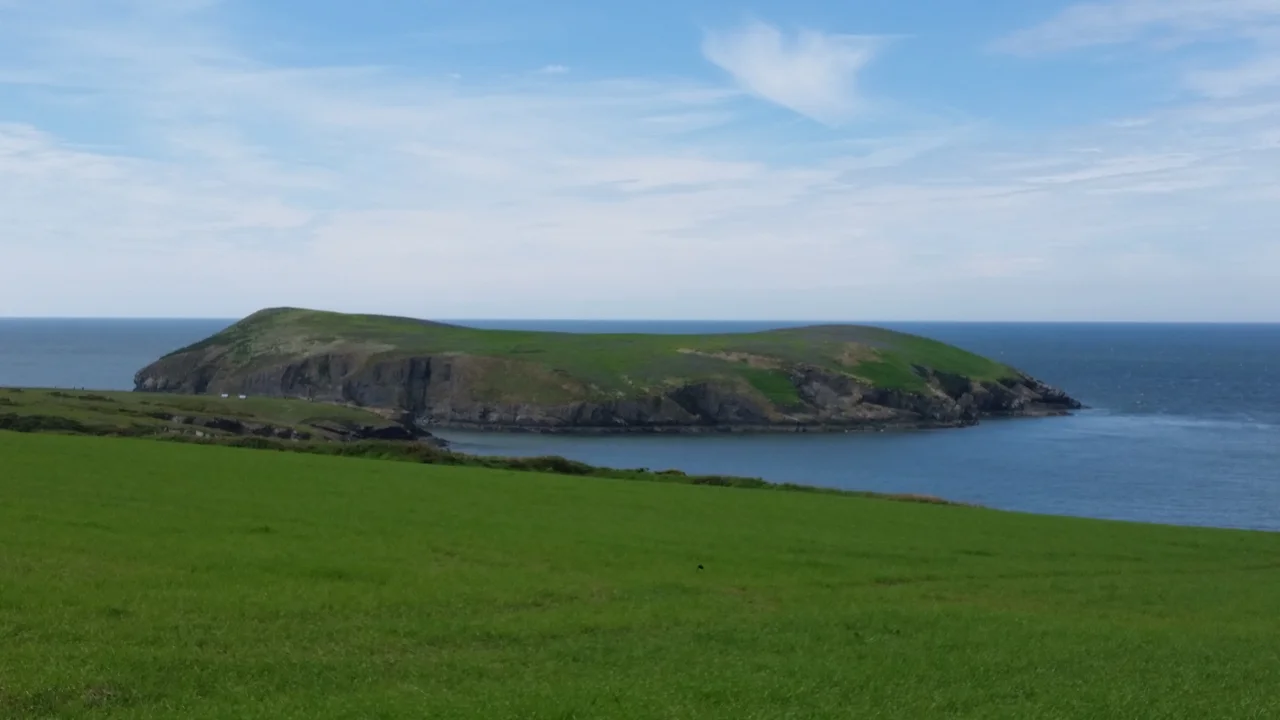

Cardigan Island
On a stormy night in 1934, the liner Herefordshire broke free of her tow rope and ran aground on a small, almost-island just off the Welsh coast. The ship was already on her way to the breakers' yard. What no one realised in the wreckage and rescue was that her real cargo had been the rats living in her hold. They came ashore. They found nesting puffins, Manx shearwaters, eggs and chicks, and they ate. By the time anyone thought to count, the seabirds were gone. It would take 45 years to get the rats off Cardigan Island, and the puffins have never returned.
Welsh Parrots
Before the wreck, Cardigan Island had been famous for them. A guidebook in the 1890s called the puffins "Welsh parrots", a name that captures something of their absurd, painted-clown faces and the noisy disorder of a thriving colony. In 1924 the Welsh naturalist Ronald Lockley counted roughly 25 to 30 pairs nesting in the burrows on the island's grassy crown. Manx shearwaters came in at dusk, navigating by smell back to nest holes they had used for years. The island, 52 metres at its highest point and only 38 acres in total, was big enough to feel oceanic from a kayak but small enough that a single bad night could change its biology forever.
The Storm of 1934
The Herefordshire was a Bibby Line ocean liner of nearly 8,000 tons, decommissioned and being towed from the Mersey to a Welsh scrapyard when the weather turned. Her tow parted in heavy seas off Ceredigion, and she drifted onto Cardigan Island, where she broke up against the cliffs. The wreck still draws divers; marine life has colonised the iron and made it a small reef. But the rats that came ashore in 1934 had no such useful role. They worked through the burrows methodically, year after year, and the seabirds that depended on island isolation discovered that the isolation had ended.
Empty Burrows
Forty-five years is a long time to fight a small mammal on a small island. The Wildlife Trust of South and West Wales, which owns Cardigan Island, only managed to declare the rats gone in the late 1970s. By then the puffin colony was generations vanished. Shearwaters did not return. What did return, slowly, was everything else: guillemots, razorbills, cormorants, shags, fulmars, and the usual Welsh assembly of gulls now nest on the cliff ledges where mammals cannot easily reach. A small flock of Soay sheep grazes the grass, descendants of an experiment in keeping the vegetation low enough for ground-nesting species that might one day come back.
The Sea Around It
From the coast at Gwbert, Cardigan Island looks impossibly close — barely 200 metres of churning channel separates it from the mainland. The strip of water is what saves it. Atlantic grey seals haul out on its rocks and pup in its sea caves. Bottlenose dolphins from Cardigan Bay's resident population, one of only two such colonies in British waters, pass between the island and the headland on most calm summer days. Watching from the clifftop path, the eye moves naturally from seal to seal, then catches the sudden dark arc of a dolphin's back, and then realises that the bird wheeling above the waves is a chough — red beak, glossy black, a survivor of older Welsh skies.
What Islands Teach
Cardigan Island is a small lesson in how easily a place can be unmade. A snapped tow rope, a few rats, and a colony that had been there long enough to earn a nickname was simply gone. The Wildlife Trust now treats the island the way a museum treats an irreplaceable manuscript: with constant vigilance, monitored visits, and careful biosecurity for anyone who lands on it. Recovery is slow and uncertain. The cliffs are louder than they were in the lean years, the seals are back in numbers, the dolphins still come. But the burrows on the island's grassy top stay empty, and the Welsh parrots, for now, remain a memory carried only in old guidebooks.
From the Air
Cardigan Island sits at 52.13 degrees north, 4.69 degrees west, in the mouth of the River Teifi. The island is small but distinctive — a green humpbacked rock about 200 metres off the headland at Gwbert, visible from low altitude as a clear separation between mainland cliff and sea. Best viewed at 1,500-2,500 feet AGL on a westerly approach along Cardigan Bay; the Teifi estuary and Poppit Sands beach to the south make a useful chain of landmarks. Nearest airfield is Haverfordwest (EGFE) about 25 nm south; Aberporth (military, ICAO EGFA) lies about 6 nm east-northeast along the coast. Cardigan Bay weather is famously changeable; sea fog can form quickly even when inland conditions are clear.
Nearby Stories
- HMS H47 4.6 km away
- National Botanic Garden of Wales 5 km away
- Narberth 6.3 km away
- Aberystwyth Lifeboat Station 9.3 km away
- Skomer 13 km away
- Diamond (1823 ship) 21 km away
- Talley Abbey 22 km away
- HMS Tyler 32 km away