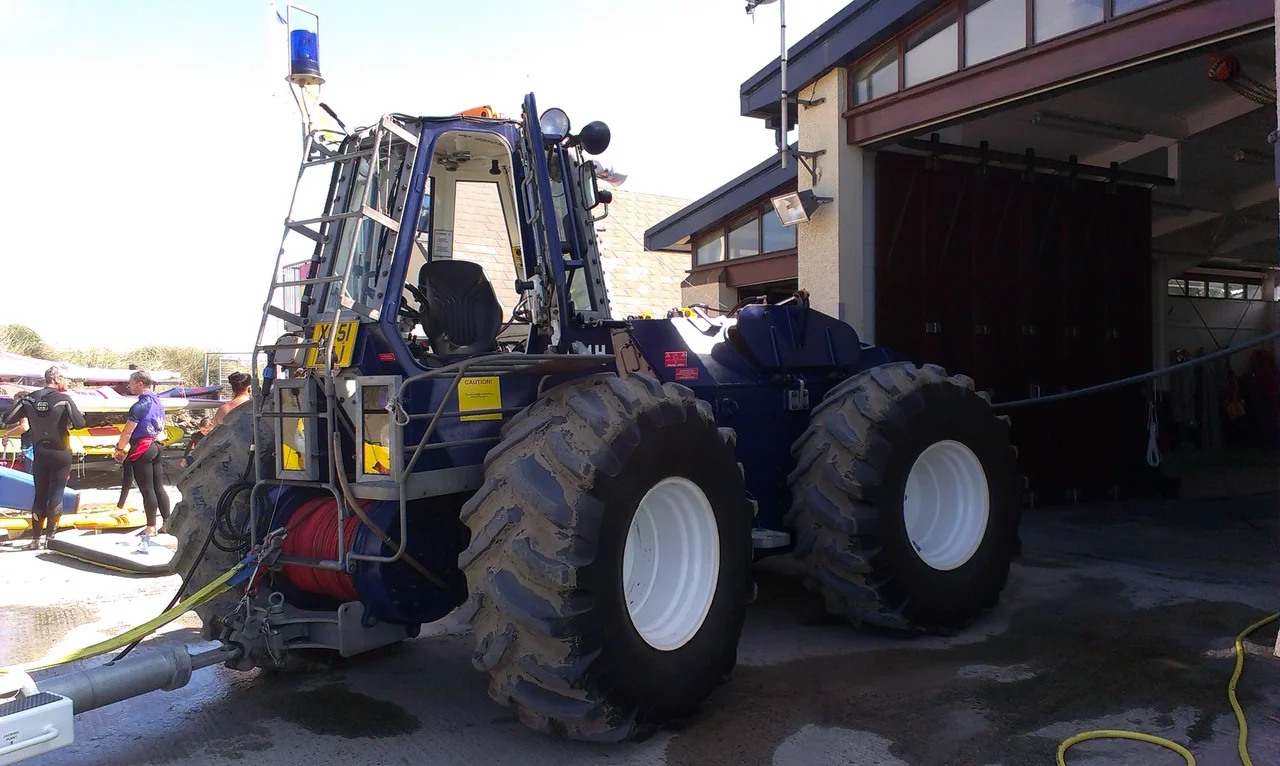

Cardigan Lifeboat Station
The brig Agnes Lee broke up on Cardigan Bar in the winter of 1848, and her crew drowned in sight of the Welsh coast. The town watched from the cliffs above Poppit Sands, and decided. By the following year a lifeboat sat in a small house below Penrhyn Castle, manned by men who knew exactly how the Teifi estuary's sandbar shifted in a gale. They have been launching from that stretch of coast, on and off, for more than 175 years.
The Bar That Made Them
Cardigan Bar is the reason. The River Teifi meets the open Atlantic at Poppit Sands across a long shallow sandbar that moves with each storm, exposing new shoals and burying others. Ships running for shelter from a westerly blow can find themselves on top of sand before they see it. The brig Agnes Lee was only the first wreck the town would mourn. On 21 January 1861, the schooner Dewi Wyn, on passage from Bristol, struck the bar in heavy weather. The Cardigan lifeboat launched and brought back all eight of her crew alive — the kind of result that justifies the cold hours, the broken oars, the volunteer hands.
The John Stuart
The first proper RNLI boat arrived in 1864 — a 32-foot self-righting pulling-and-sailing lifeboat with ten oars, transported free by the Great Western Railway to New Milford. The Manchester Lifeboat Fund had paid for her, mostly through the persistence of a man named Robert Whitworth, and the boat was named John Stuart in honour of one of his donors. There is something quietly Victorian in that chain of generosity: a Manchester businessman writes a cheque, a Bristol industrialist organises the fund, the railway company carries the boat for nothing, and at the end of the chain Welsh fishermen pull on oars in a North Atlantic storm. The chain held for sixty-eight years until the station closed in 1932, the new motor lifeboats farther down the coast having made the old pulling boat redundant.
Inshore Lifeboats
After the war, leisure changed everything. The 1960s brought weekend sailors, family swimmers, surfers, kayakers — and the kind of accidents that came with them. In 1964 the RNLI placed 25 small inflatable inshore lifeboats around the coast, fast and launchable by a handful of volunteers from a beach. Cardigan reopened in 1971 on a new site at Poppit Sands, and has been there since. A new boathouse went up in 1987, then a larger double boathouse in 1998 for two boats and a Talus amphibious tractor. Today the station runs an Atlantic 85 named Albatross and a D-class named John Darbyshire, working the same bar that drowned the Agnes Lee.
The Women of 2011
On a December evening in 2011, three volunteers were on call when the pagers went off: Gemma Griffiths, Sarah Griffiths, and Louise Francis. They launched the inshore lifeboat into Cardigan Bay together. It was the first time in Welsh RNLI history that an all-female volunteer crew had answered a callout. That kind of milestone tends to sound like a press release, but it was three women doing the job because they were the ones on the rota, and the job needed doing. Two and a half years later, in 2014, helmsman Derek Pusey, crewman Leonard Walters, and crewman Clive Williams received the St David Bravery Award and additional honours from the Shipwrecked Mariners' Society for a night rescue of walkers cut off by the tide at the foot of cliffs near Cemaes Head — five hours of searching in darkness across surf and rock.
What Remains
Five RNLI medals — three silver, two bronze — sit in the station's history. The earliest, a silver medal, went in 1873 to Coastguard Richard Jinks, who saved two men from a vessel called Ocean wrecked on Cardigan Bar. Down the estuary at Black Rocks, the remains of the 1876 boathouse and its slipway are slowly being reclaimed by tide and weed, a small ruin of Victorian masonry that nobody preserves and nobody quite lets go. The bar still moves. The Atlantic still arrives. Every summer brings new visitors who do not know the currents, and somewhere on a green hill above the boathouse, a pager waits.
From the Air
Cardigan Lifeboat Station sits at 52.10 degrees north, 4.70 degrees west, on the southern shore of the River Teifi estuary at Poppit Sands in North Pembrokeshire. From the air the station is a distinctive double boathouse facing the long Poppit Sands beach; the sandbar at the estuary mouth is often visible as a paler curve in the water. Best at 1,000-2,000 feet for a coastal pass; the cliffs of Cemaes Head rise sharply just to the west and provide a dramatic vertical landmark. Nearest airfield is Haverfordwest (EGFE), about 18 nm south-southeast. Weather along this exposed Atlantic coast can change in minutes; respect the same conditions that keep the RNLI busy.
Nearby Stories
- HMS H47 4.6 km away
- National Botanic Garden of Wales 5 km away
- Narberth 6.3 km away
- Aberystwyth Lifeboat Station 9.3 km away
- Skomer 13 km away
- Diamond (1823 ship) 21 km away
- Talley Abbey 22 km away
- HMS Tyler 32 km away