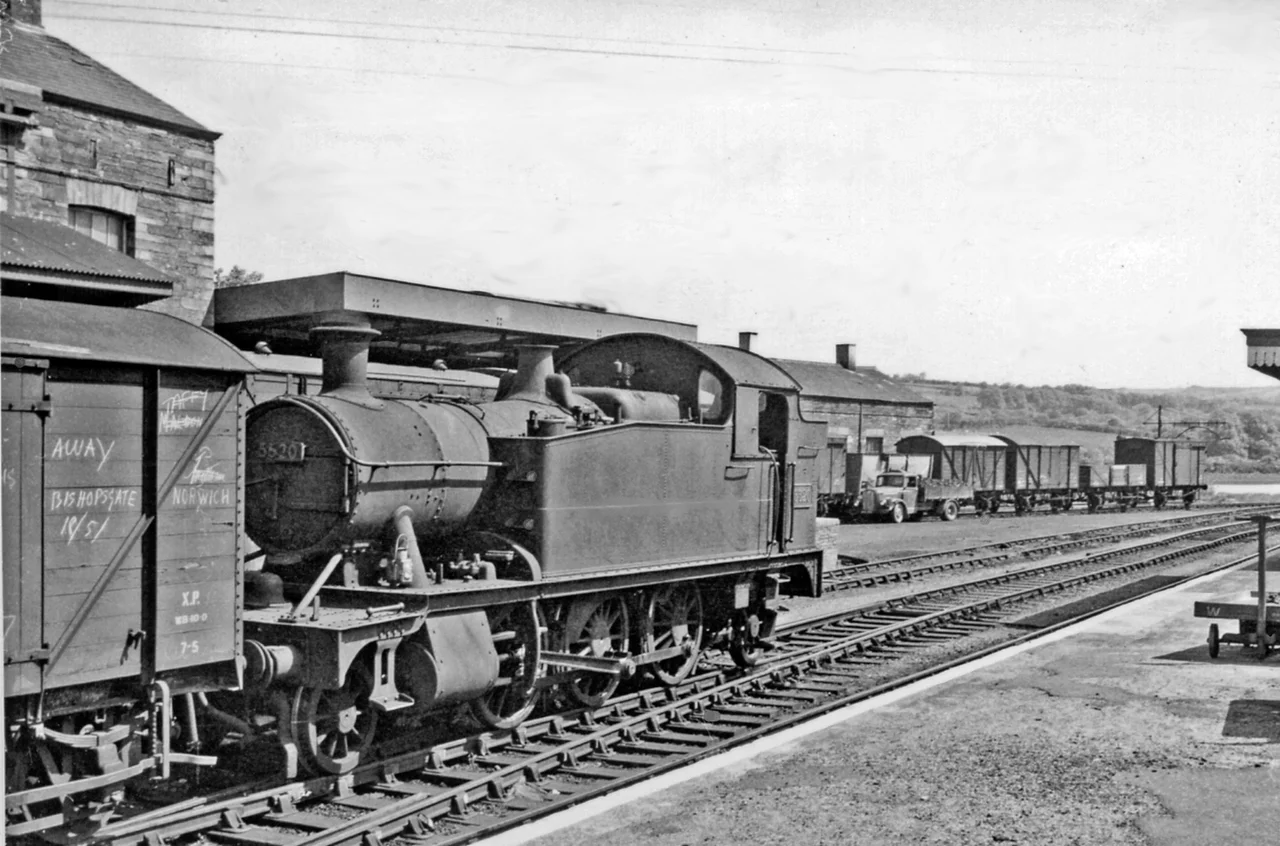

Cardigan Railway Station
On 8 September 1962, the 5:45 pm Cardigan Mail pulled out of the platform at Cardigan station and turned its tail to the town. Two days later, on 10 September, the line officially closed to passengers. The locals had a name for the railway: Y Cardi Bach, the Little Cardiganshire Line, after the Welshmen who built it and worked it. It had taken the better part of two decades to push the track to Cardigan in the 1880s. It had only taken Doctor Beeching's accountants a few months in 1962 to decide it was finished.
Slow Track to Cardigan
The Whitland and Taf Vale Railway had been hammered out between 1869 and 1873 across the rolling hills of inland Pembrokeshire. The aim, from the start, was Cardigan — a market town and port at the mouth of the River Teifi, hungry for a connection to the British rail network. But the Cardigan extension was hard to finance. Subscribers were slow to write cheques and landowners, despite earlier positive noises, made trouble over rights of way. Authorisation came in 1877 by Act of Parliament; the company changed its name to the Whitland and Cardigan Railway. Even so, the line did not actually reach Cardigan until 1886. Colonel Rich of the Board of Trade made his statutory inspection on 29 and 30 June that year and ruled the line not yet ready. After further work it opened on 31 August 1886, and the Great Western Railway took over operations the next day.
Death of a Port
Cardigan in the early 19th century was one of the busiest ports in Wales, with seven hundred and fifty ships registered there at its peak — coastal traders running slate, butter, cheese, herrings, and emigrants bound for the Americas. The arrival of the railway in 1886 began the slow strangulation. Goods that had moved by sea now moved by train; the quay grew quiet; the warehouses emptied. By the time the GWR absorbed the line fully in 1890 under a section of the Great Western Railway Act, the port was dying. The pattern repeated itself across coastal Britain in the late Victorian era: railways killed the small ports, then the roads killed the railways, and the towns were left to discover whether they had any other reason to exist.
Four Trains a Day
Under the GWR, the Cardigan branch settled into the rhythm that small rural lines kept for half a century: four trains each way every weekday, plus a Saturday round trip and an extra train on the day of the monthly agricultural fair at Crymmych. The trains ran slowly, calling at every halt. Salmon fishers used the line to send their catch east. Farmers used it for stock and milk. The population density of north Pembrokeshire was simply too low to make the line pay, and the surrounding slate quarries — once a steady source of freight — went into decline through the 1920s and 1930s. The GWR was working the line for shareholders who could not afford to keep it open and could not bring themselves to close it. After nationalisation in 1948, British Railways inherited the problem.
Beeching's Shadow
Cardigan closed before Doctor Richard Beeching's famous 1963 report on the reshaping of British Railways. The branch went on 10 September 1962, ahead of the Beeching Axe but with the same logic behind it: not enough passengers, not enough freight, too much subsidy. Goods traffic limped on until 27 May 1963. The station then opened as a coal depot until April 1965, staffed by railway employees until November 1964, and the final final closure came on 6 September 1965. Twenty years after victory in Europe, the Welsh branch lines that had carried evacuees and troops were quietly being torn up across the map. Cardigan was one of hundreds.
The Track That Became a Path
The site of Cardigan station is now occupied by the old goods shed and small modern development. The platform is gone. But the line lives on as something nobody could have planned: the section of trackbed between Cardigan and Cilgerran is now a cycle path and footway, running through the Teifi Marshes and Wildlife Park — a Site of Special Scientific Interest, one of Wales' richest wetlands. Otters use the trackbed banks. Kingfishers nest where signal boxes once stood. The cuttings have grown to woodland; the embankments are wild with bluebells in spring. The Cardi Bach, after sixty years of being officially nothing, has quietly become one of the loveliest walks in west Wales.
From the Air
The site of Cardigan railway station sits at 52.08 degrees north, 4.66 degrees west, on the south bank of the River Teifi near the centre of Cardigan town. From the air the old trackbed is a narrow green corridor running south-east from Cardigan along the river through Teifi Marshes towards Cilgerran. The Welsh Wildlife Centre at Cilgerran is a good landmark about 3 nm upstream. Best viewed at 1,500-2,500 feet AGL following the river. Nearest airfield is Haverfordwest (EGFE), 18 nm south-southeast. Surrounding terrain is rolling Welsh hill country with little high ground; sea fog from Cardigan Bay can drift inland up the Teifi valley on cool mornings.
Nearby Stories
- HMS H47 4.6 km away
- National Botanic Garden of Wales 5 km away
- Narberth 6.3 km away
- Aberystwyth Lifeboat Station 9.3 km away
- Skomer 13 km away
- Diamond (1823 ship) 21 km away
- Talley Abbey 22 km away
- HMS Tyler 32 km away