
Carew
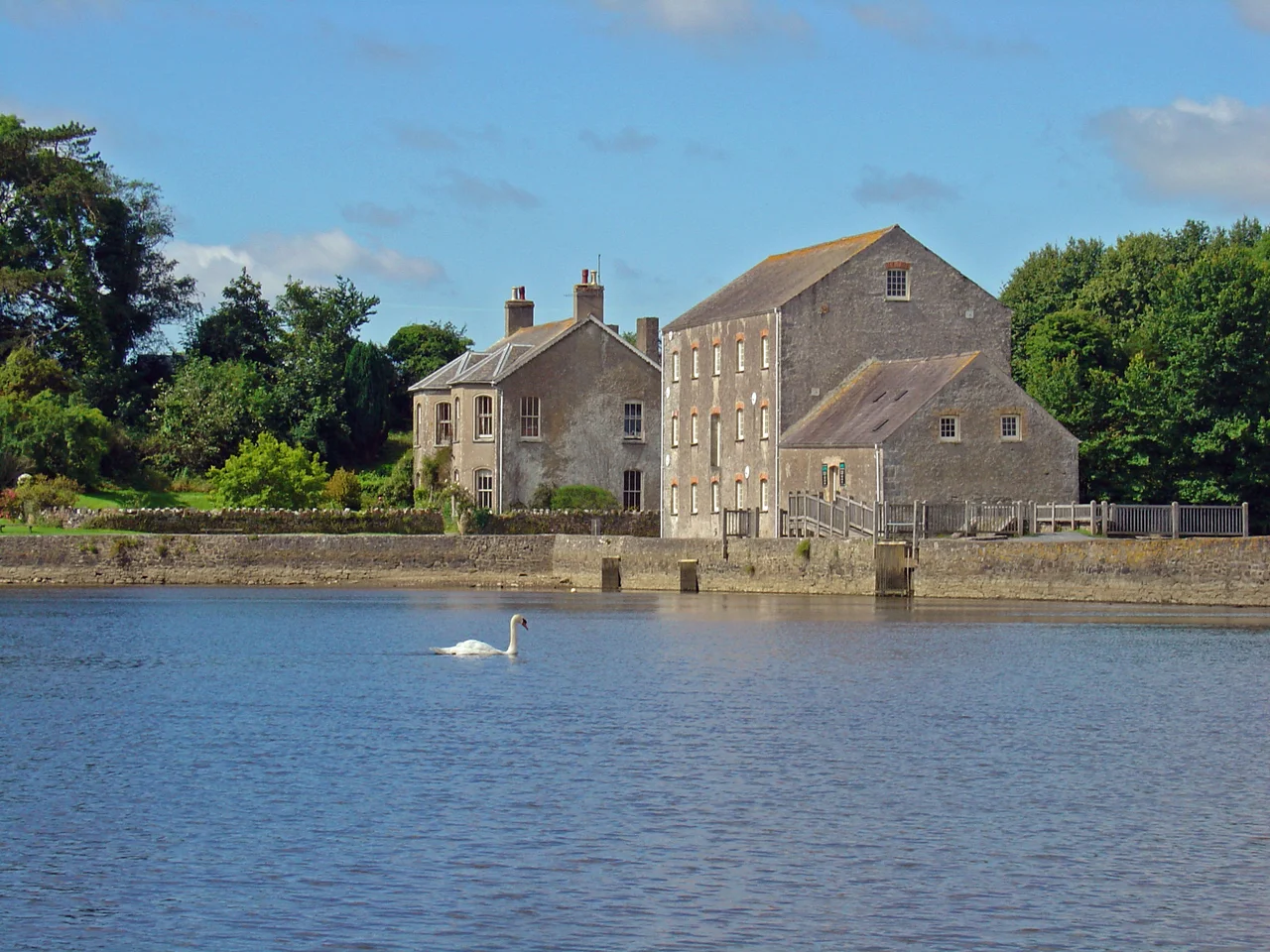
Beside an unremarkable Welsh village road stands one of the finest 11th-century high crosses in Britain. The Carew Cross is four meters tall, cut from local limestone, joined in two pieces by a mortise-and-tenon joint, and it marks the memory of Maredudd ab Edwin - a king of Deheubarth who died in 1035 and whose kingdom is no longer on any map. The cross has stood by this roadside for nearly a thousand years. Drivers from Pembroke pass it on their way to Tenby. Most do not stop. Across the field, the Norman castle looms in its long ruin; downstream, the tidal mill still keeps its sluices.
Cross for a Lost King
Maredudd ab Edwin ruled Deheubarth, the southern Welsh kingdom that once stretched from the Bristol Channel north to the Dyfi estuary. He died in 1035 - the records do not agree on how, only that his rule was brief and contested. The cross at Carew commemorates him. It belongs to a small family of monumental Welsh crosses from the eleventh century, similar in form to the better-known cross at Nevern further north. Two pieces of limestone are connected by a tenon joint, the interlace patterns carved with confidence and skill, a possible inscription on the western face. Whoever commissioned it intended that Maredudd's name should outlast his kingdom, and in this they succeeded. The kingdom is gone. The cross is still here, four meters of stone at the edge of the road, where farmers and tourists and the occasional historian pass it without quite knowing what they are seeing.
Castle Above the Inlet
Carew Castle sits 170 meters west of the village, on an inlet of Milford Haven that fills and empties with the tide. The first fortification here was Iron Age. Around 1100, the Norman Gerald de Windsor built an earth-and-timber fort - the same Gerald whose wife Nest ferch Rhys gave Welsh legend one of its great romances and one of its great kidnappings. Stone replaced timber over the centuries, and the castle grew. By the Tudor period it had become something else again: an Elizabethan mansion grafted onto a medieval shell, with great mullioned windows on the north range that look out toward the mill across the water. Most of those windows are now empty rectangles framing the sky. The castle is ruinous, but its size is undiminished. From the inlet path, looking up at the north front, you can still feel what the Elizabethan owners were trying to do - build a country house comfortable enough to live in, defensible enough to mean it.
Mills, Limestone, Anthracite
The parish made things. Textile mills gave the hamlet of Milton its name - a carding mill downstream, a weaving mill by the bridge, a fulling mill upstream. The cloth they processed has not been made here for a century. At West Williamston, limestone was quarried from slot-shaped flooded pits that opened directly onto Milford Haven; the locals called them docks. Stone was dropped from the quarry faces into barges waiting below, and shipped to lime kilns all around the coasts of Pembrokeshire and Cardiganshire. A small quarry still works the limestone north of Carew village. Anthracite came from Minnis Pit at the parish's northeastern edge - never on the scale of the great South Wales coalfields, just enough for local consumption. Like most of southern Pembrokeshire, the parish has been English-speaking since the 12th century - a linguistic boundary called the Landsker Line still cuts across the county, separating the English-speaking south from the Welsh-speaking north.
The Cricket Scandal
And then, in 2017, Carew made the national news for cricket. In the final match of the Pembroke County Cricket Club championship, Carew faced their local rivals Cresselly, needing a win to take the title. They declared their innings closed at a precise moment that, by the strict reading of the rules, left them eligible for the championship. The Pembroke County Cricket Club ruled afterwards that no rule had been broken - but that the spirit of cricket had been, which in English-speaking cricket is somehow worse. Carew were demoted to a lower division. Pembroke's village cricket grounds have seen worse drama, surely, but few that reached the BBC. The cross still stood by the road. The castle still ruined above the inlet. The mill below kept on with its tides. Carew, as it has done for a thousand years, simply continued.
From the Air
Carew sits at 51.70°N, 4.83°W, on a tidal inlet of Milford Haven, four miles east of Pembroke. From the air, the castle ruins and the long causeway across the inlet to the tidal mill are unmistakable - the mill pond is roughly 11 hectares, a clear sheet of water that fills and drains with the tide. Best altitude 2,000-3,500 ft for both castle and cross. Nearest airports: Haverfordwest (EGFE) about 8 nm northwest, Pembrey (EGFP) about 15 nm east, Swansea (EGFH) about 30 nm east-northeast.
Nearby Stories
- St Andrew's Church, Bayvil 1.6 km away
- Skomer 3.7 km away
- National Botanic Garden of Wales 9 km away
- HMS H47 13 km away
- Mumbles Lifeboat Disaster 32 km away
- Strata Florida Abbey 38 km away
- Lighthouses on Lundy 38 km away
- Tehidy Country Park 140 km away