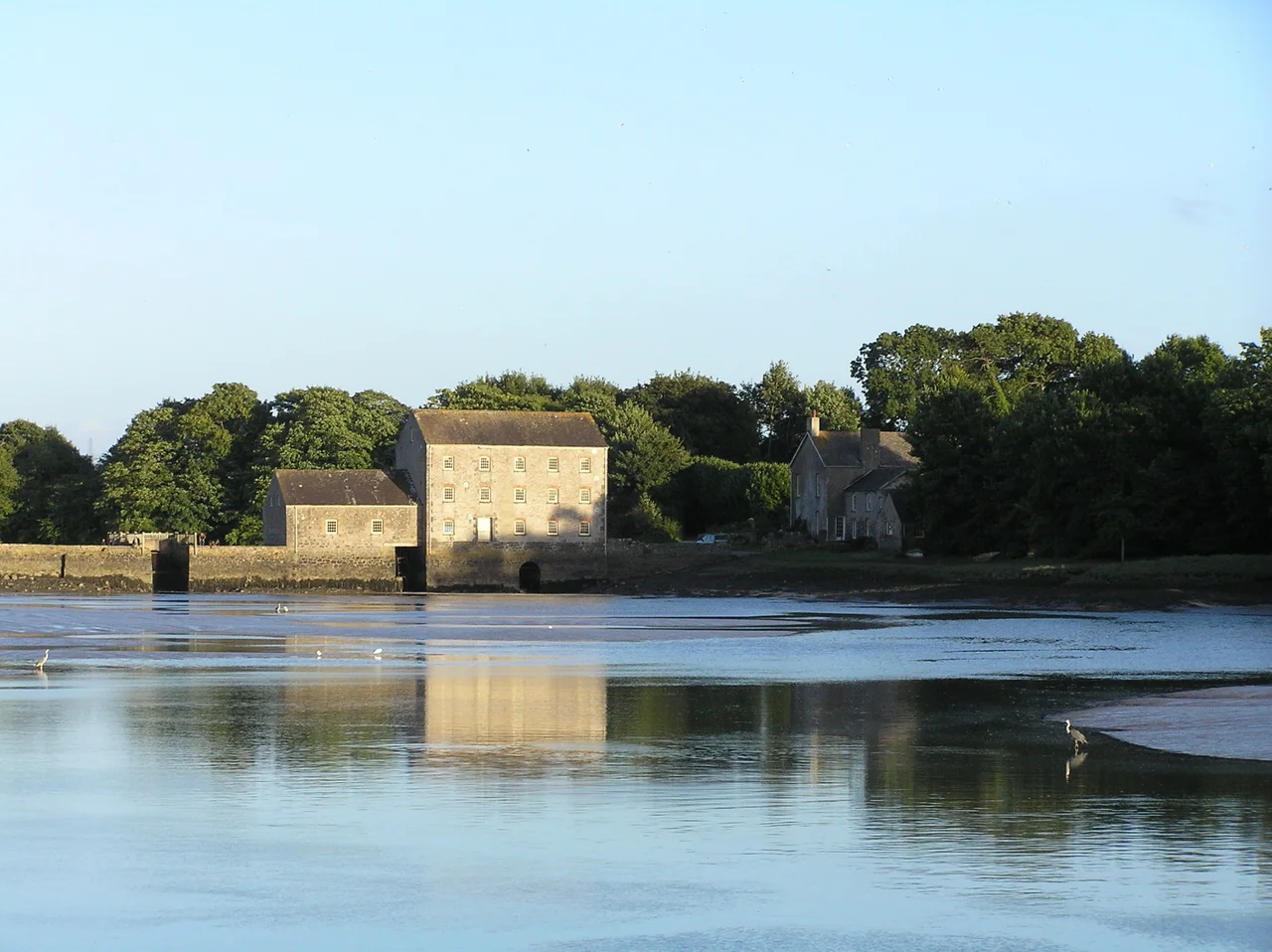

Carew Tidal Mill
The miller at Carew did not work mornings. He worked tides. The sea filled his pond at high water; the sea drained it through his wheels as the tide ebbed; and whether that drainage happened at dawn, midnight, or three in the afternoon decided when the millstones turned. A second tide followed twelve and a half hours later, and he had to be ready for that one too. The mill is a three-storey stone building on a causeway across the Carew inlet, with two great undershot water wheels and six pairs of millstones above. It is the only restored tidal mill in Wales. The tide still comes in; the gates still close at high water; the mill, when its keepers wish it, can still grind.
How It Works
The system depends entirely on the difference between high tide and low. As the tide rises, floodgates in the centre of the 150-meter causeway dam open, and seawater flows into the mill pond - an enclosed sheet of water about eleven hectares in area. At high water, the gates close, trapping the water. As the open sea begins to fall away, the trapped pond stands at high level while the sea outside drops. Once the difference is large enough, the miller opens sluice gates beneath the building, and the pond drains through them, driving two undershot water wheels - one 1.65 meters wide, the other 2.10 meters wide, both 4.8 meters across. Each wheel powers three pairs of millstones on the floor above. The pond empties; the miller closes everything down; he waits for the next tide. There is no shortcut around the moon.
Ministers and French Stones
There has been a mill here since at least 1541. The Ministers' Accounts prepared for Henry VIII record 'two mills under one roof called le french mills' - the name probably derived from the imported French burr stone used for the millstones, the hardest and finest grinding stone available in the period. John Bartlett took a lease in 1558 for ten sovereigns a year. The mill burned in the 18th century and was restored in 1792. The present building dates from around 1801, with one of the water wheels carrying the date - probably erected during the Napoleonic Wars, when British ports were rerouting grain shipments and demand for flour was rising. The causeway dam itself goes back to at least 1615, when Sir John Carew is recorded as having repaired its walls and floodgates.
The Working Building
Inside the three-storey building, the milling process is choreographed across the floors. Grain arrived by cart or by sailing vessel at the quay. A sack hoist lifted it to the attic - the garner floor - from where it poured down to a winnower on the stone floor below, which removed the chaff. The cleaned grain was hoisted back up to the attic, then dropped into large bins on the bin floor, then released through chutes down to the millstones, where it was ground. The meal was hoisted again, dropped through a flour dresser, which separated the white flour from the bran. Finished flour went out by sailing vessel. The miller's house adjoined the building, because the work hours followed the tides and waiting at home was not practical. By the late 19th century, steam-powered roller mills in the port towns were grinding cheap imported corn into flour faster and cheaper than any tidal mill could compete with. Carew began grinding bones for fertilizer and animal feed.
Saved Twice
The mill stopped working in 1937. After that, tie bars were installed on the south wall to stop the building from collapsing outward, but the structure continued to deteriorate. It was given Grade II* listing in September 1971. Restoration funded by the Historic Buildings Council of Wales, Pembrokeshire County Council, and the Pembroke Rural District Council was completed in 1972 and won the Times Conservation Award. In 1983 the mill was leased to the Pembrokeshire Coast National Park Authority, which spent further years and around £100,000 on underpinning, new windows, a reception area, and an audiovisual room. By 1998 the south wheel and machinery were operational again. Today the mill houses a museum and demonstrates milling on the rising of certain tides - the only place in Wales where you can see the sea turn a wheel that turns a millstone that grinds flour, on a schedule set by the moon and kept by the same building for two centuries.
From the Air
Carew Tidal Mill stands at 51.70°N, 4.84°W on a 150-meter causeway across the Carew inlet, an arm of Milford Haven. From the air, the mill pond is unmistakable - a sheet of water about 11 hectares, enclosed by the causeway dam, with the three-storey mill at its south end and Carew Castle 300 meters to the east. The whole tidal system is best observed from 2,000-3,500 ft, ideally near low tide when the mud flats around the pond contrast against the still water. Nearest airports: Haverfordwest (EGFE) about 8 nm northwest, Pembrey (EGFP) about 15 nm east, Swansea (EGFH) about 30 nm east-northeast.
Nearby Stories
- St Andrew's Church, Bayvil 1.6 km away
- Skomer 3.7 km away
- National Botanic Garden of Wales 9 km away
- HMS H47 13 km away
- Mumbles Lifeboat Disaster 32 km away
- Strata Florida Abbey 38 km away
- Lighthouses on Lundy 38 km away
- Tehidy Country Park 140 km away