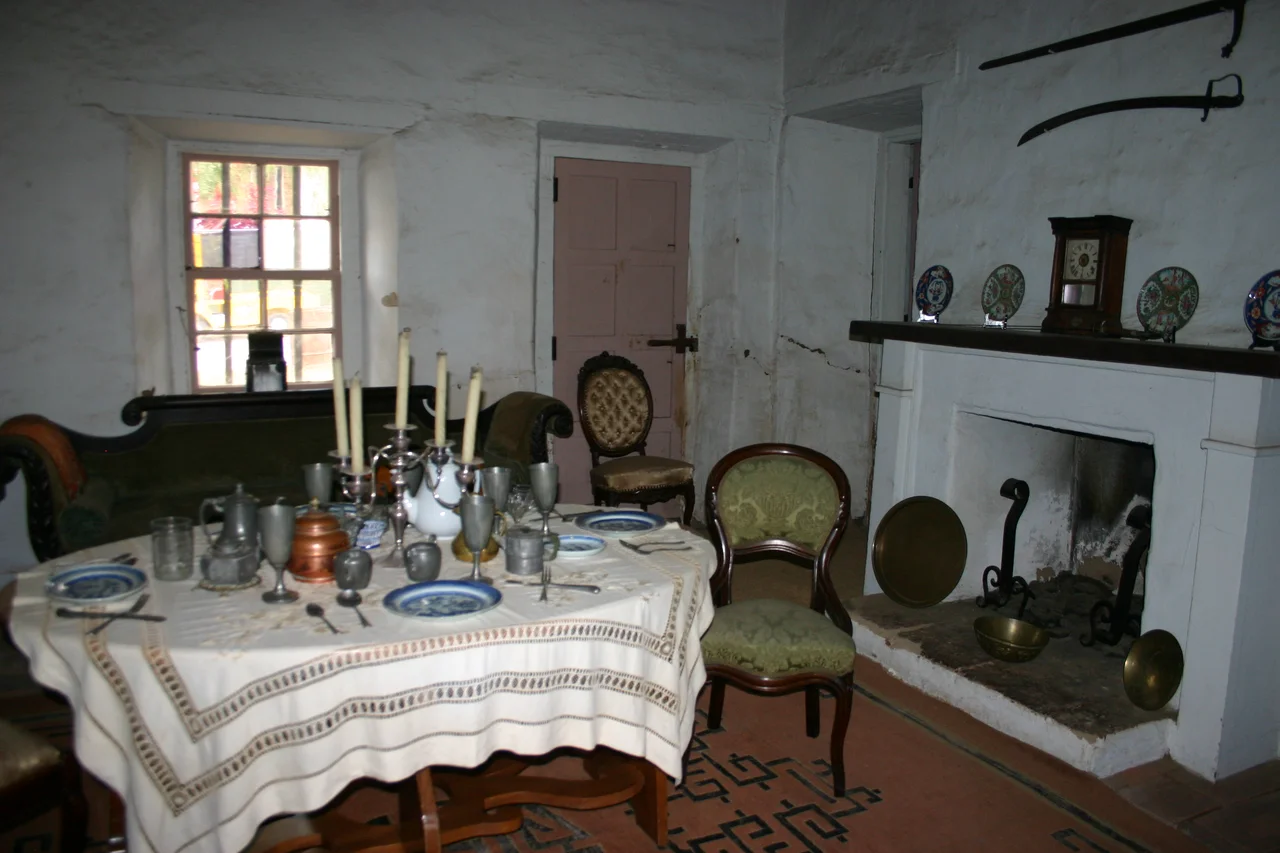

Casa de Estudillo
Built in 1827 by one of California's most prominent Spanish colonial families, the Casa de Estudillo in Old Town San Diego became both a landmark of Mexican California and, a century later, a tourist site reimagined as the setting for a fictional romance — a layering of real history and invented legend that defines the place to this day.
The Family and the House
José María Estudillo was a Spanish military officer and California presidio commander who became one of the most influential figures in early San Diego. In 1827, he and his son José Antonio began constructing a large adobe home on the plaza of the Pueblo de San Diego — the town that had grown up near the old mission site at the top of what is now Old Town.
The house that resulted was considered one of the finest residences in Mexican California. Adobe construction in this period produced thick-walled, cool-in-summer buildings that could be expanded over time. The Estudillo house grew to include multiple rooms arranged around a central courtyard — the classic Californio ranchero design that provided both family space and a defensible enclosure.
José Antonio Estudillo, the son, became a leading figure in the pueblo's civic life. The family hosted visitors, conducted business, and played a central role in the social world of early San Diego. The house on the plaza was at the center of that world.
Abandonment and Ruin
After the Mexican-American War, California's Spanish and Mexican-era elite faced an uncertain transition to American rule. Property disputes, legal challenges, and shifting economic conditions disrupted many of the old Californio families. The Estudillos left the Old Town house, and without maintenance, the adobe deteriorated over the following decades.
By the late nineteenth century, the Casa de Estudillo was a roofless ruin. The thick adobe walls still stood, but the interior had collapsed and the courtyard had been abandoned to weeds. San Diego was growing rapidly during this period, and Old Town was no longer the center of activity — the new city had developed around the harbor to the south.
Ramona's Marriage Place
What revived interest in the Casa de Estudillo was not history but fiction. Helen Hunt Jackson's 1884 novel Ramona — a romantic story set in old California that was enormously popular in the late nineteenth and early twentieth centuries — sparked a wave of nostalgia for Spanish colonial California.
John Spreckels, the San Diego businessman who invested heavily in the city's development, had the ruins of the Casa de Estudillo reconstructed in the early twentieth century. But rather than market it straightforwardly as a historic site, promoters connected the reconstructed house to the Ramona legend and called it 'Ramona's Marriage Place' — a manufactured connection to a fictional character. The story drew visitors who came to see the setting of a novel, not the history of the Estudillo family.
The conflation of real history with invented romance became part of the site's identity for decades.
A National Historic Landmark in Old Town
Today the Casa de Estudillo is part of Old Town San Diego State Historic Park, a preserved district of the original pueblo that draws visitors to its historic buildings, museums, restaurants, and demonstrations of early California life. The casa is designated a National Historic Landmark, recognizing its significance as a surviving example of Spanish-Mexican adobe architecture in California.
The reconstruction of the early twentieth century has been refined over subsequent decades, with efforts to better reflect what the original building looked like and to tell the actual story of the Estudillo family alongside the Ramona mythology.
The house on the plaza remains a place where the layers of California's history are visible all at once: the Spanish colonial foundation, the Mexican California period, the American conquest, the romantic reimagination of all three, and now the interpretive work of figuring out what actually happened and why it matters.
From the Air
Casa de Estudillo is located in Old Town San Diego State Historic Park, approximately 4 miles north of KSAN (San Diego International Airport). Old Town sits at the foot of Presidio Hill, where San Diego's original Spanish settlement was established. Flying north from the airport along Mission Bay, the hillside of the Presidio and the Old Town neighborhood below it are visible on the right side of the corridor.
Nearby Stories
- Laguna Fire 0.9 km away
- San Diego Botanic Garden 3.3 km away
- Santa Ysabel Asistencia 10 km away
- Valle de Las Palmas 19 km away
- Tijuana: The Border City That Became Its Own Third Country 20 km away
- Laguna Art Museum 55 km away
- San Clemente Island 69 km away
- USS Higbee 206 km away