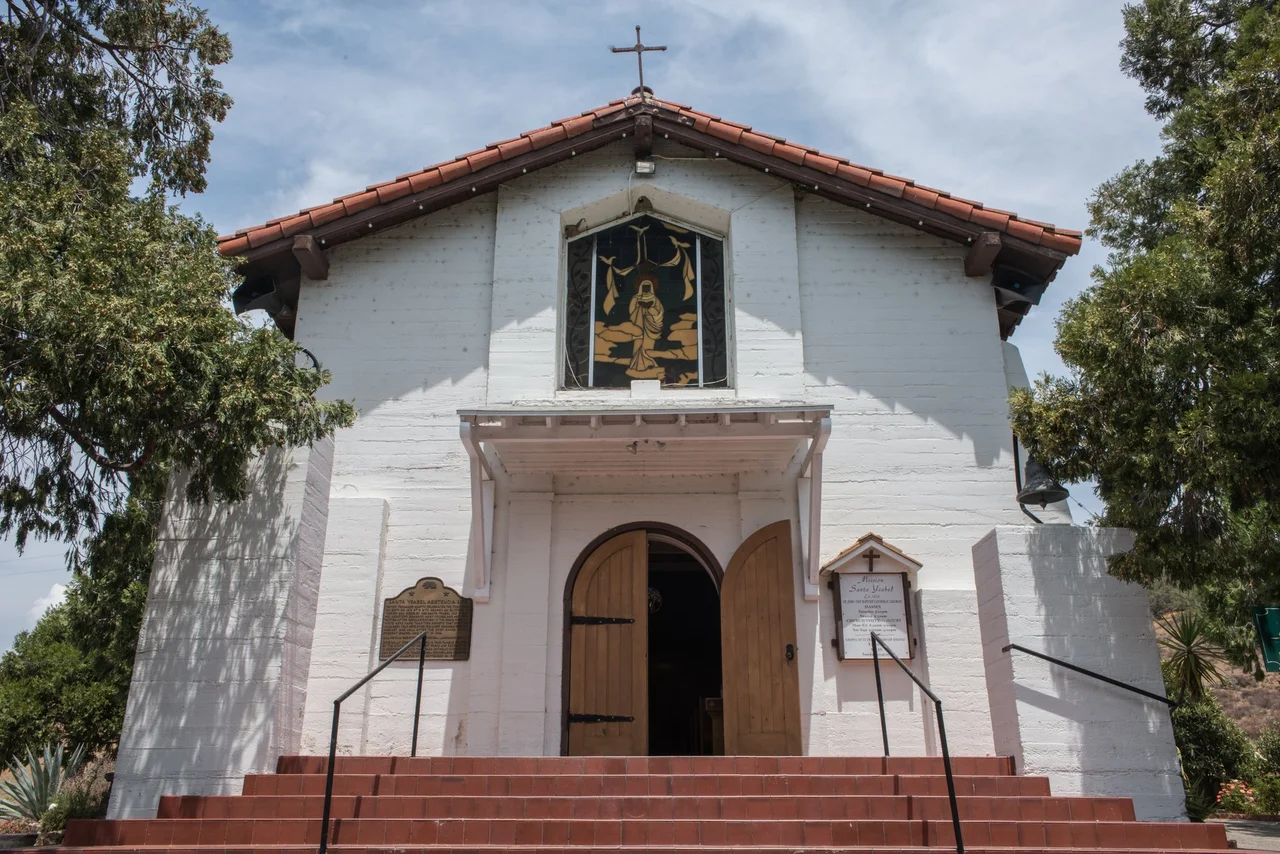

Santa Ysabel Asistencia
Two bronze bells hang in the chapel at Santa Ysabel today, but they are not the original bells. The originals — cast in 1723 and 1767, among the oldest in California — were stolen in the summer of 1926. They have never been recovered. The theft stripped the asistencia of its most tangible connection to the colonial period that created it, leaving the small white chapel in the mountains east of Julian as a beautiful but incomplete artifact of a history that was never simple. Founded September 20, 1818, as a satellite of Mission San Diego de Alcalá, the Santa Ysabel Asistencia served hundreds of Luiseño and Diegueño neophytes and witnessed events that would not be forgotten.
The Purpose of an Asistencia
An asistencia was a mission sub-station — smaller than a full mission, without a resident priest, but providing religious services, agricultural instruction, and administrative oversight to indigenous people in areas too distant from the main missions for regular contact. At its height, the Santa Ysabel Asistencia served approximately 450 Luiseño and Diegueño neophytes, indigenous people who had been brought into the Spanish mission system through processes that combined religious conversion with coercive labor requirements and geographic displacement from their traditional territories. The asistencia provided them with a religious community while also integrating them into the colonial agricultural economy. The mountain setting, cooler and better-watered than the coastal zones, supported different crops and provided access to inland communities the main mission could not easily reach.
Famous Visitors Before the Battle
In November 1846, General Stephen Kearny and his Army of the West camped at Santa Ysabel on their march westward through California. Kearny was heading toward San Diego as part of the American effort to secure California during the Mexican-American War. Less than three weeks after leaving the asistencia, on December 6, 1846, his forces would engage Californio lancers at the Battle of San Pasqual in one of the bloodiest engagements of the war in California — a battle that Kearny's side lost in terms of casualties, though it ultimately continued toward its strategic objectives. The campsite at Santa Ysabel was the last moment of relative calm before that engagement. In 1847, the asistencia received another remarkable visitor: Jean Baptiste Charbonneau, the son of Sacagawea and Toussaint Charbonneau, who had been carried across the continent as an infant on the Lewis and Clark Expedition and was now, as a young adult, working in California.
The Lost Bells
The two bells that were stolen in the summer of 1926 were not ordinary colonial bells. Cast in 1723 and 1767, they predated the founding of the asistencia itself — the 1723 bell was nearly a century old when the mission sub-station was established. Their age made them particularly valuable, both historically and monetarily, which likely motivated their theft. Despite investigations at the time and occasional subsequent inquiries, the bells have never been found. The replacement bells that hang in the chapel today serve their function — calling the faithful to worship — but the originals, if they survive anywhere, represent an irreplaceable connection to California's earliest colonial history. Their absence is a quiet persistent reminder that preservation is never guaranteed.
The 1924 Chapel
The current chapel at Santa Ysabel was built in 1924, replacing earlier structures that had deteriorated over the decades since the mission period. The white adobe-style building sits in a landscape that has changed considerably since 1818 — the town of Santa Ysabel has grown up around it, and modern roads have replaced the horse trails that connected the asistencia to Mission San Diego. Yet the site retains something of its original character: a small chapel in a mountain valley, surrounded by oak trees, at the edge of the territory where the coastal California world meets the desert interior. The nearby Iipay Nation of Santa Ysabel maintains its own connection to this landscape, one that predates the asistencia and all its history.
From the Air
The Santa Ysabel Asistencia sits at approximately 33.130°N, 116.678°W in the Santa Ysabel Valley of San Diego County, about 5 miles northwest of Julian at around 3,400 feet elevation. From altitude, the valley is visible as a pastoral bowl between mountain ridges, with the white chapel identifiable among the clustered buildings of the small community. Ramona Airport (KRNM) is approximately 25 miles southwest; Palomar Airport (KCRQ) is about 40 miles west. Mountain terrain requires weather awareness; winter fog can fill the valleys while peaks remain clear.
Nearby Stories
- Escondido Public Library 1.8 km away
- American Airlines Flight 6-103 5 km away
- 700,000 People Looking Up 6.7 km away
- The International Banana Museum 14 km away
- Santa Rosa Mountains 18 km away
- Fish Creek Mountains Wilderness 18 km away
- California State Prison, Centinela 22 km away
- Tenaja Fire 24 km away