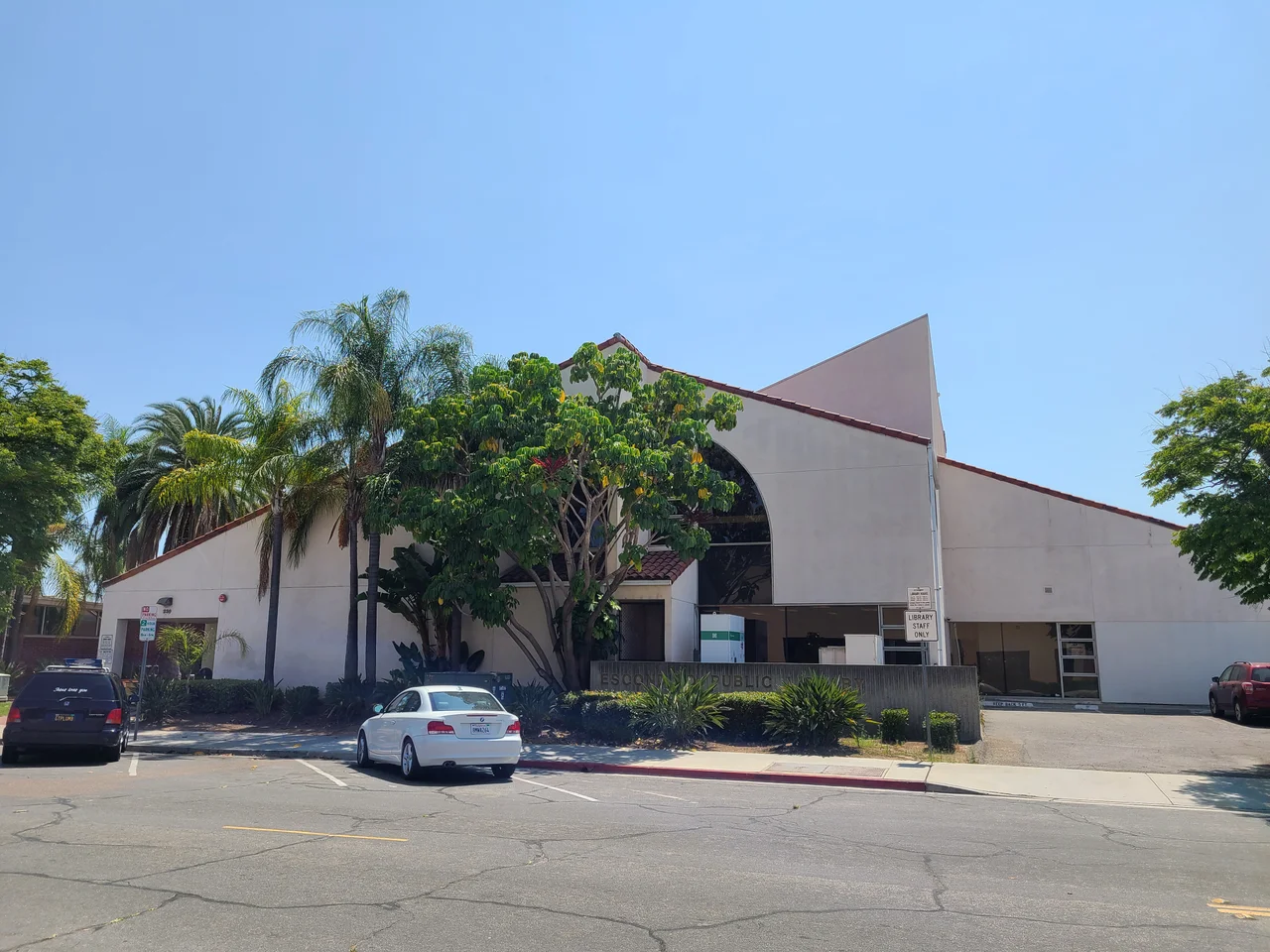

Escondido Public Library
The Escondido Public Library was founded in February 1891 — three years after the city incorporated — from books donated by the Escondido Dramatic Club, an organization whose members had decided that a theater group should also be a library. The initial collection was small, the space improvised. By 1894, a proper building stood on donated land. By 1910, Andrew Carnegie's foundation had funded a replacement. By 1980, the current 40,000-square-foot building on Kalmia Street had opened. By 2017, a divided city council had voted four to one to outsource the library's operations to Library Systems and Services, a Maryland-based company that contracts to run public libraries for municipalities seeking to reduce costs. The library that began with theater club books has outlasted several of its own definitions of what a public library should be.
The Carnegie Building
Andrew Carnegie funded more than 2,500 library buildings between 1883 and 1929, most of them in the United States. The Carnegie library in Escondido, which opened in 1910, followed the standard program: a donation contingent on the city providing a suitable site and committing to fund operations. Carnegie's model was based on the belief that a well-designed building in a prominent location would elevate the library's standing in the community and encourage use. The Escondido Carnegie library served the city for decades before the population growth of the postwar era required a larger facility. When the current building opened in December 1980 on Kalmia Street, the Carnegie building's role diminished; it was eventually repurposed for other city uses. The new building's 40,000 square feet reflected a city that had grown from a small agricultural town into the second-largest city in San Diego County.
The Pioneer Room
The Pioneer Room, which opened within the library in 1996, was designed to serve local history and genealogy researchers — the segment of library users most dependent on primary sources that circulating collections cannot provide. The room holds Escondido and San Diego County historical records, photographs, newspapers, and genealogical materials that document the valley's history from Spanish land grants through the agricultural era and into the suburban present. Materials related to the Luiseño and other Indigenous peoples of the region are part of the collection, though the depth of that documentation reflects the historical biases of who was doing the documenting. The Pioneer Room represents a library function that digitization has not eliminated: physical primary sources, in a space designed for sustained research, staffed by people who know where things are.
The Outsourcing Vote
In 2017, the Escondido City Council voted four to one to contract the library's operations to Library Systems and Services, known as LS&S, a Maryland-based company that manages public library systems for municipalities across the United States. The contract model promised cost savings through centralized management and purchasing. Critics argued that public libraries are civic institutions whose value cannot be fully captured in a management efficiency calculation — that the library's relationship to the community it serves depends on staff who are part of that community, rather than employees of a corporation whose primary obligation is to a management contract. The vote was contentious. The library continued to operate. What changed, and what did not, in the transition from public to contracted management is the kind of question that library communities in several cities were asking simultaneously in the 2010s, as the LS&S model spread.
From the Air
The Escondido Public Library is located at approximately 33.1208°N, 117.079°W in downtown Escondido. The building is part of the civic core of the city, near City Hall. Recommended viewing altitude 3,000–5,000 ft AGL. Nearby airports: KSEE (Gillespie Field, ~10 nm southwest), KOKB (Oceanside Municipal, ~12 nm northwest). Escondido's downtown core is visible from altitude as a denser grid within the surrounding suburban development.
Nearby Stories
- Where Hollywood Came Home to Make Theater 0.5 km away
- Viejas Band of Kumeyaay Indians 3.4 km away
- Santa Ysabel Asistencia 3.8 km away
- Cahuilla Band of Indians 14 km away
- Tenaja Fire 15 km away
- Laguna Art Museum 16 km away
- Balboa Island Ferry 54 km away
- USS Agerholm 165 km away