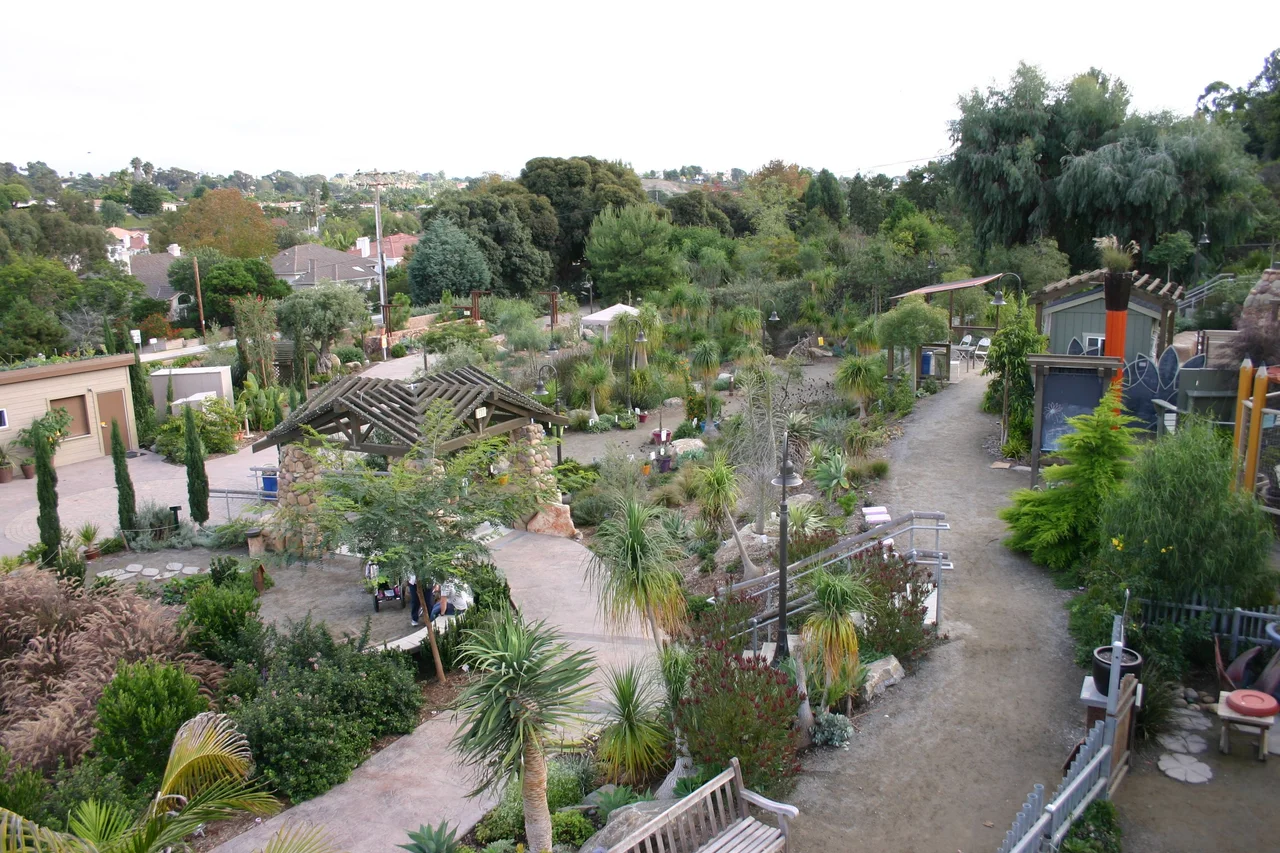

San Diego Botanic Garden
Ruth Baird Larabee spent decades cultivating her property in Encinitas. When she died in 1957, she left it to San Diego County — the house, the grounds, and the beginning of what would eventually become the San Diego Botanic Garden. The county received a private estate and, over the following decades, transformed it into one of the most ecologically diverse botanical collections on the Pacific coast: 37 acres, more than 5,000 plant species and varieties, 15 regional gardens, 12 demonstration gardens, and a bamboo collection that holds no rival among public gardens in North America.
From Estate to Public Garden
The Quail Botanical Gardens Foundation was established in 1961, four years after Larabee's donation. In March 1970, the garden opened to the public under the name Quail Botanic Gardens — a name that stuck for nearly four decades. The 'Quail' identity became embedded in the garden's culture and in the memories of generations of Encinitas residents and San Diego County schoolchildren who visited on field trips.
In 2009, the name changed to San Diego Botanic Garden, a decision that reflected the institution's ambitions beyond its North County neighborhood. The new name positioned it within a broader regional and national context — a botanical garden for San Diego, not just for the Encinitas community where it happens to sit. The quails remain in the landscape, but the institutional identity had grown larger than them.
The Collection
The garden's 15 regional gardens represent different ecosystems and horticultural traditions from around the world. Southern California's Mediterranean climate allows the garden to grow an unusual range of plants that could not survive in more extreme climates elsewhere in the country. Australian shrubs, South African proteas, cacti, succulents, fuchsias, hibiscus, brugmansias, and palms coexist in a landscape that treats the coastal California climate as both subject and medium.
The bamboo collection is the garden's most statistically distinctive feature — the largest public collection in North America, a dense grove that surprises visitors accustomed to thinking of bamboo as an Asian plant rather than a Southern California landmark. The cork oak forest is equally unexpected: paths wind through a cluster of mature Quercus suber, their bark harvested elsewhere in the world for wine corks and leather goods, here simply left to grow old and twisted in the coastal sunlight.
The Corpse Flower and Other Spectacles
In July 2023, the garden's corpse flower bloomed for the first time in two years. The spectacle required advance reservations — the flower is only in bloom for a few days — and drew visitors willing to queue for the experience of encountering Amorphophallus titanum in its brief, olfactorily memorable flowering. The smell, which has been compared to rotting flesh, is the flower's pollination strategy: it mimics the scent of decay to attract carrion beetles and flies. The plant stands around four feet tall and is classified as endangered.
Botanic gardens across the United States maintain corpse flowers as part of conservation programs for the species, which is native to the rainforests of Sumatra and has become an unlikely draw for institutions that can maintain the demanding growing conditions the plant requires. At San Diego Botanic Garden, the corpse flower has become one of those events — unpredictable, brief, entirely unmistakable — that remind visitors that botanical gardens are living systems, not static collections.
Children's Garden and Community Programs
The Hamilton Children's Garden is a dedicated space within the larger garden designed for younger visitors, with interactive elements calibrated to the curiosity of children in early elementary grades. The garden regularly provides visiting third-grade school groups with local history tours aligned to California's state-mandated curriculum — a practical integration of the botanical collection with educational requirements that brings thousands of children to the site each year.
The institution is a nonprofit, primarily volunteer-staffed, supported by membership contributions and community donations. Annual events include an old-fashioned community barbecue that preserves the garden's neighborhood character even as its national reputation grows. Ruth Baird Larabee donated an estate. What Encinitas built from it, slowly and collaboratively, is a place where the full ecological range of the Pacific world can be encountered in one afternoon.
From the Air
San Diego Botanic Garden sits at 33.05°N, 117.28°W in Encinitas, in the hills east of Interstate 5. The garden's 37 acres are visible from altitude as a dense green area contrasting with the surrounding development. Encinitas's distinctive coastal geography — lagoons, coastal bluffs, the urban grid — is visible to the west. McClellan-Palomar Airport (CLD) is approximately 8 miles to the north. Best viewed at 3,000-5,000 feet AGL in morning light.
Nearby Stories
- Where Hollywood Came Home to Make Theater 0.5 km away
- Viejas Band of Kumeyaay Indians 3.4 km away
- Santa Ysabel Asistencia 3.8 km away
- Cahuilla Band of Indians 14 km away
- Tenaja Fire 15 km away
- Laguna Art Museum 16 km away
- Balboa Island Ferry 54 km away
- USS Agerholm 165 km away