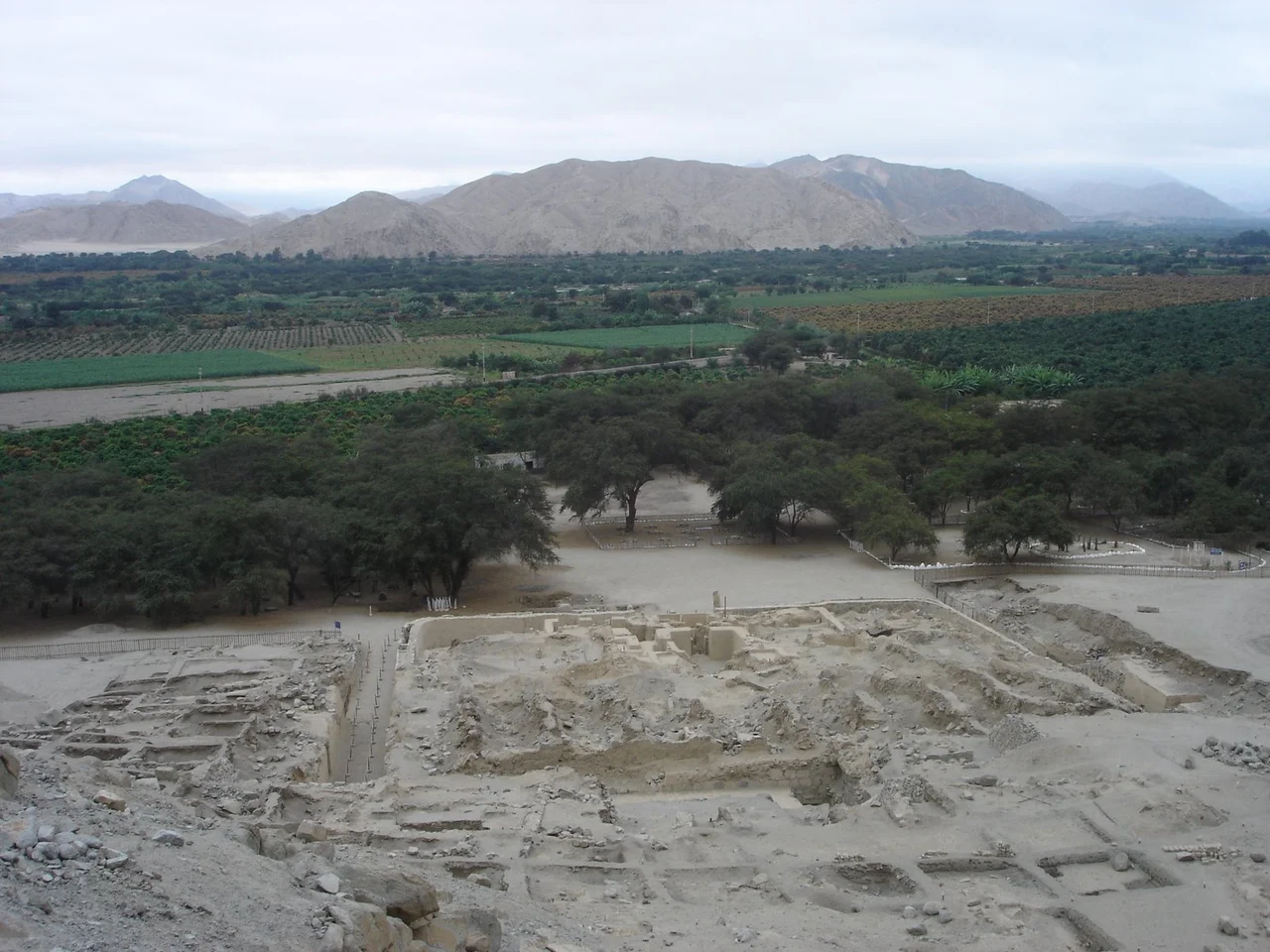

Casma–Sechin culture
A frieze carved into stone in the Sechin River valley of Peru has been radiocarbon dated to 3600 BCE. That makes it the oldest known example of monumental architecture anywhere in the Americas, possibly older than the Caral civilization 130 kilometers to the south. The frieze belongs to the Casma-Sechin culture, a sequence of related coastal settlements that built pyramids, plazas, fortresses, and one of the world's earliest solar observatories along the Peruvian Pacific coast for some 3,400 years before being abandoned. Most people have never heard of these places. They predate the Inca by millennia.
An Oasis in One of Earth's Driest Deserts
The Peruvian Pacific coast is one of the driest deserts in the world, with average annual precipitation under 10 millimeters. Outside the river valleys, almost nothing grows. But 57 small rivers flow from the Andes through the desert to the sea, each one creating a linear oasis where irrigated agriculture becomes possible. The Casma River and its tributary the Sechin form one such oasis. The culture that grew here extended about 40 kilometers inland from the Pacific. The earliest radiocarbon date for human occupation is 7600 BCE, found at Cerro Sechin, putting people in this valley nearly ten thousand years ago. By 3000 BCE, sizable populations were undertaking large construction projects. By 1600 BCE, the Sechin Alto pyramid would become the largest construction in the Americas of its era.
The First Buildings
Sechin Bajo holds the earliest monumental architecture yet found in the Americas. The First Building, as archaeologists call it, was constructed between roughly 3700 and 2900 BCE, with multiple reconstructions during that span. A plaza at the same site dates to 3500 BCE, and the famous frieze nearby dates to 3600 BCE. These are not modest constructions. They imply a settled population, a labor force, and someone organizing both. Pottery did not yet exist. The earliest Peruvian civilization differed from the other five pristine civilizations of the world in this respect: it built monuments before it made pots. Some archaeologists have proposed a maritime hypothesis, arguing that the rich Pacific fisheries enabled coastal sedentary societies to flourish before agriculture took hold. The evidence at Casma-Sechin supports a mixed economy from very early, with coastal sites like Huaynuna and Las Haldas catching fish and inland sites slowly building up agricultural systems.
Sechin Alto and the Concentration of Power
During the Initial Period, between 1800 and 900 BCE, the Casma-Sechin culture reached its greatest extent. Within five kilometers in the Sechin Valley stood four large ruins: Sechin Bajo, Taukachi-Konkan, Cerro Sechin, and Sechin Alto. Sechin Alto was dominant, a flat-topped pyramid 300 meters long and wide and 35 meters tall. When it was built between roughly 1600 and 1400 BCE, it was the largest construction anywhere in the Americas. The size and concentration of monuments in this small stretch of valley has led archaeologists to suggest that Sechin Alto served as the administrative center of a polity that united the river valleys and possibly the coastal sites under one government. Notably, Sechin Alto sits on scarce irrigable land, while the other major sites cling to the desert at the edge of the agricultural zone. The choice was deliberate. It was conspicuous consumption of the most basic Andean resource, water.
The Thirteen Towers of Chankillo
Around 350 BCE, in the Early Horizon, the people of the Casma valley built something extraordinary at Chankillo: a fortress, a ceremonial complex, and the oldest known solar observatory in the Americas. The observatory consists of a row of thirteen stone towers running along a low ridge. From two designated viewing points, an observer could watch the sun rise or set against the towers and determine the precise date of the year, with accuracy of a day or two. This is, in effect, a solar calendar built from masonry. The towers track the full annual movement of sunrise and sunset between the solstices. Chankillo predates the Mayan calendar systems by centuries. It implies a civilization sophisticated enough to design, build, and use a precise astronomical instrument before any Andean culture had what we would call writing. UNESCO inscribed Chankillo as a World Heritage Site in 2021, recognizing its global significance.
Invasion, Decline, and What Remains
Around the end of the Initial Period, the character of Casma-Sechin sites changed in ways that suggest a hostile invasion or at least a major cultural shift. Maize and domestic animals like llamas, alpacas, and guinea pigs were introduced. Dependence on marine resources for protein declined. Military themes appeared more prominently in the architecture. The new influences appear to have come from the highland Chavin culture inland to the east. The large mounds of the Initial Period stopped being built. Around 100 BCE, Chankillo and other Casma-Sechin structures were partially destroyed and abandoned in apparent conflict, and the long architectural tradition of the valleys came to an end. What remains today is a series of striking ruins scattered across two narrow river valleys, a 5,600-year-old frieze, and a row of thirteen stone towers that still mark the seasons just as they did when the sun first lined up between them more than two thousand years ago.
From the Air
Located at 9.46 degrees south, 78.27 degrees west, in the Casma and Sechin river valleys near the Pacific coast of Peru's Ancash Region. Sites are scattered across about 40 kilometers inland from the sea. The nearest commercial airports include Trujillo's Capitan FAP Carlos Martinez de Pinillos International (TRU) to the north and Lima Jorge Chavez International (LIM) to the south. The major sites are visible from cruising altitude as distinct rectangular formations along the linear oases of the Casma and Sechin valleys cutting through the surrounding desert.
Nearby Stories
- Las Haldas 9.2 km away
- Huaraz 23 km away
- Cordillera Negra 35 km away
- Huacrachuco 84 km away
- La Unión, Huánuco 99 km away
- Piura 485 km away
- Easter Island: The Mystery of Rise and Collapse 3749 km away