.jpg)
Cèilidh
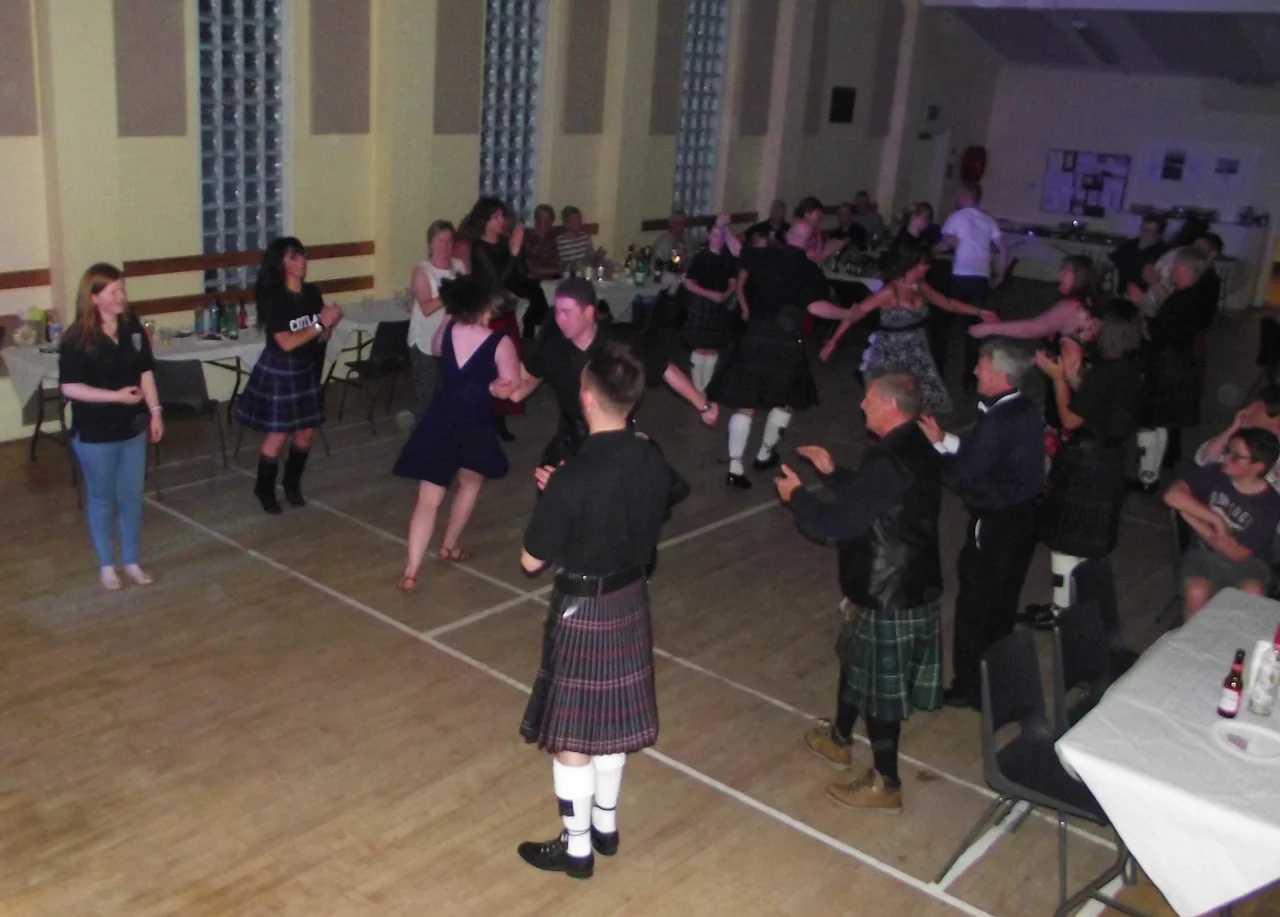
The word started small. In Old Irish, céle meant 'companion,' the kind of friend who stops by your house in the evening because there is nowhere else to be and no reason to leave. From that root came céilidh and céilí—a visit, a calling-in, a sitting together. Then, somewhere across the centuries, the fiddles arrived. And the tin whistles. And the bodhrán's heartbeat thump. And the meaning shifted. In the Gaelic-speaking corners of Ireland and Scotland, a cèilidh is now what happens when a kitchen, a pub, or a hall fills with people who would rather dance than talk—though they will do both, loudly, until the small hours.
The Man of the House
Before there was a stage, there was a chair by the fire. The fear-an-tigh—the 'man of the house,' or in modern Scottish Gaelic fear-an-taighe—presided over the older form of cèilidh, in which neighbours arrived without much warning and entertained one another with whatever they had: a song from the youngest cousin, a fragment of a story half-remembered from a grandfather, a poem recited from the bench by the window. Women hosted too, as bean-an-taighe, and the gathering followed the rhythms of rural life rather than any printed programme. The dancing was a guest, not a host. When English took over the social vocabulary, the fear-an-tigh became a 'master of ceremonies' and the visit became a venue—but in much of Hebridean Scotland and Gaelic Ireland, the older words still hold.
The Revival
By the late nineteenth century, Ireland had spent more than 800 years inside the British Empire's gravitational pull, and a generation of nationalists decided that cultural survival required deliberate work. The Gaelic League, founded in 1893, set up branches across the country offering classes in the Irish language, in singing, and in dance. The céilí was reinvented as cultural infrastructure—a place where the language could be heard, the music heard live, and the body taught movements that no English schoolmaster had ever choreographed. The first organised céilí band, according to tradition, was put together in 1926 by Séamus Clandillon, Radio Éireann's first director of music, who needed dance music for studio broadcasts. The radio carried the céilí into kitchens that had never hosted one.
The Shape of a Set
Walk into a céilí in Tipperary or a cèilidh in Inverness and you will see geometry made human. Four to eight couples form a square or a rectangle. Each pair faces another; partners advance, retreat, exchange. The Walls of Limerick, the Siege of Ennis, the Stack of Barley, the Haymaker's Jig—the dances carry names borrowed from regiments, battles, and the threshing-floor. About half the dances in the modern Scots cèilidh are couples' dances in a ring, often danced in 'progressive' style, with the lady moving to the next gentleman at the end of each repetition until everyone has danced with everyone else. The dance caller, when there is one, is not the booming auctioneer of American square dance but a teacher leaning in, calling reminders just before each figure: side step now, swing your partner, gents in the centre.
The Music That Will Not Sit Down
Fiddle, flute, tin whistle, accordion, bodhrán. Hammered dulcimer in some traditions, Scottish smallpipes in others, mandolin and bouzouki where folk revival took deeper root. The music is jigs and reels and hornpipes, polkas and slip-jigs and waltzes; Scotland adds strathspeys, with their distinctive 'snap' rhythm; England, the northeastern rant. A céilí band ranges from two players to six, and the tunes are short enough that a beginner can ride one out without disgracing herself. Step dancing—the form Riverdance carried into a global audience in 1994—is reserved for show, performed by the most talented. The set dances belong to everyone. That is the point.
Where Tradition Travels
When the Irish and Scots emigrated in the millions, the cèilidh emigrated with them. Nova Scotia—Nova Scotia in name and Gaelic Scotland in temperament—still holds cèilidhean in small communities across the Maritimes. In Cape Breton, the fiddle tradition runs through families that left the Highlands in the early nineteenth century and never lost the tunes. In Canada, the United States, Australia, and New Zealand, traditional music competitions are now frequently won by the descendants of emigrants whose grandparents danced these same steps. In Glasgow, the University Union ends its annual debating competition with a cèilidh; in Edinburgh, the Highland Annual is the oldest in the city. The visit, the kitchen, the chair by the fire became a hall, a stage, a national identity—but the word still means companion.
From the Air
The cèilidh tradition is centred on roughly 53.00°N, 8.00°W in the Irish midlands, with deep roots also across Scotland's Hebrides and Highlands. Cruise overhead at 6,000–10,000 feet and you are crossing the heartland where these dances were codified during the Gaelic Revival. Nearest Irish airports are Shannon (EINN) to the south-west and Galway (EICM) to the west. From altitude, look for the small market towns—Roscrea, Birr, Nenagh—whose pubs still host weekend céilithe.
Nearby Stories
- Portlaoise 6.6 km away
- Clonmacnoise 8.8 km away
- Thurles 8.9 km away
- Castletroy 11 km away
- St Canice's Cathedral 12 km away
- 2003 Derrybrien Landslide 16 km away
- Mountbellew 24 km away
- Mullingar 29 km away