.jpg)
Central Zambezian miombo woodlands
The name sounds like a technical term from a conservation atlas, and in one sense it is. But miombo is also the Bemba word for the Brachystegia tree - the flat-topped, slender-trunked species that defines this woodland - and the ecoregion it names covers more of southern-central Africa than any national park could ever contain. It stretches from the highlands of Angola across Katanga and the northern half of Zambia, pushes up into southern Burundi, and spills east through western Tanzania to the shores of Lake Malawi. If you have ever seen photographs of Gombe Stream, where Jane Goodall lived with chimpanzees for decades, you have seen miombo.
The Tree That Names a Biome
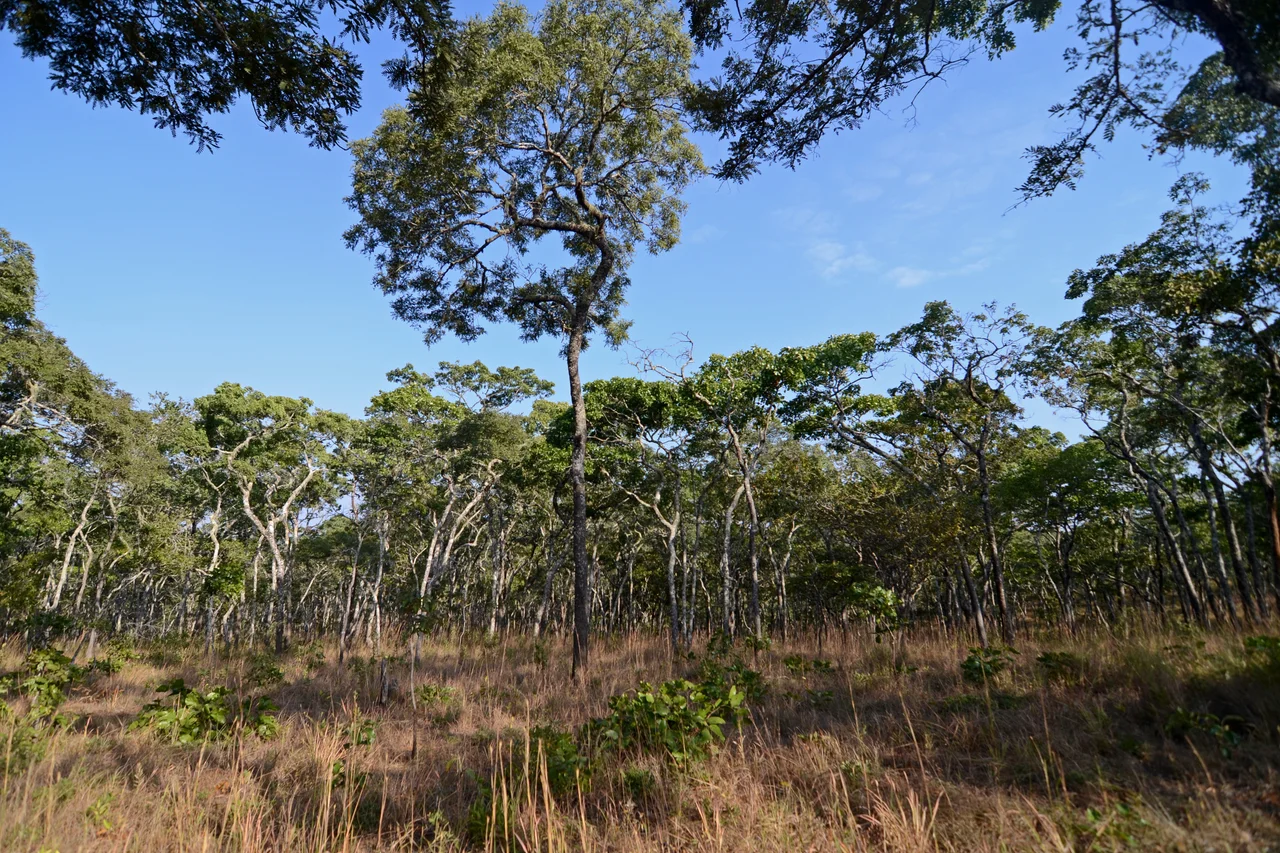
Miombo woodland is not jungle. It is open, high, and dry - a tropical woodland where the canopy is mostly Brachystegia, Julbernardia, and Isoberlinia trees, with taller individuals poking up to 20 meters and an understory of grasses, herbs, and shrubs. The soils are poor, leached by millions of years of warm rain. The plateau is mostly flat. For up to seven months of the year there is no rain at all, and then from November to March the sky opens and the land floods. The Central Zambezian variant, which sits on higher and slightly wetter ground than its drier siblings to the south, holds more evergreen trees than most miombo - a subtle shift that gives the canopy year-round cover even when the deciduous species have dropped their leaves.
Dambos and the Logic of Water
Scattered through the woodland are dambos - seasonal grassy wetlands that collect in shallow valleys and follow the river margins. Dambos can make up as much as 30 percent of the landscape in some districts, and they are where the ecosystem breathes. In the wet season they fill with standing water. In the dry season they hold moisture longer than the surrounding bush, drawing antelope, buffalo, and the predators that follow them. Zambian villagers have farmed the edges of dambos for centuries, planting maize and vegetables in the moist soil. The rhythm is ancient: wet months of growth, dry months of retreat, fire at the seams.
What Lives Here
The mammal list reads like a safari brochure and also, increasingly, like a list of animals under pressure. Cape buffalo, African elephants, black rhino - where any remain - and antelope species including eland, sable, roan, Lichtenstein's hartebeest, and the marsh-loving sitatunga. The carnivores are all present: lion, leopard, cheetah, spotted and striped hyena, African wild dog, side-striped jackal. Primates thrive in the wetter eastern margins, particularly yellow baboons and chimpanzees - Gombe Stream National Park, where Jane Goodall began her chimp research in 1960, sits at the eastern edge of this ecoregion. The list of species endemic only to these woodlands is surprisingly small for a region this large: Monard's dormouse, two shrew species, Rosevear's lemniscomys, the Lake Lufira weaver, the black-lored waxbill. Great diversity of wildlife, but relatively few species found nowhere else.
Fire, Smoke, and the Charcoal Problem
Miombo burns. It always has. Lightning strikes in the late dry season torch vast stretches of woodland every year, and the tree species here are adapted to it - thick bark, deep roots, the ability to coppice and resprout. What has changed is the scale and the timing. Human-set fires to clear land for farming or to make charcoal now burn hotter and earlier than natural fires, before the woody plants have had time to set seed. In the Copperbelt cities of northern Zambia - Ndola, Kitwe, Chingola - and in Katanga across the border in Congo, the woodland within a day's truck ride of any sizeable town has been largely cleared for charcoal production. The copper and cobalt mines add their own injuries: waterways run with tailings, the air smells of smelters, and the civil wars that have rolled across Congo have left their own scars on the forest.
What's Protected, and What Isn't
About 26.5 percent of the ecoregion lies inside some form of protected area - an unusually high share for a biome this size. The great names are here: Kafue and South Luangwa and North Luangwa in Zambia; Ruaha and Katavi and Mahale Mountains and Gombe Stream in Tanzania; Upemba and Kundelungu in the Democratic Republic of the Congo; Nyika and Kasungu and Nkhotakota in Malawi; Ruvubu and the Bururi Forest Reserve in Burundi. Upemba National Park, in Katanga, holds the largest concentration of endemic reptiles and amphibians - nineteen and thirteen species respectively, many of them found nowhere else on Earth. The protection is uneven. The parks on paper do not always translate to parks on the ground, and the pressure from bushmeat hunting, charcoal, and mining does not stop at the gate. But a quarter of the miombo still runs wild, and in a century when so many biomes have been reduced to fragments, that is not nothing.
From the Air
Coordinates 10.82°S, 27.71°E - the Katanga portion of the ecoregion, near the Zambia-DRC border. The miombo spans roughly 1.2 million square kilometers across six countries, so any flight from Johannesburg (FAOR/JNB) to Nairobi (HKJK/NBO) or from Luanda (FNLU/LAD) to Dar es Salaam (HTDA/DAR) will spend substantial time above it. Recommended viewing altitude FL300-FL400 reveals the mottled green woodland broken by dambo drainage lines and occasional large mining scars. The best visual contrast comes in the late dry season (September-October) when extensive fires leave dark burn scars visible for hundreds of miles. Wet-season flying December-April brings ITCZ convection and reduced slant visibility.
Nearby Stories
- Luishia Mine 12 km away
- Bunkeya 20 km away
- Kinsevere 32 km away
- Kamatanda 36 km away
- Dambo 115 km away
- Ntumbachushi Falls 139 km away
- Congo Pedicle 143 km away
- Luapula River 162 km away