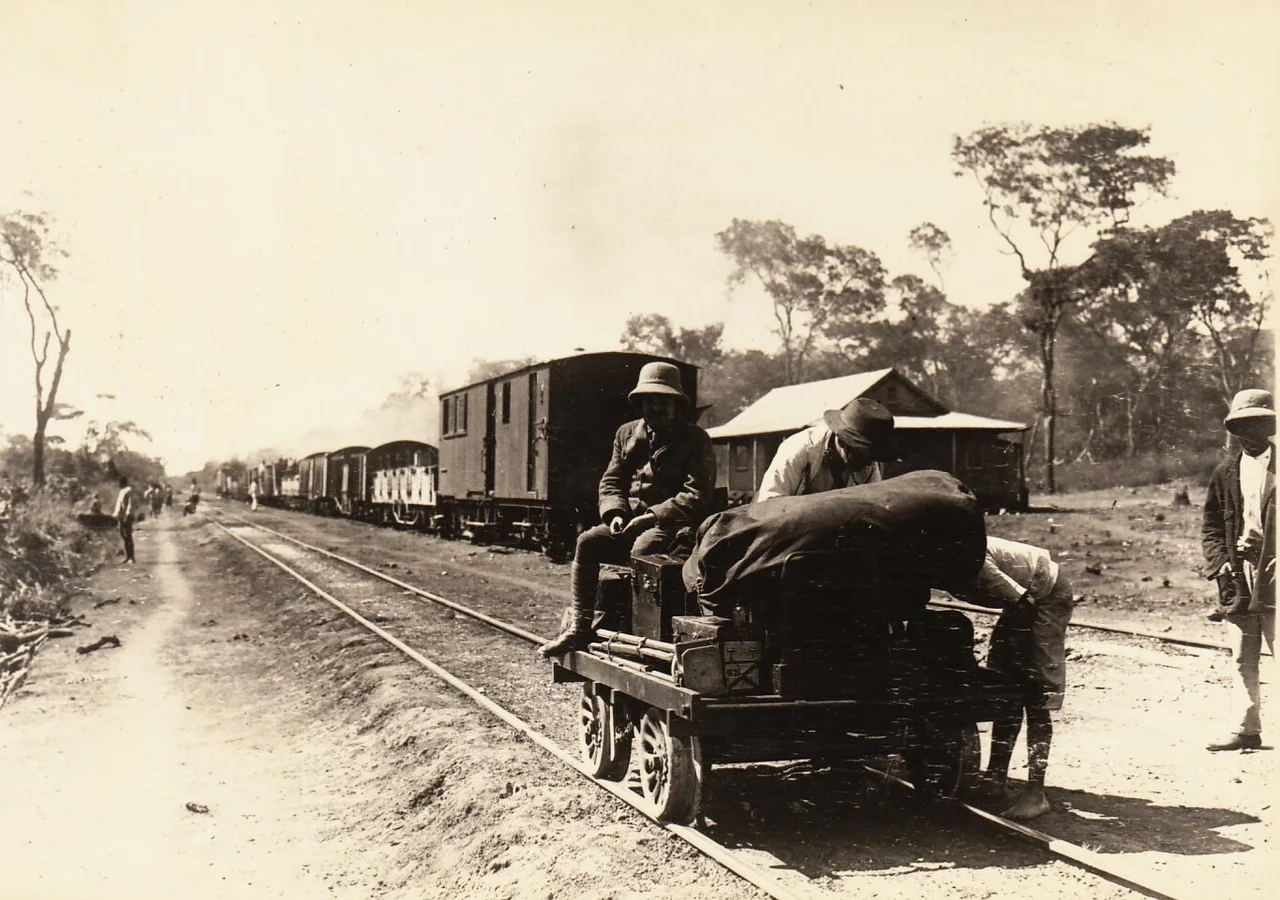

Kamatanda
A Bloomberg reporter who visited Kamatanda in 2008 described what she saw: a 2.5-square-kilometre patch of ground pitted with holes up to 25 metres deep, dug by men, women and children using hammers, chisels, hand shovels and bare hands. They climbed down without ladders, barefoot, wearing thin clothes, using candles and head torches to see in the horizontal corridors they had carved through the rock. When they filled a 110-pound bag of ore, a state agency called Saesscam took 18 cents from them. Middlemen bought the bag, paid other people to wash it in the river, and sold it to a smelter in Lubumbashi, where it became part of the global cobalt supply. This was happening on a mine formally owned by Gecamines, the Congolese state, on what had been, for centuries before any of the European companies arrived, Sanga ground.
Centuries of Copper
Long before any Belgian set foot in Katanga, the Sanga people were mining copper along the line of hills between the Lufira and the Lualaba. Their workings extended through Kamatanda, Likasi, Kambove, Msesa, Kalabi and Kakanda. Between 1850 and 1910 alone, those operations may have produced around 700 tonnes of copper, smelted by the Sanga and traded along networks that stretched to the Atlantic coast and beyond. Traditional chiefs managed the mines. Labour was organised through kinship structures. Metal flowed. When the Belgians arrived with the Compagnie du chemin de fer du bas-Congo au Katanga and the Union Miniere du Haut-Katanga (UMHK, founded 1906) the chiefs lost their authority over what had been their own ground. An American mining engineer named John R. Farrell wrote a detailed report in 1902 describing Kamatanda; archival evidence suggests he may not have visited the site at all.
Union Miniere and a Strike
UMHK took over the mine in 1906, and Emile Richet wrote a prospecting report in 1923 that described the Kamatanda block in detail. Plans of the polygon survive from 1914 through 1923. In 1932 a report described three test wells of 20 metres and the galleries and trenches dug to follow mineralisation through the foliated siliceous rock. The operation grew alongside the railway - the 29.6-kilometre branch line from Kamatanda Junction to the Kambove mines opened on 15 June 1913, and the full 114.3-kilometre line from Jadotville (now Likasi) through Kamatanda and Tenke to Tshilongo opened on 15 July 1914. In November and December 1941 a call for a general mineworkers' strike spread across the region. Some of the workers at Kamatanda, Kolwezi and Kamoto, influenced by millennial religious movements like the Watchtower, understood the strike as a kind of apocalyptic awakening - a sign that the colonial order was ending. It was not ending. Not yet.
Gecamines and the Pit Economy
In December 1966, a year after his coup, Mobutu Sese Seko seized UMHK's assets; in January 1967 they passed to a parastatal that was renamed Gecamines in 1971. For a while Kamatanda continued as an industrial mine - 57,000 tonnes of copper and 4,000 tonnes of cobalt annual capacity was the figure cited in 2003. But Gecamines eventually let artisanal miners work the pit under minimally regulated conditions. A residential settlement grew up beside the workings, with no piped water, no connection to the national SNEL electrical grid, and no drainage. A pyrometallurgical plant went up on Abattoirs Avenue in 2005; residents complained about the dust and smoke from its furnaces. Violence flared in March 2008 when riot police forcibly removed some miners from the site; in a subsequent protest in Likasi, police fired on several hundred demonstrators, injuring 32 and killing one. Further protests followed in 2009 against a company called Vanger that was trying to secure a monopoly on ore purchases.
The Children in the Pits
In 2010, about 400 children from Kamatanda and the surrounding villages were working alongside roughly 2,000 adult diggers in the pits. They sorted, carried and cleaned the ore, earning under $4 a day. Their parents, often depending on the income to feed the family, kept them out of school to do it. In February 2014 Martin Kobler, then head of the UN mission MONUSCO, visited the mine; police had chased younger children away in advance of his arrival. Kobler found about 400 miners on site that day, mostly between 15 and 49, producing roughly 8 tonnes of ore a day that fetched around $200 a tonne. Diggers paid 50 cents in informal fees just to enter the workings. In August 2016 Gecamines announced modernisation: a new concentrator at Kambove, new power lines, and a $17 million crushing plant at Kamatanda that came online at the start of 2019. The crushed ore now feeds a leach plant at Panda and an electrolysis room at the Shituru factories, where it becomes high-purity copper electrodes for the world market. The pit has been modernised. The question of who benefits - Sanga descendants, Congolese workers, artisanal diggers, global battery makers, Chinese buyers, the shareholders of Gecamines - has not been.
From the Air
Located at 10.95 degrees south, 26.77 degrees east, in Haut-Katanga Province, just northeast of Likasi. Best viewed from 9,000-12,000 feet AGL; the pit appears as a distinct reddish-brown scar against miombo woodland, with the Kamatanda rail junction visible to the south and the abandoned Kamatanda Airport (elevation 1,299 m) to the north. Nearest operating airfield is Likasi Airport (FZQB); Lubumbashi International (FZQA) lies roughly 130 km southeast. Dry-season viewing (June-September) offers best contrast.
Nearby Stories
- Kinsevere 20 km away
- Central Zambezian miombo woodlands 36 km away
- Bunkeya 37 km away
- Kalukundi mine 52 km away
- Kafue River 53 km away
- Deziwa mine 67 km away
- Lumwana 149 km away
- Dambo 184 km away