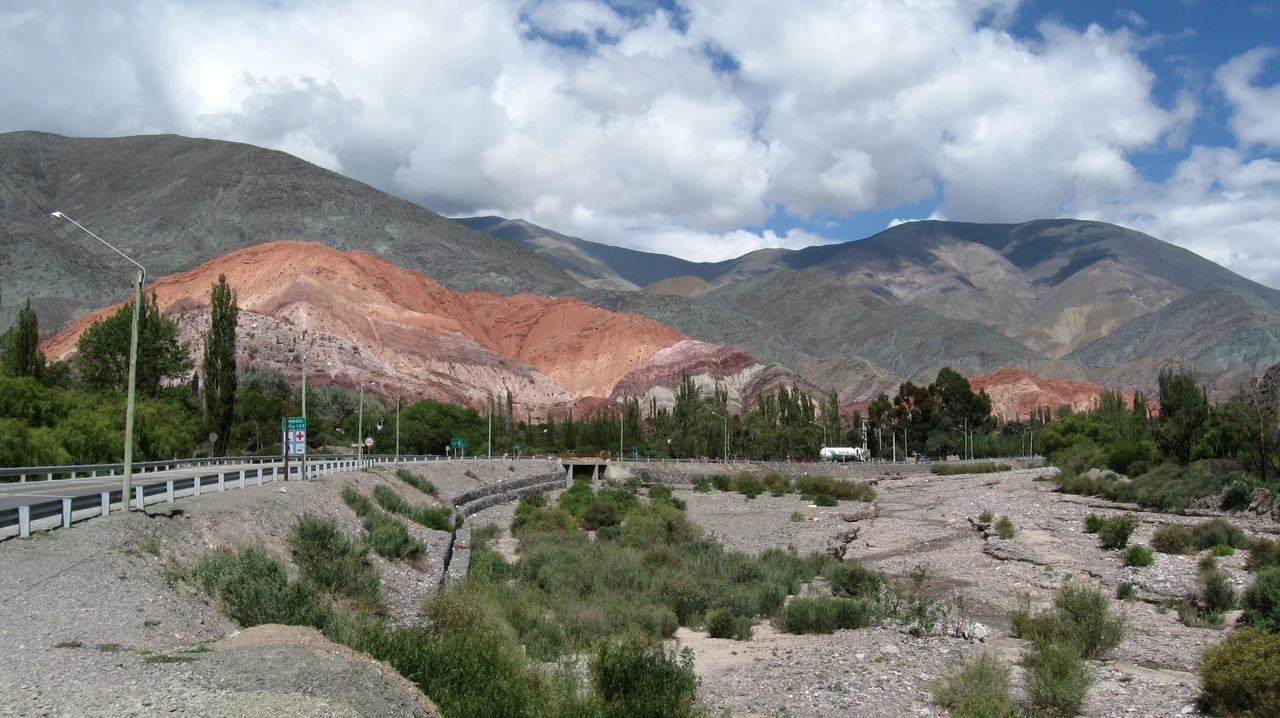

Cerro de los Siete Colores
Walk to the edge of Purmamarca at first light and the hill seems to ignite. The sun clears the eastern wall of the Quebrada and strikes a long ridge of bare rock, and suddenly the stone is striped in ochre and rose, in pale green and deep violet, in white and rust and a brown so dark it reads almost black. The bands run diagonally across the slope, as if a giant had dragged a comb through wet paint. Locals call it the Cerro de los Siete Colores, the Hill of Seven Colors, though anyone who lingers as the light shifts will swear there are more.
A Book Written in Sediment
The colors are not paint but chemistry, laid down over an almost unimaginable stretch of time. Each band marks a different age and a different mineral, the residue of seas, lakes, and rivers that filled and drained this basin for more than 600 million years before tectonic forces buckled the floor and tilted the layers skyward. The oldest stripes, greenish from copper oxide and marine shale, date back some 600 million years. White layers are limestone; the purplish hues come from lead and calcium carbonate; the yellows are sulfur and sandstone; the pinks owe their blush to iron and red clay. The brown at the top is the youngster of the family, a manganese deposit only a couple of million years old. Fossils scattered across the slope confirm the story the rock tells.
The Village at Its Feet
Purmamarca presses right up against the hill, an adobe village of narrow lanes and a small white church, sitting at roughly 2,300 meters in a side branch of the Quebrada de Humahuaca. The hill rises about 200 meters above the rooftops and stretches some 600 meters wide, so it does not loom so much as fill the western horizon, a backdrop that changes hour by hour. Tourists drift in from the handicraft market in the plaza to photograph it, but for the families who live here it is simply the shape of home, the thing you see when you step out your door. The pairing of village and stripes has become one of the most recognized images in all of Argentina.
Light Is the Only Brush
There is no best color, only a best moment. Dawn warms the reds and golds; midday flattens the palette into a chalky uniformity; late afternoon deepens the violets and greens until the whole ridge seems to glow from within. The light high in the Andes is famously clear and hard, sharpening every edge, and the colors people remember are as much a trick of that light as of the minerals beneath it. Visitors often walk the Paseo de los Colorados, a loop trail that swings behind the town through eroded red badlands, to see the rock from angles the roadside view never offers.
Fame, Old and New
The hill has anchored this corner of the world for as long as people have lived beneath it, but its fame keeps finding new forms. The Quebrada de Humahuaca was named a UNESCO World Heritage Site in 2003, drawing travelers from across the globe to a valley that had long sat outside Argentina's commercial currents. The football pitch at the base of the hill, home to the Santa Rosa de Purmamarca club, has been praised as one of the most scenic fields anywhere. And in 2024, Argentina's Ministry of Foreign Affairs partnered with a game studio to recreate the Cerro de los Siete Colores inside the video game Fortnite, putting six hundred million years of geology in front of an audience that had never heard the village's name.
From the Air
The Cerro de los Siete Colores sits at roughly 23.75 degrees south, 65.50 degrees west, in the Quebrada de Purmamarca, a western branch of the Quebrada de Humahuaca in Jujuy Province. The striped ridge backs directly onto the village of Purmamarca at about 2,300 meters elevation, with surrounding peaks rising well above. The nearest airport is Gobernador Horacio Guzman International (ICAO SASJ) near San Salvador de Jujuy, about 65 km southeast; Martin Miguel de Guemes International at Salta (ICAO SASA) lies farther south. The colors read best from the east in low morning or late-afternoon light; midday sun and haze wash them out. Expect high-altitude terrain and rapidly changing mountain weather.
Nearby Stories
- Ledesma S.A.A.I. 25 km away
- San Antonio de los Cobres 28 km away
- San Salvador de Jujuy 29 km away
- Uquía 35 km away
- Cerro Tuzgle 47 km away
- El Rey National Park 80 km away
- Baritú National Park 116 km away
- Laguna Lejia 163 km away