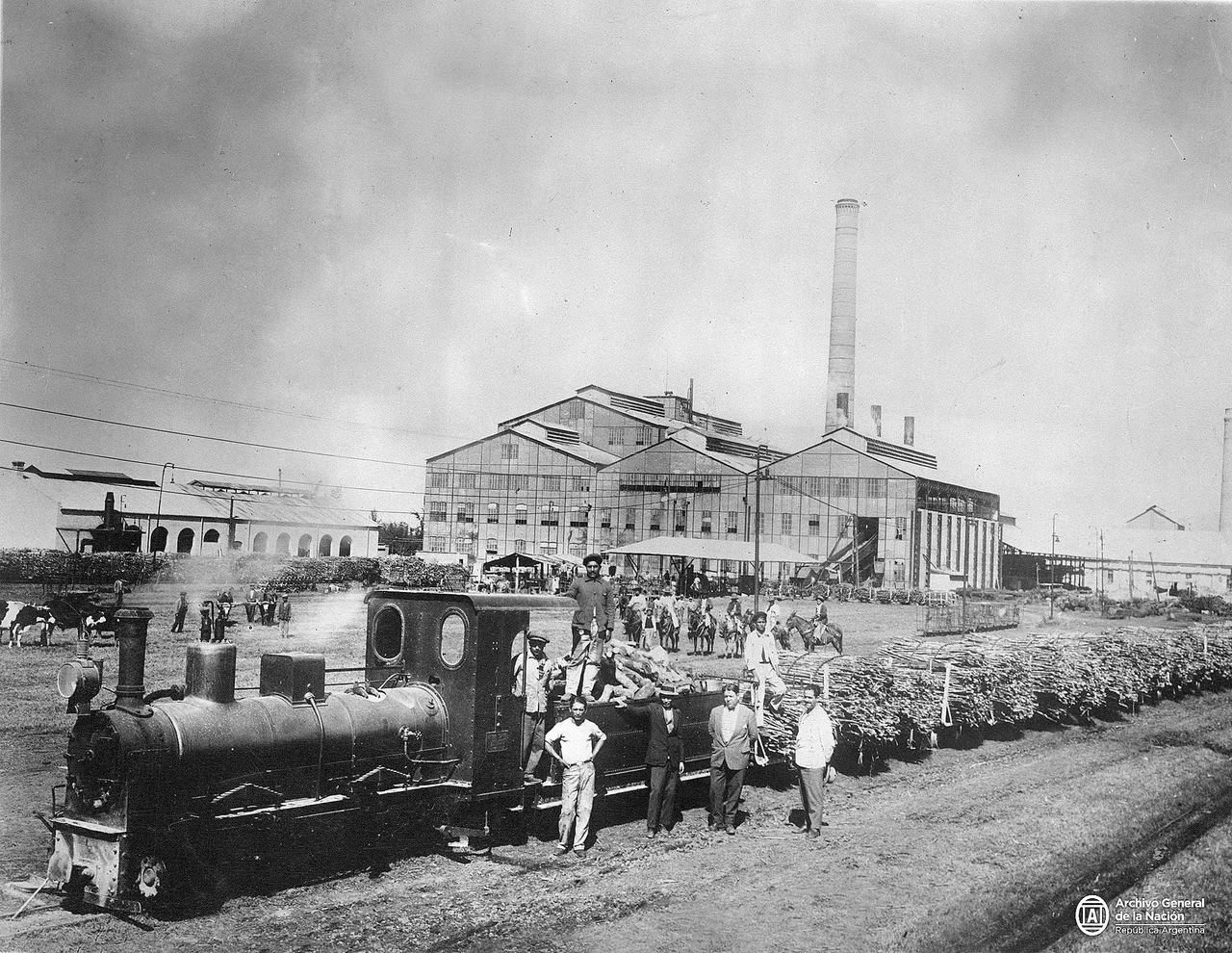

Ledesma S.A.A.I.
In July 1976, the lights went out across Libertador General San Martin. They went out in the houses and the streets, in the small Jujuy town of Calilegua nearby, everywhere except one place: the factory of the Ledesma sugar mill, which stayed lit. In the darkness, under the cover of a blackout that spared only the company, security forces moved through the streets in vehicles and rounded up workers, union delegates, and activists. That night, and the cooperation it implied, would shadow the company for decades. But the story of Ledesma begins much earlier, and in a far gentler register.
Sugar in the San Francisco Valley
It started with cane. In 1830, José Ramírez Ovejero González planted the first sugarcane fields at Ledesma, a remote hamlet in the warm, fertile valley of the San Francisco River in Jujuy Province. His heirs built a steam-powered sugar mill in 1876, and the family enterprise grew into a formal company: incorporated as Ingenio Ledesma in 1889, reorganized as the Compañía Azucarera Ledesma in 1908. The name reached back further still, honoring Martín de Ledesma y Valderrama, who had raised the valley's first defensive fort in the mid-seventeenth century and lent his name to the river and the department alike. From sugar, the company spread into citrus, paper, alcohol, and, in time, bioethanol and fossil fuels.
An Empire of Fields and Mills
Today Ledesma is one of Argentina's largest agribusinesses, employing more than 7,700 people. Around Libertador General San Martin its holdings are vast: tens of thousands of hectares of sugarcane, thousands more of fruit orchards, mills turning out sugar, cellulose, and paper, distilleries producing alcohol and bioethanol, and enough generating capacity to supply a slice of the national grid, all laced together by hundreds of kilometers of private road and irrigation canal. Beyond Jujuy the company runs corn-milling and notebook factories in San Luis, citrus groves in Salta, and cattle and grain estancias on the Pampas. For generations, in much of Jujuy, Ledesma has not simply been an employer. It has been the landscape itself.
La Noche del Apagón
That dominance is inseparable from its darkest chapter. Between roughly July 20 and 27, 1976, in the early months of Argentina's military dictatorship, the power was cut across Libertador General San Martin and Calilegua while the Ledesma plant remained illuminated. Police, army, and gendarmerie sealed off the towns, and in the blackout they seized people from their homes. By many accounts more than four hundred were detained; thirty-three were forcibly disappeared and never seen again. Survivors testified that company trucks carried the captured to clandestine detention centers, including warehouses on the mill's own grounds, where they were held bound and hooded. The targets were largely Ledesma's own workers and former workers, union delegates pressing for their labor rights, along with their families and other activists. It came to be called La Noche del Apagón, the Night of the Blackout.
Names That Did Not Return
Memory has proven more durable than justice. The people taken that week were not statistics; they were neighbors, parents, and coworkers who had asked for fairer treatment and were forcibly disappeared for it, and their families have spent half a century demanding an accounting. Ledesma's longtime owner, Carlos Pedro Blaquier, and the company's administrator, Alberto Lemos, were eventually charged as accomplices, accused of providing the vehicles used to carry off the detained. The case dragged through the courts for years, lifted and reinstated more than once, and Blaquier died in 2023, at ninety-five, still under indictment but never convicted. Each July, Argentines march to remember the Night of the Blackout, keeping the names of the forcibly disappeared in the light that was denied them.
From the Air
Ledesma's principal operations center on Libertador General San Martin in Jujuy Province, at roughly 23.83 degrees south, 64.79 degrees west, in the lowland valley of the San Francisco River at modest elevation east of the Andean foothills. The nearest airport is Gobernador Horacio Guzman International (ICAO SASJ) near San Salvador de Jujuy, to the southwest; Martin Miguel de Guemes International at Salta (ICAO SASA) lies farther south. From the air the site is unmistakable: a sprawling grid of sugarcane fields, mills, and irrigation canals on the valley floor, distinct from the dramatic colored canyons of the Quebrada de Humahuaca to the west. Expect warm, humid lowland conditions; the terrain is gentler here than in the high country of Tilcara and Purmamarca.
Nearby Stories
- Purmamarca 13 km away
- San Salvador de Jujuy 46 km away
- Uquía 58 km away
- Santa Rosa de Tastil 70 km away
- Laguna Lejia 235 km away
- Rincón Bomba massacre 385 km away
- Battle of Campo Grande 430 km away
- Santiago del Estero 441 km away