
Santa Rosa de Tastil
Eleven people live in Santa Rosa de Tastil. Three of them work at the museum. The rest tend a clinic, a school, a police post, and a church that serve perhaps 150 souls scattered across the surrounding highlands. It is, by any measure, one of the smallest communities you will ever pass through. And yet this near-empty outpost in the Andean folds of Salta Province sits beside the bones of a metropolis. Just up the slope lie the ruins of Tastil, a place that five centuries ago held more people than live in this whole region today.
The City That Came Before the Inca
Tastil was, at its height in the fifteenth century, the largest pre-Columbian city in the territory of what is now Argentina. Built by the Atacameño people on a strategic perch between the high puna and the Calchaquí valleys, it grew to perhaps 400 households and more than 2,000 inhabitants. Its builders raised it from local sandstone, fitting the stones without mortar, the structures spiraling outward from a central plaza arranged around a wanka, a sacred standing stone. This was no scattering of huts but a planned urban settlement, dense and deliberate, anchoring a network of trade and movement across one of the harshest landscapes on the continent.
A Mystery in Stone
By the time Spanish boots reached this valley, Tastil was already empty. Why its people left remains genuinely uncertain. Some studies suggest the water gave out in this bone-dry country; others point to displacement, the inhabitants drawn or driven off to other settlements as the expanding Inca Empire pressed into the region. Whatever the cause, the abandonment came before the conquistadors, which means the ruins were never razed by colonizers or built over by a Spanish town. They simply weathered in place. What survives today is among the most complete and original archaeological sites in Argentina, foundations and walls and lanes still legible after six hundred years of mountain wind.
Honoring the Ancestors
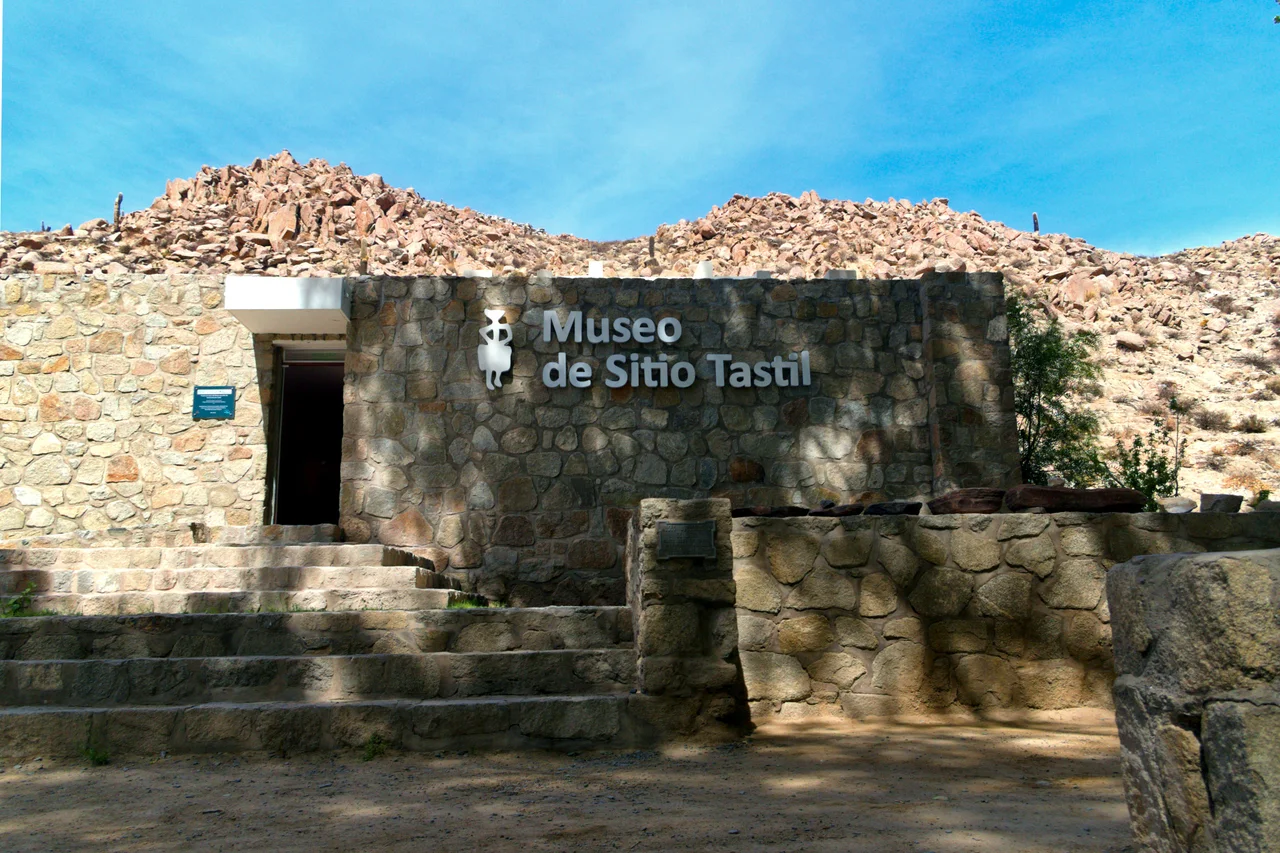
These ruins are not an abstraction to the people who live among them. The small Moisés Serpa Regional Museum of Tastil, opened in 1997 when the site was declared a National Historic Monument, holds artifacts gathered from the ruins and the surrounding land, including a mummy dating from the fourteenth century. The remains and objects belong to real ancestors of the indigenous communities who still inhabit these valleys, descendants of the people who quarried the sandstone and circled the sacred stone. To walk the site is to step into their inheritance, and the most fitting response is not to treat it as a curiosity but to recognize a civilization that flourished here entirely on its own terms, long before anyone arrived to write it down.
Where the Train Still Passes
Tastil is not as cut off as its eleven residents might suggest. The Tren a las Nubes, the famous Train to the Clouds and one of the highest railways in the world, runs through this country, and the Puerta de Tastil station lies nearby. For travelers winding up National Route 51 from Salta toward the puna, the village makes a natural and humbling pause, a chance to stand in a place where the modern world is reduced to a handful of buildings and a railway line, dwarfed by the silent stone evidence of a city that thrived here when Europe had never heard of these mountains at all.
From the Air
Santa Rosa de Tastil lies at 24.45°S, 65.95°W in the Andean highlands of Salta Province, set in rugged terrain between the high puna and the Calchaquí valleys along National Route 51. From the air, look for the deeply eroded canyons and bare, reddish ridgelines of the pre-Andean ranges; the village and the adjacent ruins are tiny against the vast empty landscape. The nearest major gateway is Salta's Martín Miguel de Güemes International Airport (ICAO SASA, IATA SLA), roughly 100 km to the southeast, with Jujuy's Gobernador Horacio Guzmán International (ICAO SASJ) to the north. The dry season from April to November brings the clearest skies and sharpest light over the high desert.
Nearby Stories
- Large Latin American Millimeter Array 7.9 km away
- San Salvador de Jujuy 12 km away
- San Antonio de los Cobres 41 km away
- Cachi 45 km away
- Cerro Tuzgle 52 km away
- 1844 Salta Earthquake 70 km away
- El Rey National Park 79 km away
- Salar de Pedernales 313 km away