
Battle of Campo Grande
"Water! Water! Water!" By 15 September 1933, that was the only word the surrounded Bolivian soldiers could still shout, and a young officer named Benigno Guzmán wrote it down in his diary as the men around him began to break. They had half a liter a day to live on under a sun he called hellish. They could not swallow the meat they were given because their throats had gone dry. And across the thorn scrub the Paraguayans were calling out an offer of water along with a threat to cut their throats. This is how the Battle of Campo Grande ended: not with a charge, but with thirst doing the work that bullets could not.
A Weakened Line
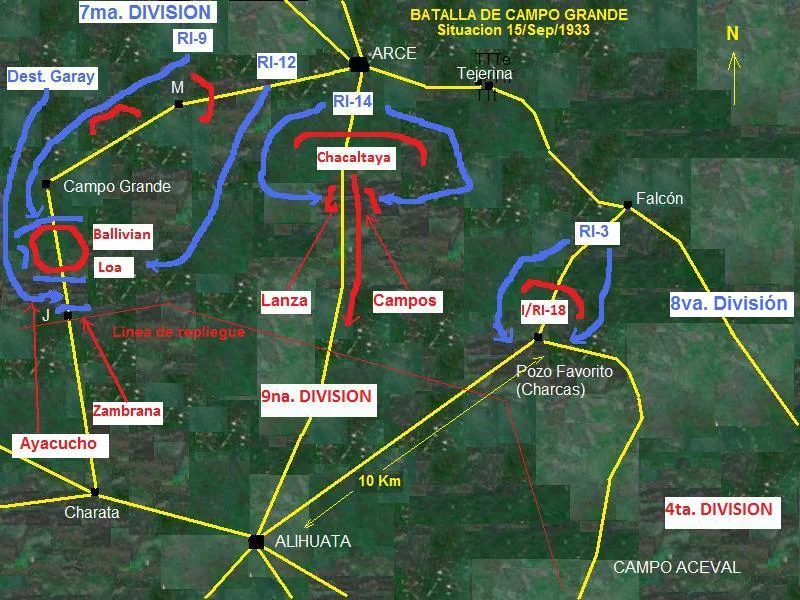
The battle grew out of an opportunity. The fighting at Gondra had forced the Bolivian high command to strip troops from the 9th Division defending Fort Alihuatá, leaving only three scattered units in the advanced area. Seven hundred men of the Chacaltaya regiment held the road from Alihuatá near Arce; the Ballivián regiment sat five kilometers to the left at Campo Grande; a company of the Junín regiment covered a point called Pozo Favorito. Paraguayan reconnaissance patrols noticed everything, the thin numbers, the isolation, the gaps. Where the Bolivian commanders saw a line, the Paraguayans saw three lonely outposts waiting to be taken apart one at a time.
Command in Confusion
What followed exposed the paralysis at the top of the Bolivian army. General Hans Kundt, directing operations from the rear at Muñoz, had forbidden the use of his Loa regiment without his personal permission. When desperate messages arrived that the Ballivián and Chacaltaya were being surrounded, an officer named Lieutenant Colonel Toro, unable to reach Kundt, finally moved the Loa regiment on his own authority. Kundt scolded him for it. The generals misread the battle entirely, convinced the main Paraguayan blow was falling on the Chacaltaya, where in truth the attackers were weak. At Campo Grande the Paraguayans had quietly deployed an entire division, the 7th. By the time Colonel Banzer of the 9th Division grasped the danger, Paraguayan patrols had already closed the roads behind him.
The Siege
On 12 September the Paraguayans seized the route to Campo Grande, cornering the Ballivián and Loa regiments. The pressure never let up. When the Bolivian line was pierced, cooks and couriers were thrown in to plug the gap. A relief company under Captain Julio Zambrana Bayá charged toward the trapped men; after half an hour the noise of its fighting died away, and Zambrana and many of his comrades were dead. Inside the pocket, aircraft dropped bags of coca leaves and cans of supplies, but the men past a certain point wanted none of it. They wanted only water. Guzmán's diary records soldiers who no longer recognized their own officers, some weeping, some simply staring.
The Surrender
On the western side, a Paraguayan officer demanded surrender and gave one hour for a reply. The veteran Lieutenant Colonel Eugenio Garay crossed into the Bolivian command post to settle terms on behalf of the Paraguayan division commander, José A. Ortiz. As Bolivian planes dropped water cans and Paraguayan soldiers passed water to their starving enemies, the surrender was signed. A total of 509 men capitulated, among them two colonels, eleven officers, three surgeons, and ten non-commissioned officers. Five hours earlier the Junín company at Pozo Favorito had given up as well. These were exhausted, demoralized men, many of them highland conscripts who had been marched into a lowland furnace, and in the end it was the Chaco itself, more than any rifle, that defeated them.
What the Battle Meant
Campo Grande was a small fight by the numbers, yet it marked a real shift. The Paraguayan commander Ortiz had kept the true direction of his attack secret until the last moment, giving the slow Bolivian command no time to react, and prisoners spoke of growing distrust between Bolivian soldiers and the senior officers ordering them forward in hopeless dribs and drabs. There is no battlefield park here today, only the same flat scrub at 23.03°S, 60.17°W where the trapped men once rationed their half-liter. To remember Campo Grande honestly is to remember that war in this country was waged as much against the human body's need for water as against any enemy across the wire.
From the Air
The battlefield lies at 23.03°S, 60.17°W in the central Paraguayan Chaco, in Boquerón Department, near the former Bolivian stronghold of Alihuatá. From 6,000 to 8,000 feet the country is flat thorn-scrub forest broken by pale dry watercourses and scattered clearings, almost featureless and infamously short of surface water, the very condition that decided this battle. Mariscal Estigarribia (SGME), home to Paraguay's longest runway, lies to the west-northwest in the same Boquerón Department and is the most useful regional field; Silvio Pettirossi International at Asunción (SGAS) sits roughly 250 km to the southeast. The dry season (May to September), when the siege took place, brings hard heat and long visibility; the summer rains bring haze and flooding to the flats.
Nearby Stories
- First Battle of Nanawa 9.9 km away
- Neuland Colony 26 km away
- Second Battle of Nanawa 38 km away
- Paraguayan Chaco 98 km away
- Rincón Bomba massacre 151 km away
- Baritú National Park 391 km away
- Ledesma S.A.A.I. 408 km away
- Calilegua National Park 414 km away