
Second Battle of Nanawa
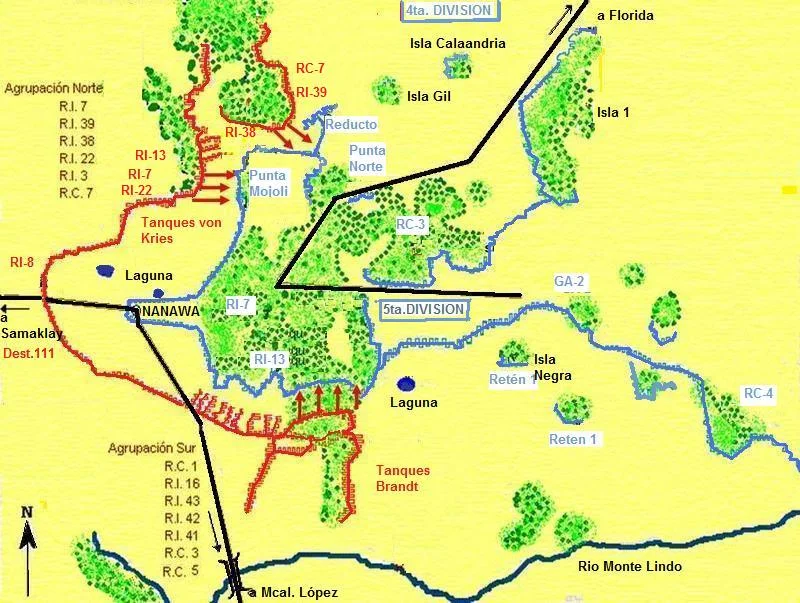
At nine in the morning on 4 July 1933, the ground in front of the Paraguayan redoubt erupted. A great mine, planted just thirty yards short of the main position, blew open the dry Chaco earth, and behind the smoke came the largest assault Bolivia had yet attempted at Nanawa, complete with tanks, tankettes, and flamethrowers. The Bolivian command had failed to take this carob-tree stronghold in January, and they had come back in the dry season to finish it. They would fail again, and in failing, they would lose the war's initiative for good.
The Prize
Nanawa was a salient jutting into the southern front, and Bolivia wanted it badly. Taking it would let the Bolivian army isolate Isla Poí, the Paraguayan headquarters and a vital water point to the northeast, then push on toward Concepción on the Paraguay River and the country's interior. In a war where control of water could decide a campaign, that prize was worth almost any cost. The outpost had been founded in 1928 by Ivan Belaieff, the exiled White Russian officer who had helped turn this patch of thorn forest into a fortress. By March 1933 it had become the headquarters of the Paraguayan Fifth Division. Its commander, Colonel Luis Irrazábal, had built a horseshoe-shaped defense facing west and packed it with four regiments. The carob-tree forest was about to face the hardest blow of its existence.
Iron and Fire
This was the Chaco War at its most mechanized. The Bolivians hit the line with artillery and mortar fire, air strikes, three Vickers light tanks, two small Carden-Lloyd tankettes, and four flamethrowers, weapons designed to burn defenders out of trenches at close range. The assault came in two prongs, one from the north and one from the south, with a diversionary force fixing the center in place. Part of the main redoubt fell to the attackers in the first rush. But the Paraguayans answered with their own artillery and with armor-piercing rounds, and they fought their way back into the overrun fortifications. One Bolivian tank was knocked out by artillery; the crippled machine was finished off by Paraguayan sappers who blew it apart where it sat.
The Cost
By 9 July the assault was spent. The defenders had held, but the price on both sides was staggering for so small a piece of ground. Bolivia lost more than two thousand men killed and wounded; Paraguay, fighting from prepared positions, lost 559. The disparity tells the story of the whole war's southern front, where attacking across open scrub against entrenched machine guns was close to suicidal. These were young conscripts on both sides, fed into the same few hundred meters of trench line that had already consumed thousands in January, and the second battle earned Nanawa its enduring, mournful nickname: the South American Verdun. For many of the dead there would be no marked grave, only the scrub that closed over them where they fell.
The Turning
The Paraguayans did not stop at survival. On 11 July they launched a counterattack on Bolivian positions in the wooded ground southwest of the outpost, near Gondra. That particular thrust failed, but it hardly mattered. The larger truth was that the strategic initiative, which had belonged to Bolivia since early 1933, had passed to Paraguay, and it would not return. Within weeks came the encirclement at Gondra; within months, the catastrophe at Campo Vía, where two Bolivian divisions surrendered. The German general Hans Kundt, who had hurled his men at Nanawa twice, would be dismissed before the year was out. The carob-tree forest that Bolivia tried twice to seize had instead become the place where its advance in the Chaco finally, irreversibly broke.
From the Air
Nanawa lies at 23.46°S, 59.72°W in the southern Paraguayan Chaco, Presidente Hayes Department, with the Pilcomayo River and the Argentine border to the south. From 6,000 to 8,000 feet the landscape is flat thorn-scrub forest and seasonal grass, nearly featureless apart from the Pilcomayo's winding course and a scatter of clearings. The nearest major field is Silvio Pettirossi International at Asunción (SGAS), roughly 150 km east-southeast; Mariscal Estigarribia (SGME) lies far to the northwest in Boquerón. The July dry season, when this battle was fought, gives the steadiest visibility of the year, hot and clear, while the summer rains bring haze and standing water across the flats.
Nearby Stories
- Battle of Campo Grande 20 km away
- Battle of Boquerón (1932) 60 km away
- Neuland Colony 93 km away
- Rincón Bomba massacre 119 km away
- Tevego 138 km away
- Concepción 167 km away
- Río Pilcomayo National Park 176 km away
- Villa Hayes 258 km away