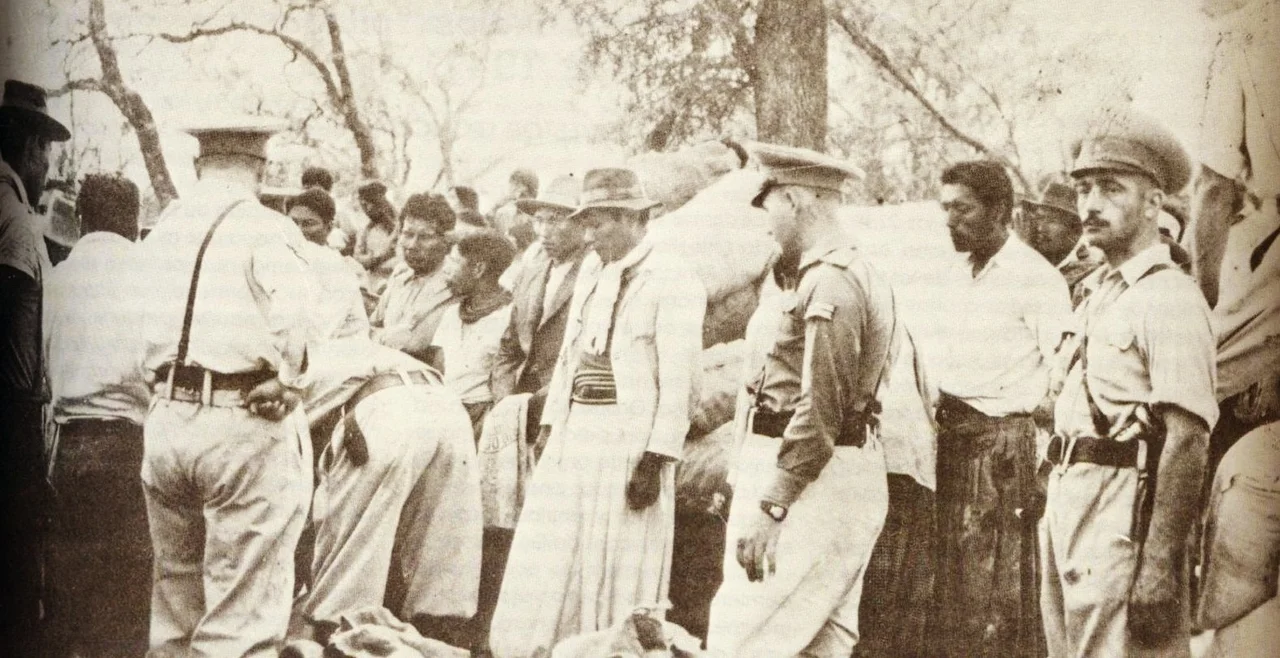

Rincón Bomba massacre
They had come for work and were owed honesty, and they got neither. In the spring of 1947, hundreds of Pilagá families and their neighbors gathered at a dry ravine near Las Lomitas, in the Formosa scrubland of northern Argentina. The Pilagá had lived in the Gran Chaco for centuries, resisting Spanish conquest and outlasting it, and these were their descendants — farmers, healers, children, elders. They were hungry, they were grieving, and they were waiting. What arrived was not relief. Between October 10 and 30, the Argentine National Gendarmerie surrounded them with machine guns and an aircraft and killed an estimated 750 to 1,000 people. For more than fifty years, the country pretended it had not happened.
The Wages They Were Promised
The road to Rincón Bomba began at a sugar mill. In April 1947, the El Tabacal estate in Salta Province hired hundreds of Qom, Pilagá, Mocoví, Chorote, and Wichí families for the cane harvest. Whole families walked hundreds of kilometers to reach the work. When payday came, the company paid 2.50 pesos a day instead of the six it had agreed to. When the workers protested this plain theft, they were dismissed — left stranded, unpaid, far from home. With nowhere else to go, they set out again on foot, some 450 kilometers across the Chaco toward Las Lomitas, where they hoped the state might help. They arrived in mid-May.
Gathering at the Madrejón
The Pilagá settled at a place called Rincón Bomba, beside a dry ravine the locals called a madrejón. They were led by a healer named Tonkiet — Luciano Córdoba — and by the caciques Pablito Navarro and Nola Lagadick. Word of Tonkiet's healing drew more people, until the gathering numbered well over a thousand. At first the townspeople and the local gendarmes were welcoming. Then hunger set in. Food finally sent by the government arrived spoiled, and the rotten supplies poisoned the camp, killing at least fifty people in early October — most of them children and elders. Many believed, then and now, that the poisoning was no accident. The dead were not even permitted burial in the town cemetery.
What the State Called Order
As fear spread among the white residents, the local press began warning of an indigenous "raid" that was never coming. The Pilagá were starving and mourning, not arming. The Gendarmerie commander ringed the camp with about 100 men and four machine gun nests and confiscated what few weapons the people had. From October 15 to 23, a Junkers Ju 52 aircraft fitted with a machine gun joined the operation, flying out of Las Lomitas. The killing went on for twenty days. More than 200 people simply disappeared. Those who fled were hunted down a corridor of country later remembered as the "trail of death," stretching some 40 kilometers from the camp. These were families — mothers, grandfathers, small children — pursued and shot for the crime of being unwanted.
The Long Road to Being Believed
Argentina buried the memory along with the dead. For decades the massacre went unspoken in official history, surviving only in the testimony of the Pilagá themselves — among them eight people who had been children at the ravine and lived to describe it. In 2005 the Pilagá People's Federation sued the state, and a forensic team began recovering bodies from the mass graves. In 2019 a federal court ruled that what happened at Rincón Bomba was a crime against humanity; in 2020, it was classified as a genocide. The court ordered the state to commemorate the dead and to repair what could be repaired. Some of the children who survived lived long enough to hear their country, at last, say the word out loud.
From the Air
The Rincón Bomba site lies at 24.71°S, 60.59°W in Formosa Province, Argentina, near the town of Las Lomitas in the flat scrub of the Gran Chaco. The landscape is low, dry, and sparsely settled, threaded by seasonal ravines (madrejones) and the rail line and route through Las Lomitas — the clearest navigation references over otherwise featureless terrain. Recommended viewing altitude is 3,000–5,000 feet AGL. The nearest major airport is El Pucú / Formosa International (ICAO: SARF), about 170 nautical miles to the east; Silvio Pettirossi International in Asunción, Paraguay (ICAO: SGAS), lies roughly 175 nautical miles to the northeast. The Chaco is extremely hot in summer with afternoon storms; the dry winter (June–August) offers the most stable visibility. This is a place of memory; treat it with corresponding respect.
Nearby Stories
- First Battle of Nanawa 116 km away
- Concepcion de Buena Esperanza 134 km away
- Battle of Gondra 143 km away
- Second Battle of Nanawa 144 km away
- Río Pilcomayo National Park 200 km away
- Campo del Cielo 302 km away
- El Rey National Park 350 km away
- Ledesma S.A.A.I. 373 km away