
Campo del Cielo
The people of the Chaco had a name for the place where the iron lay: Piguem Nonralta, the field of the sky. They knew the dark, heavy metal had fallen from above, and they worked it into blades and tools long before any outsider thought to look for it. When Spanish soldiers came searching in 1576, it was because they had heard the Indigenous people possessed weapons of an iron unlike any they knew. What lay beneath that ground was the scattered wreckage of a catastrophe roughly 4,000 years old, when a body from space tore through the atmosphere and shattered, salting the plain with metal across the modern border of Chaco and Santiago del Estero provinces.
The Night the Sky Broke
The numbers are staggering even now. At least 26 craters pock the strewn field, the largest stretching 115 meters across, scattered over an area several kilometers wide. The pattern tells the story: a single large object, more than four meters in diameter, entered the atmosphere at a shallow angle and broke into pieces that struck the earth in a long, raking line. Charred wood recovered from beneath the buried fragments was dated by carbon-14 to between roughly 4,200 and 4,700 years ago. This was no ancient prehistory lost to memory. People already lived in the Chaco when it happened, and the event entered their understanding of the world, woven into stories of the sky and the forces that move through it.
Knowledge the Conquerors Misread
The Indigenous peoples of the region, among them the Toba and Mocoví, held the truth plainly: the metal had come from the sky. The Spanish, by contrast, spent centuries getting it wrong. In 1774, Don Bartolomé Francisco de Maguna rediscovered a great mass he named el Mesón de Fierro, the Table of Iron, and assumed it was the tip of a buried vein. In 1783, Rubin de Celis blasted away the surrounding soil, decided the lump was worthless, and concluded it had come from a volcano. Only when he sent samples to the Royal Society in London were they analyzed and found to be 90 percent iron and 10 percent nickel, the unmistakable signature of a meteorite. The people who had named the field had been right all along, four thousand years ahead of the science.
Giants in the Ground
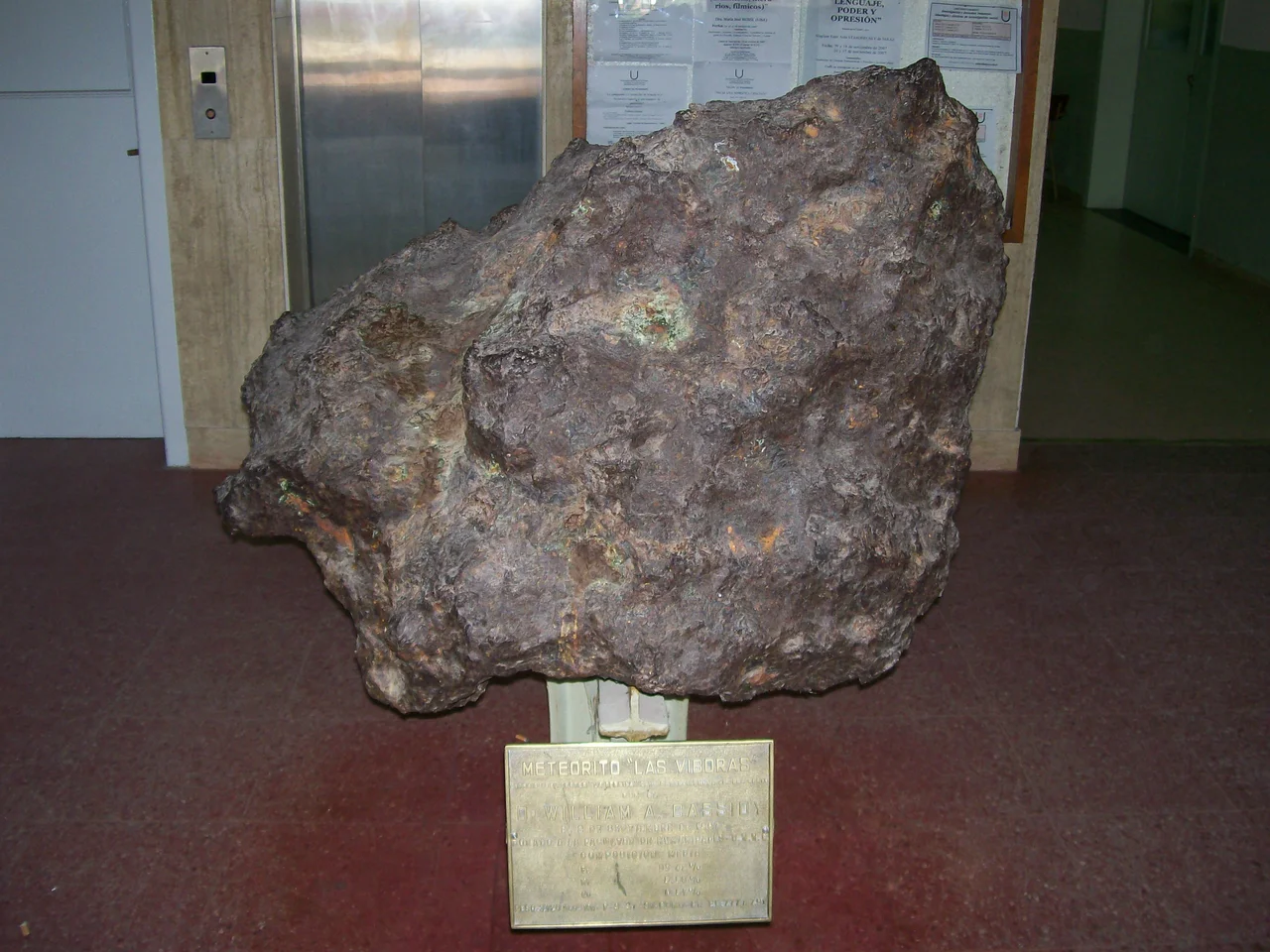
Campo del Cielo has yielded more meteoritic iron than any find on Earth, roughly 100 tonnes recovered in fragments ranging from a few milligrams to colossal single masses. Two of those masses are among the heaviest ever pulled from the ground anywhere on the planet. El Chaco, located in 1969 five meters below the surface with a metal detector, weighs about 28.8 tonnes. In 2016, an even larger mass was unearthed nearby and named Gancedo, after the town whose equipment helped haul it free; at 30.8 tonnes it became the largest fragment ever recovered from the field. Only Namibia's Hoba meteorite and a piece of Greenland's Cape York exceed them. These are not museum-case specimens. They are house-sized chunks of a single ruined sky-stone.
Worth Stealing, Worth Protecting
The same scale that makes the meteorites wonders has made them targets. In 1990, an Argentine highway police officer foiled an attempt by a collector to spirit El Chaco out of the country; the mass was returned and is now shielded by provincial law. In 2015, police arrested four people trying to smuggle out more than 900 kilograms of protected fragments. The fight to keep the iron where it fell reflects a slow reckoning with what Campo del Cielo really is. Not loose treasure for the taking, but the remains of an event that shaped a landscape and a people, with names in Indigenous languages that recorded its origin long before instruments confirmed it. The field of the sky still belongs to the sky, and to the ground it struck.
From the Air
Campo del Cielo lies at approximately 27.63°S, 61.70°W, straddling the boundary between Chaco and Santiago del Estero provinces in northern Argentina, about 1,000 km north-northwest of Buenos Aires. The terrain is flat, low Chaco plain at modest elevation, so any comfortable cruising or sightseeing altitude of 3,000–6,000 ft offers a clear view. The craters themselves are shallow and easily missed from above, often ringed by vegetation; look for the small town of Gancedo and the cluster of subtle circular depressions and ponds in the surrounding scrubland southwest of it. The nearest major airport is Resistencia International (ICAO SARE) in Chaco, roughly 200 km to the east-northeast; Santiago del Estero's airport (ICAO SADE) lies to the southwest. The flat Chaco offers long sightlines but can be hazy in the heat of summer afternoons; cooler, drier conditions give the sharpest view of the strewn field.
Nearby Stories
- Mailín 118 km away
- Napalpí Massacre 119 km away
- Chaco National Park 176 km away
- Concepcion de Buena Esperanza 198 km away
- Santiago del Estero 201 km away
- Argentine Declaration of Independence 302 km away
- Moisés Ville 308 km away
- 1973 San Justo Tornado 320 km away