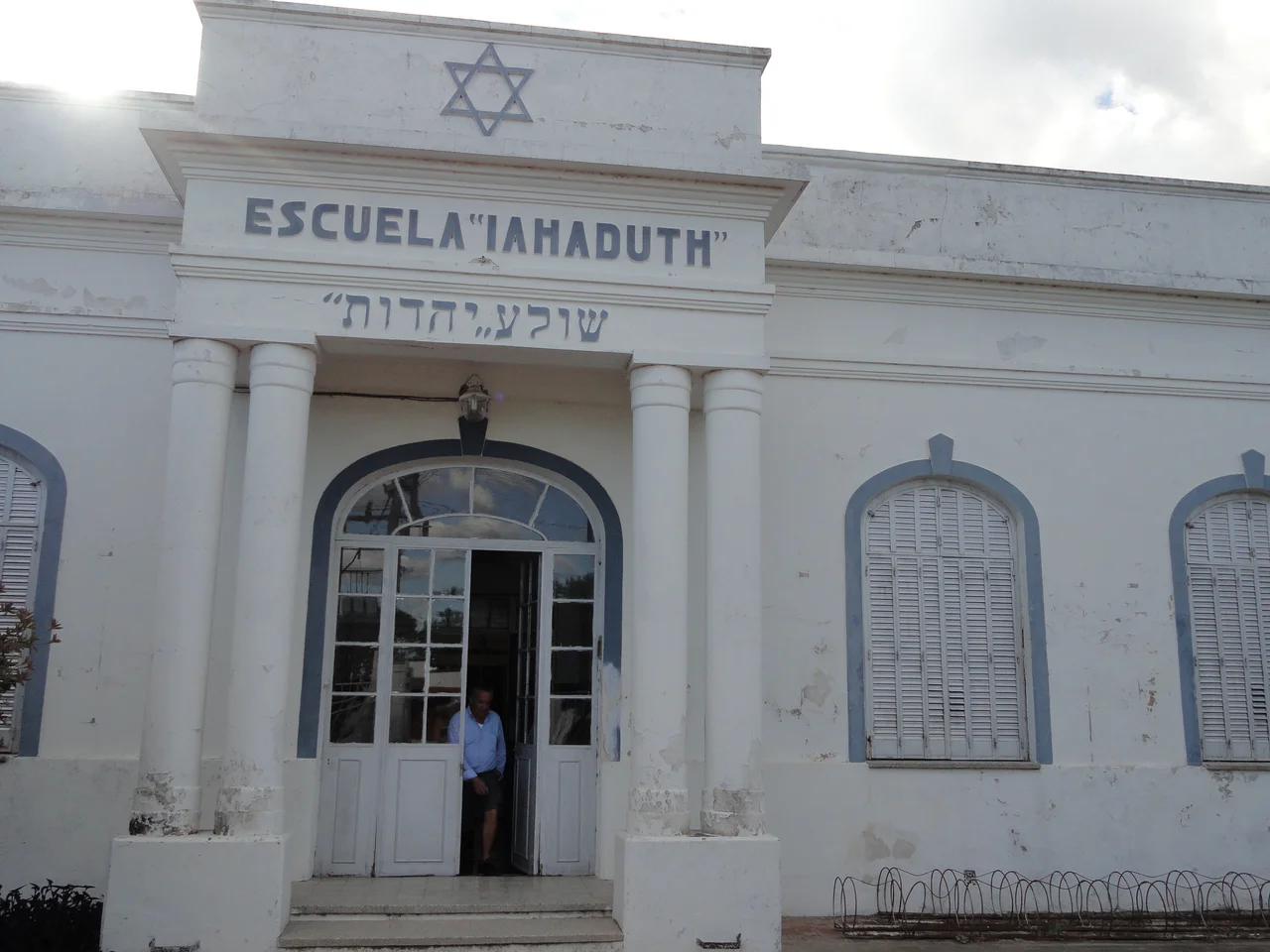

Moisés Ville
They came to farm and instead they had to dig graves. In August 1889, a group of Russian and Eastern European Jews stepped off the steamship Weser at Buenos Aires, fleeing the pogroms of the Russian Empire, only to find the land they had bought was no longer for sale. Stranded, herded into freight cars on a railway siding deep in the pampas, they watched a typhus epidemic take 64 of their children before a single field was plowed. The cemeteries they raised in their grief became the reason they stayed. From that ground rose Moisés Ville — the first Jewish agricultural colony in South America, a place that would one day be called the Jerusalem of South America.
A Promise Broken at the Dock
The story began in 1887, when leaders of Jewish communities in Podolia and Bessarabia gathered in Katowice, in Polish Silesia, desperate for a way out. They sent a delegate, Eliezer Kauffman, to Paris to plead with the philanthropist Baron Edmond de Rothschild. The meeting failed, or perhaps never happened. Unwilling to return empty-handed, Kauffman struck a deal through Argentina's information bureau for land near La Plata. The 820 people he represented — 130 families, equal to roughly half of all the Jews then in Argentina — sailed on the Weser trusting that promise. They reached Buenos Aires on August 14, 1889 and learned at once that the price of the land had doubled and the contract would not be honored. They had crossed an ocean to nothing.
Typhus on the Railway Siding
A second arrangement sent them to land owned by Pedro Palacios in Santa Fe, along the railway being pushed toward Tucumán. The reality was worse than the journey. Promised farms, animals, and tools, the families instead were lodged in freight cars parked in a trackside shed, with none of the equipment the contract had guaranteed. Railway workers passed food to the starving children, but typhus swept through the camp and killed 64 of them. Two cemeteries went up almost immediately, at Palacios and at Monigotes. These were the colony's first permanent buildings — graves before homes. And it was precisely the dead who anchored the living: no family would abandon the resting place of its children, so they stayed.
The Town of Moses
Their rabbi and leader, Aharon Halevi Goldman, gave the settlement a name heavy with meaning: Kiryat Moshe, the Town of Moses. Just as Moses had led the Jews out of bondage in Egypt toward freedom, he said, this battered community had escaped the tyranny of Russia to build a free life in Argentina. The name was translated to Moïsesville and softened over time into the Spanish Moisés Ville. Word of the colony's suffering reached Paris. A Romanian doctor named Wilhelm Loewenthal, traveling on a scientific mission, was stunned by the misery he found at Palacios Station and carried the colonists' plight back to Europe. His report helped move Baron Maurice de Hirsch to found the Jewish Colonization Association in 1891, which would resettle thousands more Jewish families across the pampas.
The Jewish Gauchos
The colony grew in waves of the displaced. Families came from Grodno, from Białystok led by the writer Gdalia Bublik, from Bessarabia after the 1903 Kishinev pogrom, from Kherson, and in the 1930s from a Germany that had begun to hunt them. They named their hamlets with plain Yiddish arithmetic — the Four Houses, the Six Houses, the Twelve Houses, the Twenty-four Houses. They learned to ride and rope and work the soil, and they became the legendary Gauchos Judíos, the Jewish gauchos, immortalized by the writer Alberto Gerchunoff, who grew up here. At its height from the 1920s to the 1950s, Moisés Ville held some 5,000 people, with synagogues, schools, a theater, and libraries holding more than 20,000 books — Yiddish culture flourishing on the Argentine plain.
What Endures
The Worker's Synagogue, the Baron Hirsch Synagogue, the Brener Synagogue, the Kadima theater, the Baron Hirsch Library, the Aaron H. Goldman museum — the bones of that world still stand, smaller now but cared for. The town's population has thinned, yet Moisés Ville has refused to fade into a footnote. It is a candidate for UNESCO World Heritage status and a stop on Argentina's Pueblos Auténticos program, launched in 2017 to draw travelers to authentic rural towns. Visitors come from across Argentina and the world to walk among the synagogues and read the old Hebrew on the cemetery stones — the same stones that once held a frightened community in place, and from which an entire chapter of the Jewish diaspora grew.
From the Air
Moisés Ville sits on the open Santa Fe pampas at 30.72°S, 61.48°W, about 177 km from the provincial capital of Santa Fe and roughly 16 km from the village of Palacios. The nearest major airport is Santa Fe's Sauce Viejo (ICAO: SAAV), to the southeast. From 2,500–4,000 feet the town reads as a compact grid set in a vast quilt of wheat, alfalfa, and grazing land, with the railway line and Provincial Highway 69S running toward National Highway 34. The terrain is famously flat, so visibility is excellent on clear days; spring and autumn (September–November, March–May) offer the most stable air over the pampas.
Nearby Stories
- 1973 San Justo Tornado 26 km away
- Rafaela 39 km away
- Mar Chiquita Lake 66 km away
- Cayastá 69 km away
- Battle of Quebracho Herrado 76 km away
- Mailín 253 km away
- Mercedes, Corrientes 296 km away
- Campo del Cielo 311 km away