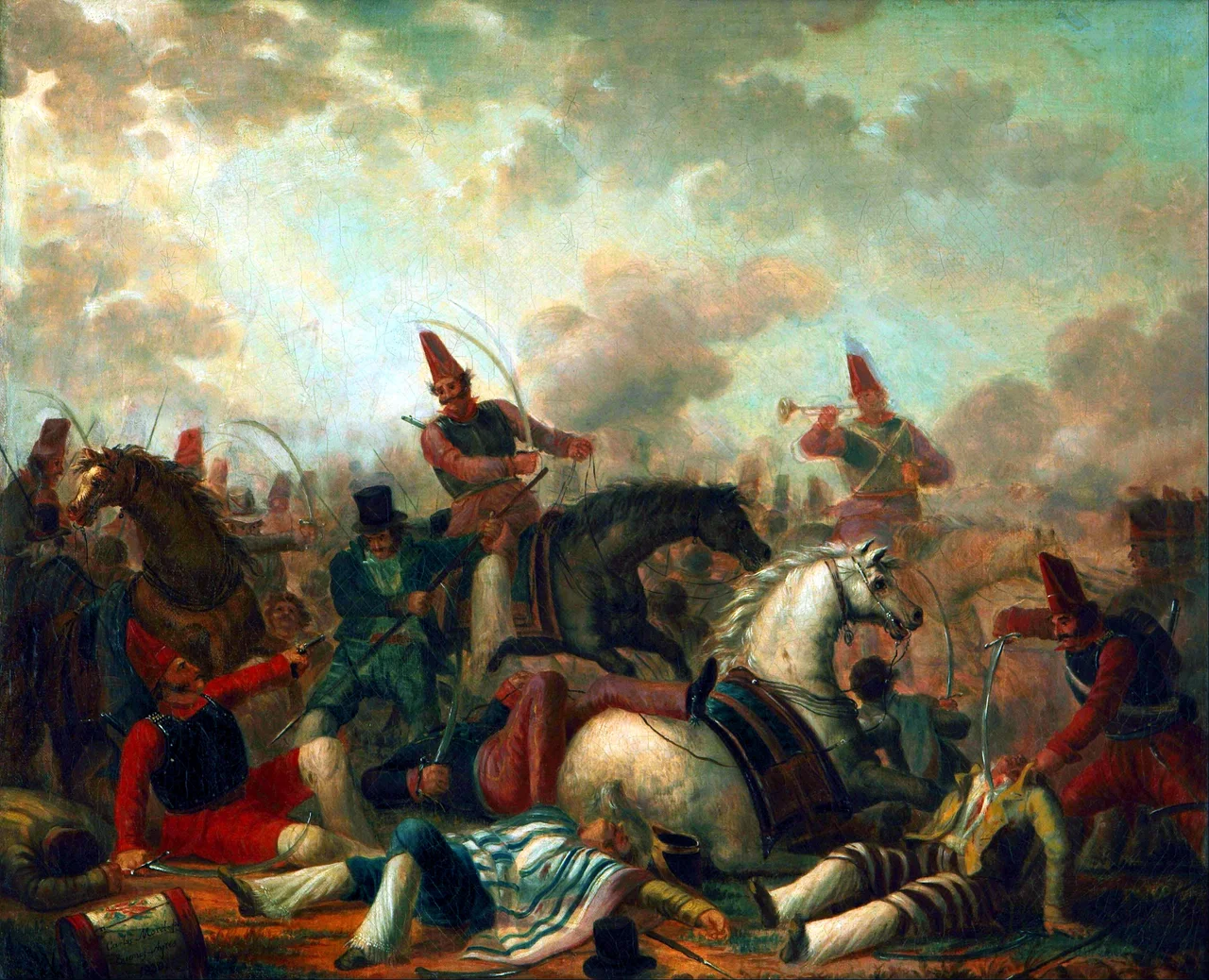

Battle of Quebracho Herrado
The ally never came. Juan Lavalle had marched his exhausted army to the appointed rendezvous expecting to find Lamadrid and fifteen hundred reinforcements waiting. Instead he found an empty post and no word of where his comrade had gone. Behind him, gaining every hour, rode an enemy who had just done something almost unthinkable: covered 150 kilometers across desert in two days. On November 28, 1840, near a place called Quebracho Herrado in eastern Córdoba, Lavalle ran out of room to run, and the largest battle of Argentina's civil wars began at noon.
A Country at War With Itself
By 1840, Argentina was tearing itself apart. The dictatorial rule of Juan Manuel de Rosas had provoked revolt across the interior, pitting his Federalists against the Unitarians who dreamed of a different republic. Brigadier Juan Lavalle led one Unitarian army; a coalition of five northern provinces fielded another under Gregorio Aráoz de Lamadrid. Against them stood the Federal forces commanded by Manuel Oribe, a former president of Uruguay now fighting Rosas's war. These were not abstract factions. They were neighbors, families, and provinces turned against one another in a conflict that would grind on for years and consume thousands of lives.
The Relentless Pursuit
What brought Lavalle to Quebracho Herrado was a chase that punished everyone in it. Driven from Entre Ríos and frustrated in Buenos Aires Province, he had retreated toward Córdoba to unite with Lamadrid. Oribe gave him no peace. The Federal general's march of roughly 150 kilometers in two days through arid country was, by one account, unique in the nation's military history. The pressure was so unrelenting that Lavalle, slowed by a convoy of anti-Rosas civilians who had thrown in their lot with him, kept halting to form a battle line he did not actually want to fight. When he finally reached the meeting point, Lamadrid had withdrawn westward without warning, leaving Lavalle cornered.
Four Hours in the Balance
The numbers favored the Federals heavily. Lavalle could field about 4,600 men, a third of his cavalry dismounted for lack of horses, against more than 6,500 of Oribe's troops. Lavalle staked the fight on his right wing, whose charge checked the Federal cavalry but could not break it. On the opposite flank the Federal horsemen under Ángel Pacheco shattered the Unitarian left and swept into the rear. In the center, infantry on both sides held one another in a grinding deadlock for four hours. Lavalle, watching his army crumble around the edges, took personal command of his last reserve and threw himself into the fight. It was not enough.
The Cost
By four in the afternoon the Unitarian horses could no longer move and Oribe held the field. More than five hundred men lay dead, and over a thousand Unitarian soldiers were taken prisoner, helpless once their cavalry had been forced to fight on foot. Among the captured was Colonel Pedro José Díaz, who would spend years in Rosas's prisons. The Federals, by contrast, counted only thirty-six killed and fifty wounded. Several hundred civilians who had marched with Lavalle out of Buenos Aires and Santa Fe were swept up as well, their baggage plundered on the battlefield while the victors, themselves spent from the long chase, paused to rest before pursuing the survivors. These were ordinary people, soldiers and refugees alike, caught in a war between their own countrymen.
What the Battle Decided
The defeat poisoned what was left of the Unitarian cause. Lamadrid finally rushed up with his men only after the disaster, meeting Lavalle at El Tío where the two commanders bitterly blamed each other for the missed rendezvous. They never recovered their trust or their footing. Within months they parted ways, and within eight months both were beaten decisively, Lavalle at Famaillá and Lamadrid at Rodeo del Medio. The Northern Coalition dissolved. Quebracho Herrado was not the final blow, but it turned the war sharply toward Rosas and the Federalists, who would hold power until their own defeat at Caseros in 1852. Today the quiet Córdoba plain gives little hint of the day it ran red.
From the Air
The battlefield lies on the flat eastern plain of Córdoba Province at roughly 31.55°S, 62.23°W, near the modern settlement of Quebracho Herrado, west of the Santa Fe provincial border. From the air the terrain is strikingly level, a patchwork of agricultural fields with few natural features, which underscores how exposed Lavalle's cornered army would have been. A viewing altitude of 3,000 to 5,000 feet AGL gives a broad sense of the open ground over which the cavalry maneuvered. The nearest major airport is Ingeniero Aeronáutico Ambrosio L.V. Taravella International Airport (SACO) at Córdoba, roughly 175 km to the west. The flat pampa offers excellent visibility in clear weather.
Nearby Stories
- Rafaela 4.6 km away
- Sa Pereira Rail Disaster 14 km away
- Moisés Ville 84 km away
- Predelta National Park 92 km away
- Jesús María, Argentina 148 km away
- Sarmiento Park 152 km away
- San Carlos Convent 161 km away
- Villa General Belgrano 189 km away