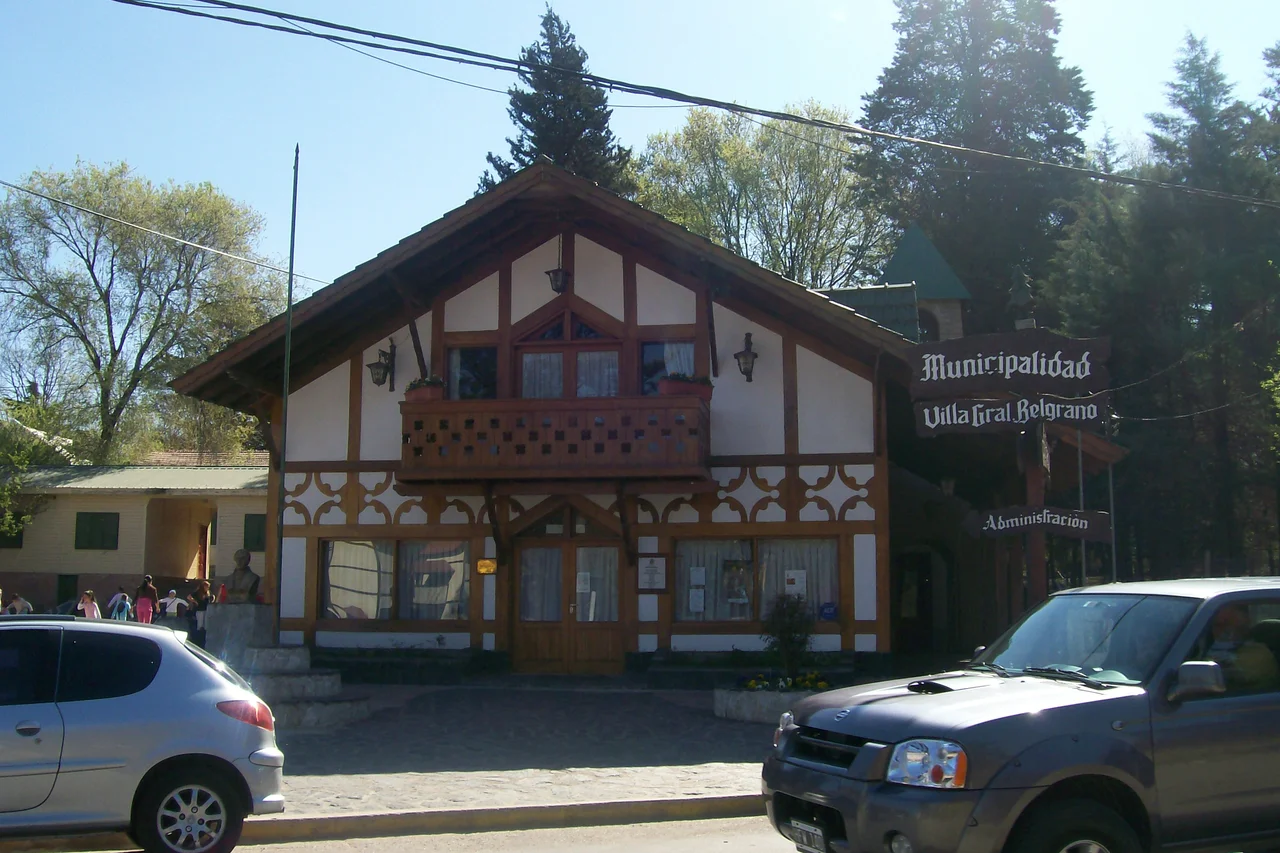

Villa General Belgrano
Some of the men who built this Alpine village had spent their last night at sea watching their own warship explode. In December 1939, the German pocket battleship Admiral Graf Spee was scuttled in the River Plate estuary off Montevideo after a hard fight with British cruisers, and her commander shot himself days later. More than a thousand of her sailors were interned in Argentina, and a group of them ended up here, in a green valley of the Sierras de Córdoba, where a tiny German-speaking settlement was just taking root. They stayed. They built. And the wood-framed, red-roofed town they helped raise still smells of strudel and fresh beer.
A Slice of Bavaria in the Sierras
Villa General Belgrano sits in the Calamuchita valley, named after Manuel Belgrano, the independence hero who designed Argentina's flag. It was founded in 1930 by two German speculators drawn to the valley's farmland, and the Alpine feel of the place quickly attracted immigrants from Germany, Switzerland, Italy, and Austria. They built in the only idiom that felt like home: steep roofs, timber framing, deep eaves, the architecture of the mountains they had left. The hills around the village belong to the Bosque Serrano, a wooded belt between roughly 500 and 1,400 meters where native chañar and molle mingle with the pines and acacias that later settlers planted, and gray foxes and vizcachas move through the underbrush. Today the village survives on visitors who come for that fantasy and for the food that goes with it, apple strudel, leberwurst, spätzle, and German-style beer poured in tankards, even if the recipes have drifted a little in their long exile.
The Sailors of the Graf Spee
The town's most haunting chapter belongs to the Graf Spee. Cornered at the Battle of the River Plate in December 1939, the raider had sunk nine merchant ships before three British cruisers ran her down and forced her into neutral Montevideo. Rather than risk capture, Captain Hans Langsdorff took the ship out into the estuary and scuttled her; soon after, in a Buenos Aires hotel room, he ended his own life. His crew was interned in Argentina, and around 130 of the survivors settled in Villa General Belgrano. They were sailors, not builders, but they put their hands to the work anyway, helping to shape the streets, the homes, and the breweries that gave the village its enduring style.
An Oktoberfest in the Southern Spring
Because the seasons flip below the equator, October here means spring, not autumn, and yet every year the village throws one of the largest Oktoberfests on the planet. By long reckoning it ranks third, after Munich itself and Blumenau in Brazil, drawing crowds for the beer, the brass bands, the dancing, and the food. For a few weeks the town's permanent costume becomes its everyday dress. The festival is both a genuine inheritance and a careful performance, a community keeping faith with a homeland that most of its founders never saw again, turning memory into music for thousands of strangers a night.
A Homeland Frozen in Time
Like many isolated immigrant communities, Villa General Belgrano kept customs that quietly faded in Germany itself. Newsstands still carry German-language papers like the Argentinisches Tageblatt, and the church holds Sunday services in both German and Spanish. The town once ran its own German school, the Colegio Alemán Steck, and German names still mark its shops and streets. One notable resident was the aircraft designer Kurt Tank, who became a leading figure at Argentina's aeronautical institute. The mother tongue can still be heard in the streets, but it is thinning with each generation, slipping away the way an accent softens over a lifetime. The village remains a museum of a vanished moment, lovingly maintained, even as the living language that built it grows fainter.
From the Air
Villa General Belgrano lies in the Calamuchita valley of central Córdoba Province at about 31.97°S, 64.57°W, in the Bosque Serrano zone roughly 500 to 1,400 meters above sea level. The nearest major airport is Córdoba's Ingeniero Aeronáutico Ambrosio L.V. Taravella International (ICAO SACO, IATA COR), known as Pajas Blancas, about 90 km to the north. From the air, look for the compact, densely built town nestled against forested sierra slopes, with the nearby resort town of Santa Rosa de Calamuchita a short distance away and the Calamuchita reservoir country to the south. A viewing altitude of 6,500 to 8,500 feet keeps the valley, the surrounding wooded ranges, and neighboring villages such as La Cumbrecita in view. Conditions are usually clear and calm in the morning; afternoon convection can build cumulus over the higher ground to the west.
Nearby Stories
- Villa Carlos Paz 27 km away
- Battle of San Cala 51 km away
- Villa de Merlo 51 km away
- Battle of Quebracho Herrado 167 km away
- San Luis 175 km away
- Mar Chiquita Lake 196 km away
- Sierra de las Quijadas National Park 204 km away
- Battle of Cepeda (1820) 295 km away