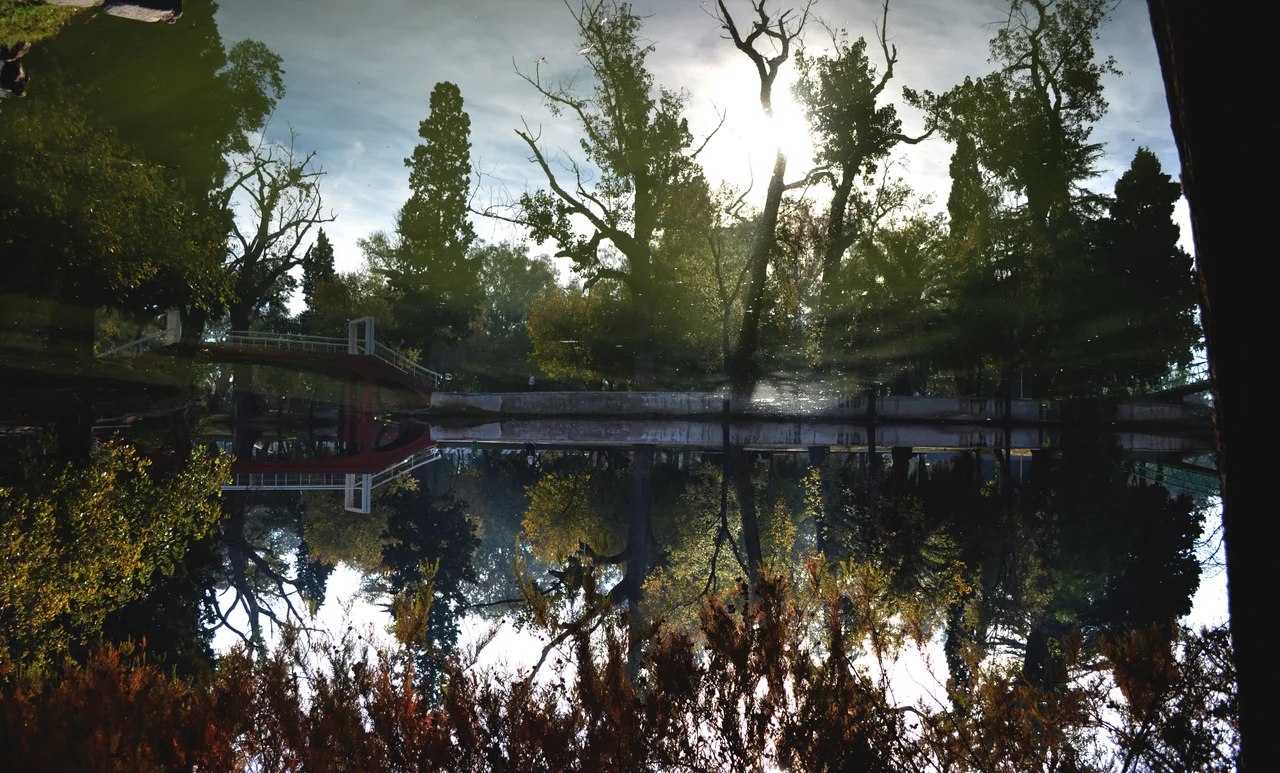

Sarmiento Park
When the French landscape architect Carlos Thays stepped off the boat in Argentina in 1889, he had been hired for exactly one job: design a park in Córdoba. He had no idea that the rest of the country was about to become his canvas. The commission was Sarmiento Park, and the work he did here - laying out paths and lakes and a rose garden on a plateau above the city - launched a career that would shape the great parks of Buenos Aires and beyond. Thays began with Córdoba. So, in a sense, does the story of public green space in modern Argentina.
The Designer Who Stayed
Jules Charles Thays was born in Paris in 1849 and trained under the celebrated landscape architect Édouard André. In 1889 the Córdoba developer Miguel Crisol brought him across the Atlantic to build a green space for a new neighborhood spreading south of the rapidly growing city. Thays chose a plateau overlooking the Cañada Brook to the west and the colonial campus of the National University to the south, and got to work on seventeen hectares of ground. He never left Argentina. Within two years he was named Director of Parks and Walkways for Buenos Aires, where he would go on to design the sprawling Palermo parks and the Botanical Garden. Of the dozen-odd major projects he undertook before his death in 1934, Sarmiento Park was the first.
A Park for the Schoolteacher President
Work began in 1890, and the park opened in 1911 under the name Parque Sarmiento. The choice honored Domingo Faustino Sarmiento, the former president and tireless champion of public education, who had been born exactly a century before. The naming fit the place perfectly. This was a city that called itself La Docta, "the learned," and here was a park dedicated to the man who had tried to put a schoolhouse in every Argentine town. The rose garden became a favorite of Córdoba society almost at once, and in 1912 a doctor named Martín Ferreyra bought land at the park's edge for a Beaux-Arts mansion, finished in 1916, that still presides over the grounds.
Museums, Lakes, and a Mayor's Belly Flop
The park drew the city's cultural life to it. A German Argentine immigrant, José Scherer, founded a zoo here in 1915; the same year, the Provincial Museum of Fine Arts - later named for the painter Emilio Caraffa - rose facing the green. In 1918 came a natatorium and an amphitheatre. The renewal of the 2000s gave the Caraffa a new wing, turned the Ferreyra palace into the Evita Fine Arts Museum in 2007, and opened a Museum of Natural Sciences the same year, so that within a short walk a visitor can pass from old masters to fossils. Not everything was solemn. When the restored swimming pool reopened in 2008, Mayor Daniel Giacomino marked the occasion by performing a belly flop into the water - a moment of municipal good humor that suited a park always meant for the public, not the dignified.
Still the City's Lungs
More than 25,000 people now live in the neighborhood around the park, and after a stretch of overuse and tight budgets near the turn of the century, the grounds were renewed. The zoo was refurbished and reopened in 2006, and in 2023 it was reimagined entirely as a Biodiversity Park - free to enter, open to anyone who wants to wander its paths or join a guided walk that runs about two and a half hours. The Bicentennial Lighthouse rises within the grounds, a modern landmark over Thays's old plateau. A duck lake still catches the afternoon light, mirroring the trees and the sky. After more than a century, the seventeen hectares that began one Frenchman's Argentine life remain exactly what they were designed to be: a green commons in the middle of a busy city, a place for Córdoba to breathe.
From the Air
Sarmiento Park sits just southeast of central Córdoba, Argentina, at roughly 31.43°S, 64.18°W - a broad green wedge that stands out sharply against the dense gray grid of the city, with the Bicentennial Lighthouse a useful point marker. The Suquía River curves to the north and the Sierras Chicas rise to the west. The gateway is Ingeniero Aeronáutico Ambrosio L.V. Taravella International Airport (ICAO: SACO, IATA: COR), known locally as Pajas Blancas, about 9 km north-northwest of the center and the busiest airport in Argentina outside Buenos Aires. The park's lakes and tree canopy are most vivid from a low daytime approach in the clear, dry conditions common to the region.
Nearby Stories
- Jesús María, Argentina 16 km away
- Alta Gracia 26 km away
- Pampa de Achala 31 km away
- Mina Clavero 31 km away
- Mar Chiquita Lake 116 km away
- Battle of Quebracho Herrado 135 km away
- Villa San Agustín 271 km away
- Predelta National Park 289 km away