
Sa Pereira Rail Disaster
Sa Pereira is the kind of place a train is meant to pass through, not stop in. A farming town of barely a thousand people on the flat plains of central Santa Fe, it sits where the Mitre railway line crosses Route 19. On the morning of Saturday, 25 February 1978, that ordinary crossing became the site of the worst rail tragedy in the province's history. The Estrella del Norte, the Star of the North, was running south from Tucumán toward Buenos Aires with some two thousand passengers aboard. It never slowed.
7:22 in the Morning
The warning system was working. The bell was ringing, the red lights flashing, the siren announcing the train already sounding across the fields as a Ford F-600 truck approached the crossing. Behind the wheel was Arnaldo Rubén Bianchini, thirty-five years old, hauling 25,000 kilograms of edible fat and canned goods for a meatpacking company. Witnesses later said the load may have blocked his view, that he simply did not see the train. Whatever the reason, the truck rolled onto the tracks at 7:22 a.m. into the path of the oncoming express. The locomotive struck it at speed, and there was no time for anyone to do anything but brace.
The Wreck
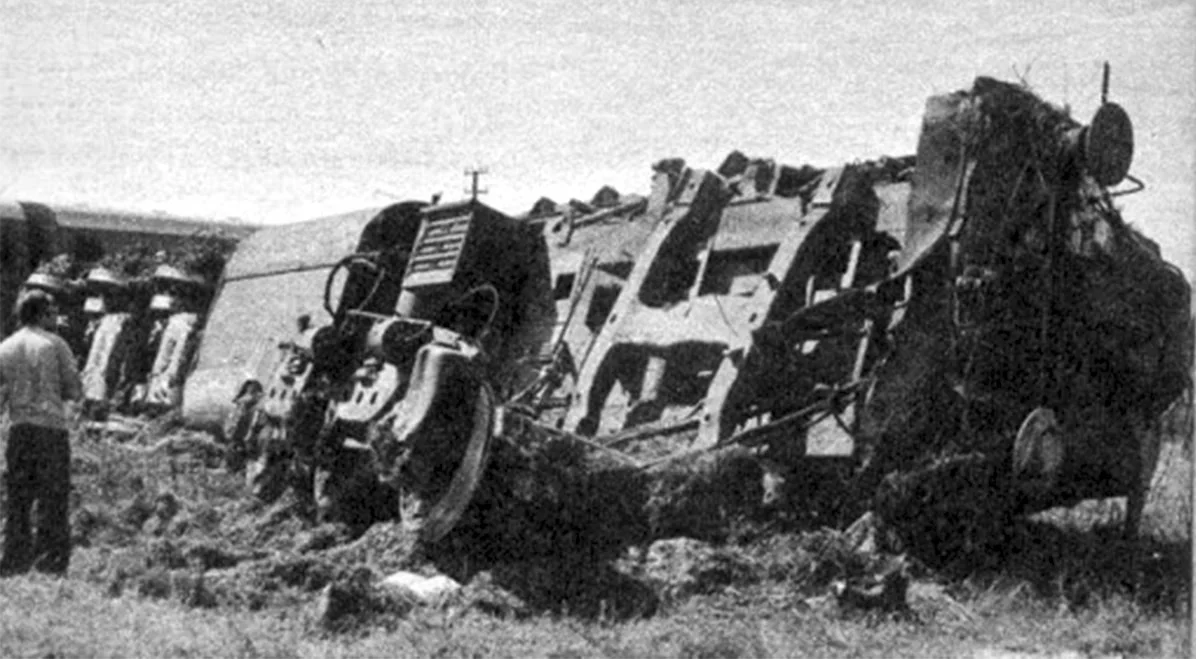
The force of the collision tore the locomotive from the rails. It traveled some fifty meters past the crossing, then tumbled end over end, gouging a deep hole in the embankment, smashing through a boundary fence, and coming to rest overturned in a neighboring field roughly a hundred meters to the south. The carriages behind it crumpled and jackknifed. In a single violent minute, fifty-five people died. It remains the second-deadliest railway accident in Argentine history, surpassed only by the Benavídez disaster of 1970, which claimed two hundred and thirty-six lives. It is also the deadliest collision between a train and a road vehicle the country has ever recorded.
Names and the Nameless
The dead were travelers, most of them strangers to Sa Pereira, caught up in the long Saturday journey south. They had boarded in Tucumán and the provinces beyond, bound for Buenos Aires for work, for family, for the ordinary business of a life interrupted without warning. The injured were carried to nearby hospitals; the dead were laid out as the town, suddenly the center of a national catastrophe, did what it could. Some of the bodies were so badly damaged that they could not be identified at all. Those victims were buried together, in a common grave, their names unknown but their loss no less complete. A thousand residents found themselves tending to the consequences of a disaster that had simply been passing through.
Still in the Memory
Decades on, Sa Pereira has not let the day fade. The town gathers each February to remember the fifty-five, and survivors and witnesses still recount what they saw with a clarity that time has not blunted. The tragedy reshaped how the country thought about its level crossings, those countless unguarded points where a fast train and an everyday errand can meet with no margin for error. The Mitre line still runs, and trains still cross Route 19. But here the crossing carries a weight no signal can measure, marked by a town that decided the people who died on its tracks would be neither nameless nor forgotten.
From the Air
The site lies at approximately 31.58°S, 61.38°W, where the General Mitre railway crosses National Route 19 at the town of Sa Pereira in central Santa Fe Province, west of the provincial capital. From the air the setting is unmistakable Pampean farmland: a tidy grid town surrounded by flat agricultural plots, the rail line cutting a straight diagonal across the fields to meet the highway. Best viewed at 2,000–5,000 ft AGL in the clear, dry air typical of the region. Nearest airports: Sauce Viejo / Santa Fe (SAAV) to the east and General Justo José de Urquiza / Paraná (SAAP) farther east across the river.
Nearby Stories
- Rafaela 13 km away
- Popular Center of Remembrance 15 km away
- Battle of Quebracho Herrado 33 km away
- Predelta National Park 41 km away
- 1973 San Justo Tornado 61 km away
- Mar Chiquita Lake 98 km away
- San Carlos Convent 119 km away
- Villa General Belgrano 255 km away