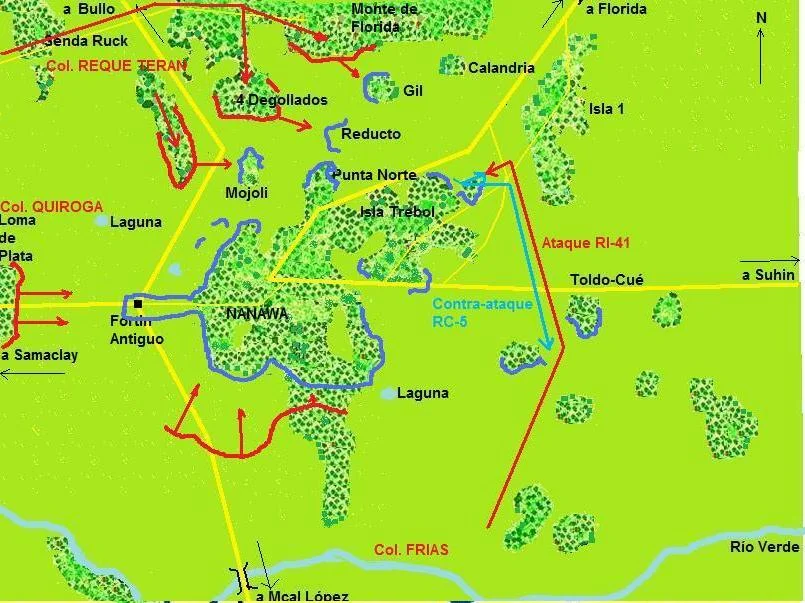

First Battle of Nanawa
Two former officers of the defeated Russian Imperial Army, refugees from a revolution half a world away, taught Paraguay how to dig in. Ivan Belaieff and Nicolas Ern had fought and lost their own war; in the 1920s they found new lives in the army of a small South American country, and at a place called Nanawa they laid out zig-zag trenches, barbed wire, and interlocking machine-gun nests in a horseshoe facing the enemy. In late January 1933, the full weight of the Bolivian army, led in person by a German general, threw itself against those defenses. The defenses held.
Carob Tree Forest
The name Nanawa comes from Enxet, the language of an Indigenous people of the Chaco, and means "carob tree forest." The Paraguayans had established the outpost in 1928, and by the end of 1932 it had become their strongest position on the southern front. The Chaco itself made every fortification a gamble. This is flat, thorny, drought-stricken country where water is scarce and the heat punishing, and where an army's true enemy is often the land rather than the man across the wire. Disease and thirst killed as freely as gunfire. Holding Nanawa meant holding a road toward the Paraguayan heartland, and both sides understood what was at stake in the dust. For a country of barely a million people, losing this outpost could mean losing the war.
Kundt's Assault
The Bolivian commander-in-chief was Hans Kundt, a German veteran of the First World War who believed in the massed frontal attack and commanded the assault from the field himself. Against Nanawa he sent his 7th Division, some 3,600 men reorganized into reduced regiments. Facing them stood the roughly 2,500-strong Paraguayan 5th Division under Colonel Luis Irrazábal, who had gathered four regiments and several smaller units behind the horseshoe. From 20 to 26 January 1933, the Bolivians attacked again and again. Three assaults clawed into parts of the stronghold and then stalled, unable to break the line. The cost was heavy, the Bolivian army absorbing some two thousand casualties for ground it could not keep. Many of those men were highland conscripts, sent down from the thin cold air of the Andes into a lowland heat that sapped them before they ever reached the Paraguayan wire.
Rain and Reinforcement
When the frontal attacks failed, the Bolivians changed tactics, trying to dig a trench all the way around the Nanawa complex and strangle it. Paraguayan reinforcements broke up the effort. Then the weather intervened. Heavy rains turned the Chaco's hard ground to mud and forced the Bolivians to abandon the portions of the complex they had seized, and the Paraguayan garrison soon recovered those positions. Kundt's army did not withdraw far. It dug itself into a semicircle around the Paraguayan trenches and waited, the two sides settling into the close, grinding proximity that would come to define this front. The carob-tree forest had held, but everyone sensed it was not finished. The Bolivians would come back in July, in the dry season, for the Second Battle of Nanawa, and that second attempt would be bloodier still.
The South American Verdun
Taken together, the two battles of Nanawa became among the bloodiest fought in South America in the twentieth century, earning the grim nickname the "South American Verdun" after the meat-grinder of the First World War. The fighting left its mark on culture as well as the land. A Paraguayan polka, 13 Tuyutí, was inspired by the battle, its lyrics written in Guaraní by the poet Emiliano R. Fernández, who was himself a soldier in the 5th Division and was wounded in the Bolivian assault. The men who held the trenches were conscripts and volunteers from a country of barely a million people, and the songs that remember them are still sung today.
From the Air
Nanawa lies at 23.46°S, 59.72°W in the southern Paraguayan Chaco, in Presidente Hayes Department, relatively near the Pilcomayo River that marks the border with Argentina to the south. From 6,000 to 8,000 feet the terrain is flat thorn-scrub forest and seasonal grassland, with the thread of the Pilcomayo the most reliable landmark in an otherwise featureless expanse. Silvio Pettirossi International at Asunción (SGAS) lies roughly 150 km to the east-southeast and is the nearest major field; Mariscal Estigarribia (SGME) sits far to the northwest. The dry season (May to September) offers the clearest flying; the January wet season, when this battle was fought, brings haze, towering heat, and flooding across the flats.
Nearby Stories
- Battle of Campo Grande 20 km away
- Battle of Boquerón (1932) 60 km away
- Neuland Colony 93 km away
- Rincón Bomba massacre 119 km away
- Tevego 138 km away
- Concepción 167 km away
- Río Pilcomayo National Park 176 km away
- Villa Hayes 258 km away