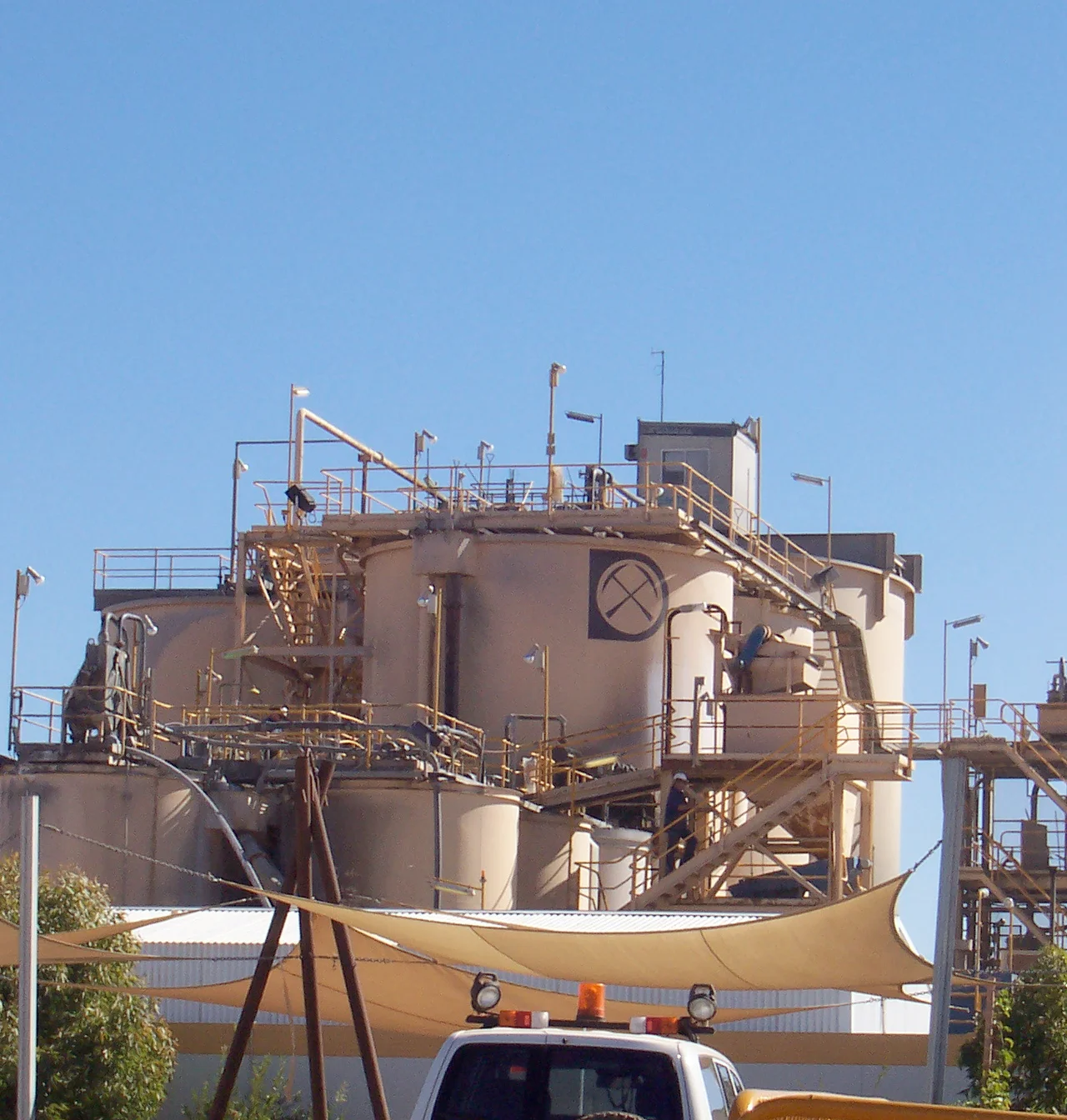

Challenger mine
It was named after a dog. When the geologist David Edgecombe pulled gold from this patch of the South Australian outback in 1995, he called the deposit Challenger, after his own faithful companion - a working-dog name now attached to one of the most remote gold mines in the country. The discovery itself owed a good deal to chance. A drilling grid spaced 800 metres apart, wide enough to miss almost anything, happened to snag a single soil sample shot through with gold. One lucky hit, and a mine was born in country so empty it sits inside a weapons range.
Gold in the Crust
The find came from a then-novel technique: sampling calcrete, the hard crust of calcium carbonate that caps so much of the arid Australian surface. Gold, washed and concentrated near the surface over ages, leaves a faint chemical fingerprint in that crust. Dominion Mining's broad 800-metre grid caught one strong reading, and the follow-up was almost immediate. The orebody lay beneath less than a metre of cover. Drilling through the late 1990s revealed something unusual - not a simple flat seam but a set of tightly folded gold-bearing shoots, plunging into the earth at around 45 degrees. The deeper they drilled, the more the gold kept going. Even now the bottom of the orebody has never been found.
Nearly Three Billion Years Down
The rock here is staggeringly old. The Challenger deposit sits within Christie gneiss, part of the Mulgathing Complex, in the Gawler Craton - an ancient slab of crystalline basement whose rocks stabilised around 2,415 million years ago and reach back into the Neoarchean, close to two and a half billion years before the present. The gold itself is dramatic up close: coarse, visible grains studded through the higher-grade zones, laced with arsenic minerals, fool's gold, and even tiny inclusions of native bismuth. The veins are twisted into the folded patterns geologists call ptygmatic, like toothpaste squeezed and crumpled. The rock is so competent and the ground so dry that the underground workings needed little support and saw almost no water seeping in.
A Mine Inside a Weapons Range
There is no easy way to reach Challenger. It lies in the Far North of South Australia, around 740 to 750 kilometres northwest of Adelaide, on the Jumbuck Pastoral Company's lease - and squarely inside the Woomera Prohibited Area, the vast military testing zone that covers a chunk of the continent the size of a small country. You get there by a nine-hour drive over sealed and unsealed road, or about ninety minutes in a plane from Adelaide. The mine grew from an open pit started in 2002 into an underground operation by 2005. At its peak it was a self-contained outpost: a processing plant, an airstrip, diesel power stations, and a village housing up to 140 workers on fly-in, fly-out rosters, all running on water pumped from a bore field three kilometres away.
The Gold Runs Out, the Rock Endures
For a remote mine, Challenger was a real producer. In 2007 it held an estimated reserve of 512,000 ounces of gold from a resource of a million ounces; a decade later, on paper, it still carried hundreds of thousands of ounces at a healthy grade. But the economics of digging gold in the middle of nowhere are merciless. The project changed hands repeatedly - Dominion gave way to Kingsgate in 2010, then WPG Resources in 2015. In 2018 WPG fell into administration and receivership, and the mine stopped. Today Challenger sits in care and maintenance, its village quiet, its airstrip idle. The lodes are still open at depth, the gold still down there in rock that was old before complex life existed. Whether anyone comes back for it is a question of price, not geology.
From the Air
The Challenger mine lies at approximately 29.88°S, 133.59°E in the Far North of South Australia, about 165-170 km west of the Stuart Highway and roughly 740 km northwest of Adelaide. Critically, it sits inside the Woomera Prohibited Area (YPWR) - active military restricted airspace - so clearance and current NOTAMs are essential before approaching; do not route through casually. The site has its own aerodrome serving fly-in/fly-out crews. From above, look for the cluster of processing infrastructure, the open pit, and the airstrip standing alone in featureless gibber and scrub country with no towns for hundreds of kilometres. Visibility is generally outstanding in the dry interior, though summer heat haze and dust can reduce it.
Nearby Stories
- Woomera Prohibited Area 23 km away
- Tarcoola railway station 94 km away
- Coober Pedy 97 km away
- Emu Field, South Australia 106 km away
- Ooldea, South Australia 111 km away
- British Nuclear Tests at Maralinga 130 km away
- Mount Willoughby Indigenous Protected Area 138 km away
- Jacinth-Ambrosia Mine 149 km away