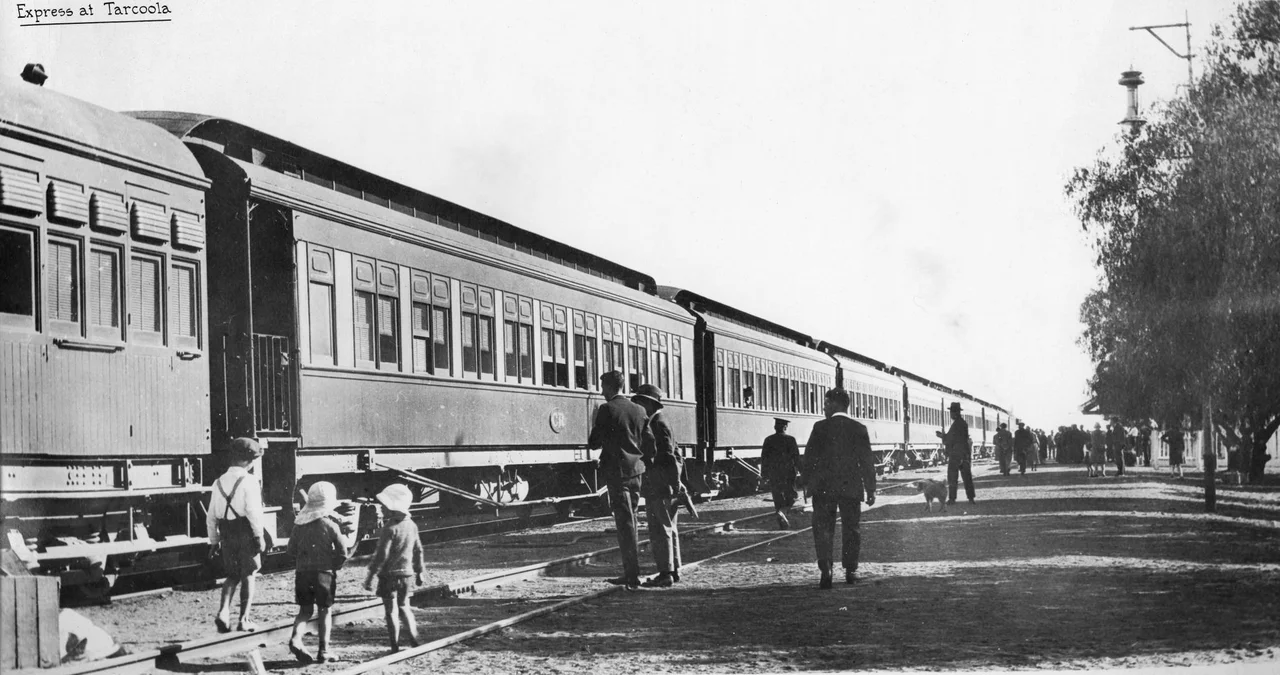

Tarcoola railway station
Somewhere out on the Trans-Australian line, a thousand kilometres of saltbush in every direction, a railway station carries the name of a horse. In 1893, a thoroughbred called Tarcoola came charging from the outside to win the Melbourne Cup, and that same year, prospectors struck gold in this empty corner of South Australia. The name of the winning horse went onto the new goldfield, and from the goldfield onto the railway town that grew beside it. Today the gold is long gone and barely anyone lives here, but Tarcoola remains one of the most important points on the Australian rail map - the junction where the continent's two great steel arteries split apart.
A Horse, a Cup, and a Goldfield
The horse came first. Tarcoola, a seven-year-old raised on a station along the Darling River in New South Wales, won the 1893 Melbourne Cup in a tight finish, trained by Joseph Cripps and ridden by his son Herbert - the only father-and-son pairing ever to combine for a Cup victory. In the same year, gold was found in this remote tract of South Australian desert, and the field took the celebrated racehorse's name. But the country was punishingly isolated and arid, and little happened at first; serious development of the Tarcoola goldfield waited until around 1900. The town that emerged was a child of two very different gambles - one on a horse, one on the ground.
The Line Across the Nullarbor
What truly put Tarcoola on the map was the railway. The Trans-Australian Railway - the engineering epic that finally bound the western third of the continent to the east - was built through Tarcoola in 1915 and opened in 1917, running from Port Augusta clear across the treeless Nullarbor Plain to Kalgoorlie in Western Australia. Suddenly this dusty mining camp sat on a transcontinental main line. The handsome station building, photographs of which survive from around 1912, served a place that mattered far out of proportion to its tiny population. The mail still arrives at Tarcoola, as it long has, by train.
Where the Rails Divide
For decades Tarcoola was simply a stop on the east-west line. Then, in 1980, it became something more. A new standard-gauge railway - 828 kilometres of fresh track - struck north from Tarcoola toward Alice Springs, replacing the old narrow-gauge Central Australia line that had wandered up through the interior since the nineteenth century. That route would eventually push all the way to Darwin. From that moment Tarcoola became a true junction: the point where the Sydney-Perth corridor and the Adelaide-Darwin corridor, having shared the rails up from the south, finally part company and head for opposite edges of the continent. Two of the longest railway journeys on Earth pivot on this single remote spot.
The Great Trains Still Pass
The romance of the line has not entirely faded. Two of the world's legendary long-distance trains roll through Tarcoola each week. The Indian Pacific traces the east-west route between Sydney and Perth; the Ghan runs the north-south journey between Adelaide and Darwin. Both pass through Tarcoola once a week in each direction, all year round, their stainless-steel carriages briefly breaking the desert stillness before vanishing again toward distant coasts. The infrastructure keeps being renewed for them and for the freight that is the line's real lifeblood: in 2018, the track between Tarcoola and Adelaide was rebuilt with heavier 60-kilogram rail in place of the old 47-kilogram steel, the work done in 600-metre stretches squeezed between passing trains so the line never closed. The town may have dwindled to a handful of souls, but the rails through Tarcoola are as vital as ever.
From the Air
Tarcoola railway station sits at roughly 30.71°S, 134.57°E in the Far North of South Australia, deep in the arid interior northwest of Port Augusta. The unmistakable navigation feature is the railway itself: trace the ruler-straight Trans-Australian line east-west, then find the point where a second line branches away to the north toward Alice Springs - that fork is Tarcoola. This is sparse, uncontrolled outback airspace with no major airports nearby; Woomera (YPWR) and its restricted area lie to the east, and Ceduna (YCDU) well to the south on the coast. The terrain below is flat gibber and saltbush, broken mainly by the rail corridors and the faint grid of the old townsite. Visibility is usually excellent across the dry interior, with summer heat haze the main limitation.
Nearby Stories
- Commonwealth Hill Station 60 km away
- Challenger mine 69 km away
- Adelaide–Darwin railway line 94 km away
- Koonibba Test Range 116 km away
- Prominent Hill mine 120 km away
- Acraman Impact Structure 127 km away
- Ceduna Airport 151 km away
- Denial Bay 162 km away