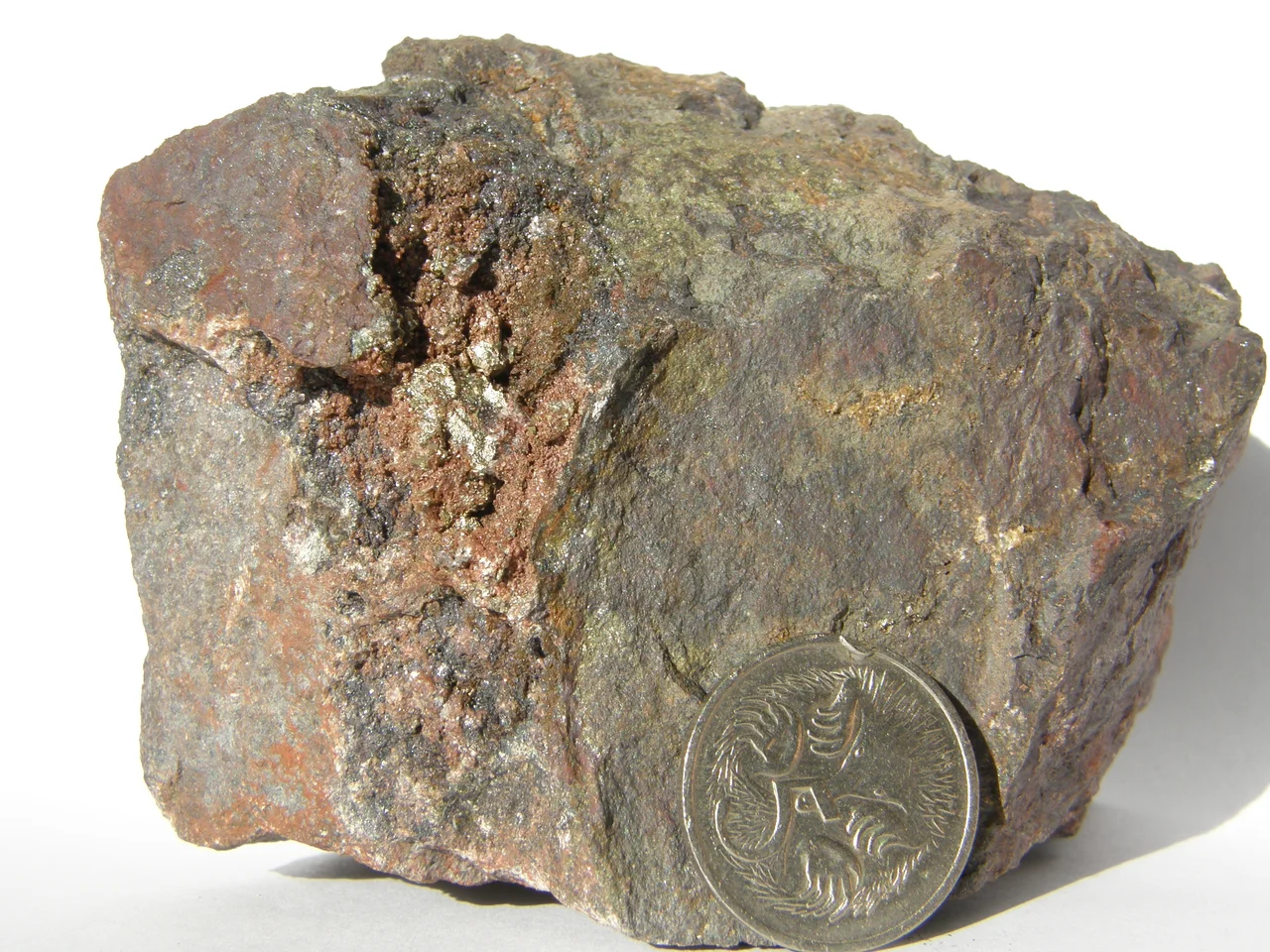

Prominent Hill mine
There is almost nothing to see. Drive the stony plains south-east of Coober Pedy and the land gives no hint of what lies beneath: a deposit of copper, gold and silver locked in iron-stained rock more than a hundred metres down, with no outcrop, no glint, nothing to betray it at the surface. Prominent Hill earned its name from a low rise on an otherwise featureless horizon, but the wealth here was invisible until geologists went looking for the kind of buried ore body that hides under blank ground. What they found turned a patch of empty outback into one of South Australia's most important mines.
Treasure in Iron-Stained Rock
Prominent Hill is an iron oxide copper gold deposit, the same broad geological family as the colossal Olympic Dam ore body about 130 km to the south-east. These deposits form where iron-rich fluids, surging up through the ancient crust of the Gawler Craton, leave copper and gold behind in vast haematite-stained masses. The resource here runs to more than 150 million tonnes of ore, grading around one per cent copper alongside gold and silver, plus a separate body of gold-rich rock. Unlike Olympic Dam, though, the uranium content stays low, never economical to recover. It is, in effect, Olympic Dam's quieter cousin: the same deep machinery of the earth, dialled to a different recipe.
From Open Pit to the Dark
The mine cost about 1.15 billion Australian dollars to build and went into production in February 2009, opened that May by the state premier. It began as a great open pit, but the richest ore lay deeper, and the operation followed it underground. The Malu mine drops vertically beneath the floor of the pit; the Ankata mine, opened in 2012, reaches a separate ore body about two kilometres to the west through a decline driven into the pit wall. Ankata takes its name from a word for dragon lizard in a local Aboriginal language, a small acknowledgement of whose country this is. Today the underground workings have largely replaced the open cut, chasing high-grade ore far below the desert floor.
Locked Inside a Forbidden Zone
Prominent Hill sits within the Woomera Prohibited Area, a vast tract of South Australian desert that doubles as one of the largest weapons-testing ranges on Earth. That setting once shaped the mine's fate dramatically. When its then-owner, Oz Minerals, sought to sell its assets to the Chinese state-controlled firm China Minmetals in 2009, the Australian government blocked the sale of this mine specifically, citing national security concerns over a foreign-owned operation inside a sensitive military zone. The rest of the company's assets changed hands; Prominent Hill was carved out and kept Australian. It was a rare moment when geopolitics reached down into a hole in the outback and changed who owned the rock.
A Long Haul to the Sea
Getting the metal out of this isolation is its own feat of logistics. Copper-gold concentrate is loaded into sealed containers and trucked roughly 120 km across the desert to a siding at Wirrida on the Adelaide-Darwin rail corridor, then railed south to Port Adelaide and onto ships bound for the world. A workforce of around 1,300 keeps the operation running, most of them flying in and out from a permanent village beside the pit, living for weeks at a time in the middle of nowhere. In 2023 the mine passed to BHP, the global resources giant, when it acquired Oz Minerals and folded Prominent Hill into a cluster of South Australian copper operations alongside Olympic Dam and the newer Carrapateena mine, part of a bet that this stretch of outback could anchor a copper province for decades to come. From a hill that barely rises above the plain, the copper that runs through the world's wiring and the gold that backs its vaults begins a journey of thousands of kilometres to reach the coast.
From the Air
Prominent Hill mine lies at approximately 29.72 degrees south, 135.58 degrees east, in far-north-west South Australia about 130 km south-east of Coober Pedy, within the Woomera Prohibited Area. From the air the mine is conspicuous against otherwise empty gibber plains: a large open pit, processing plant, tailings storage, an airstrip and an accommodation village, all isolated by tens of kilometres of bare desert. Note that the surrounding Woomera Prohibited Area is restricted military airspace; overflight requires clearance and is frequently constrained. The mine operates its own airstrip for fly-in fly-out workers; Coober Pedy Airport, ICAO YCBP, is the nearest public field to the north-west. Recommended viewing altitude is 5,000-8,000 ft AGL where airspace permits. Conditions are typically clear and very dry with strong afternoon heat haze and thermal turbulence; services are extremely limited.
Nearby Stories
- Stuart Range 41 km away
- Strangways Springs 65 km away
- Commonwealth Hill Station 83 km away
- Wilgena Station 84 km away
- Olympic Dam mine 89 km away
- Coober Pedy Solar Power Station 92 km away
- Tarcoola railway station 118 km away
- Marree Man 139 km away