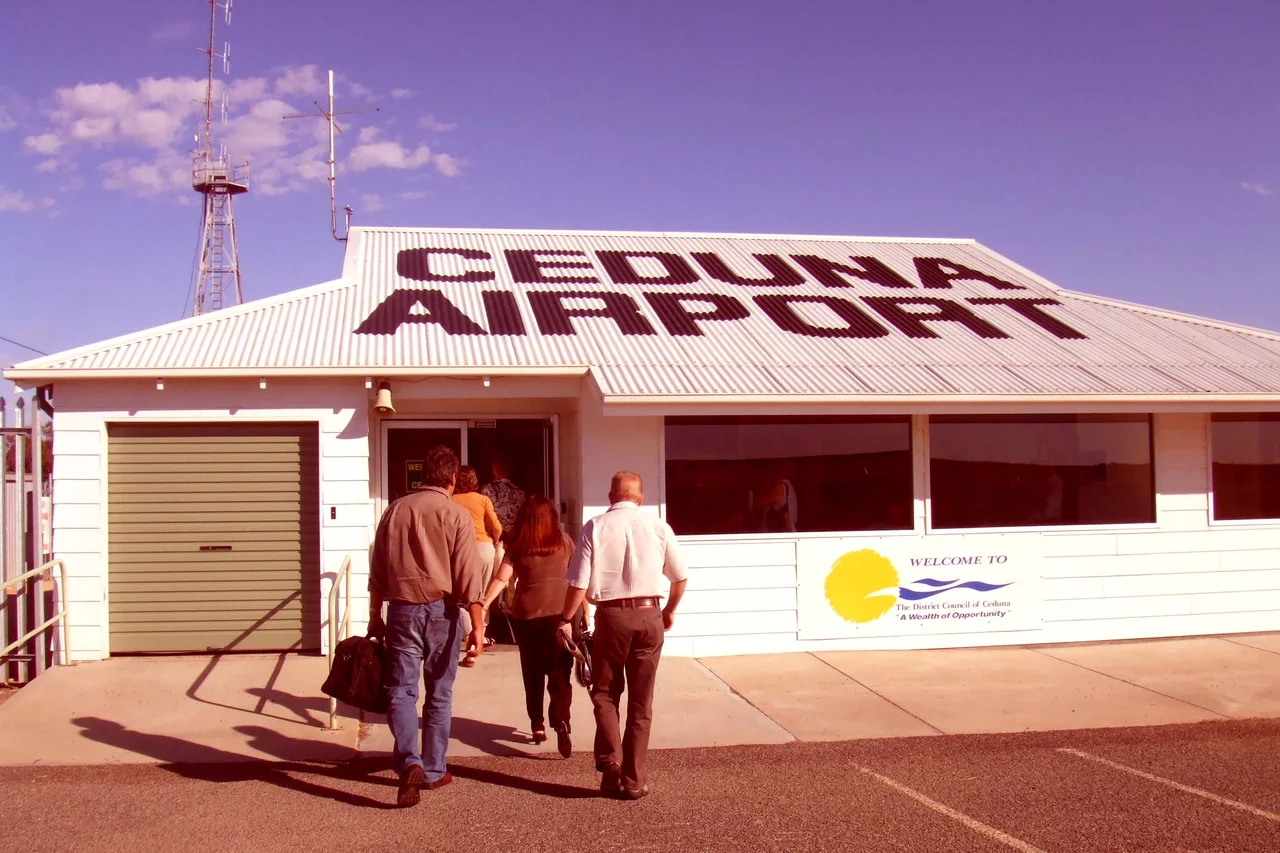

Ceduna Airport
Before there were roads worth the name across this country, there was the mail plane. In 1928, the Civil Aviation Branch carved an aerodrome out of the scrub two kilometres east of Ceduna, not for the town's sake but for the route - the new transcontinental airmail service stitching Adelaide to Perth across nearly two thousand kilometres of nothing. Ceduna was a place to come down, take on fuel, and climb back into the enormous sky. Almost a century later, it still is.
A Stop in the Long Hop
The early airmail and passenger services flown by West Australian Airways faced one merciless problem: distance. The leg between the eastern states and Western Australia ran across the Nullarbor and the empty Far West Coast, beyond the reach of any single tank of fuel. Ceduna became a link in that chain, an airfield whose whole purpose was to let the long hop continue. Pilots in open and early enclosed cockpits navigated by coastline, compass and nerve, and a place to land safely on the edge of the outback was not a convenience but a lifeline.
Six Names on a Roadside Stone
The airfield's most sombre chapter came in wartime. On 17 January 1942, a Lockheed Hudson of No. 14 Squadron, Royal Australian Air Force, crashed moments after taking off from Ceduna. It was one of four aircraft that had set down to refuel on the way to RAAF Base Pearce in Western Australia. All six men aboard were killed. A board of inquiry never publicly explained why the aircraft went down. They were young airmen far from home, lost not in battle but on a routine wartime ferry flight - and they were not forgotten. In 2006, a small memorial rose beside the Eyre Highway next to the airport, carrying the names of the six who died.
The Boy Who Flew Loops
Ceduna also gave aviation something joyful. On Christmas Day in 1938, the aerobatic pilot Chris Sperou was born in the town. He grew into one of the finest flyers Australia has produced - winner of the Australian Aerobatic Championship thirteen times and a competitor in five World Aerobatic Championships, famous for threading his biplane through manoeuvres most pilots would never attempt. There is a neat symmetry in it: a remote refuelling strip, built so aircraft could merely survive the crossing, turned out to be the birthplace of a man who made aeroplanes dance.
Still on the Schedule
The airfield never fell silent. In 2003, Rex Airlines brought Saab 340 turboprops onto the Adelaide-Ceduna run, replacing the smaller aircraft that had served before, and the regional link to the state capital held. For travellers, Ceduna remains what it always was - a small terminal where car rental must be booked ahead, the gateway to the western coast and the Nullarbor beyond. The runway that once kept the airmail moving now keeps a far-flung community connected, the same patch of cleared ground doing the same patient work it began in 1928.
From the Air
Ceduna Airport (ICAO YCDU) sits at approximately 32.13 degrees south, 133.71 degrees east, about 2 km east of Ceduna and immediately adjacent to the Eyre Highway. The field has served continuously since 1928 and is the principal regional airport for the Far West Coast, with Rex services to Adelaide. From the air it is easily identified by its position beside the highway and the nearby coastline of Murat Bay. Check current aeronautical charts for runway details and traffic patterns; the RAAF crash memorial stands beside the highway next to the field.
Nearby Stories
- Point Bell Conservation Park 16 km away
- St Francis Island 50 km away
- Poochera, South Australia 65 km away
- Nundroo, South Australia 97 km away
- Murphy's Haystacks 106 km away
- Wilgena Station 123 km away
- Tarcoola railway station 144 km away
- Great Australian Bight 312 km away