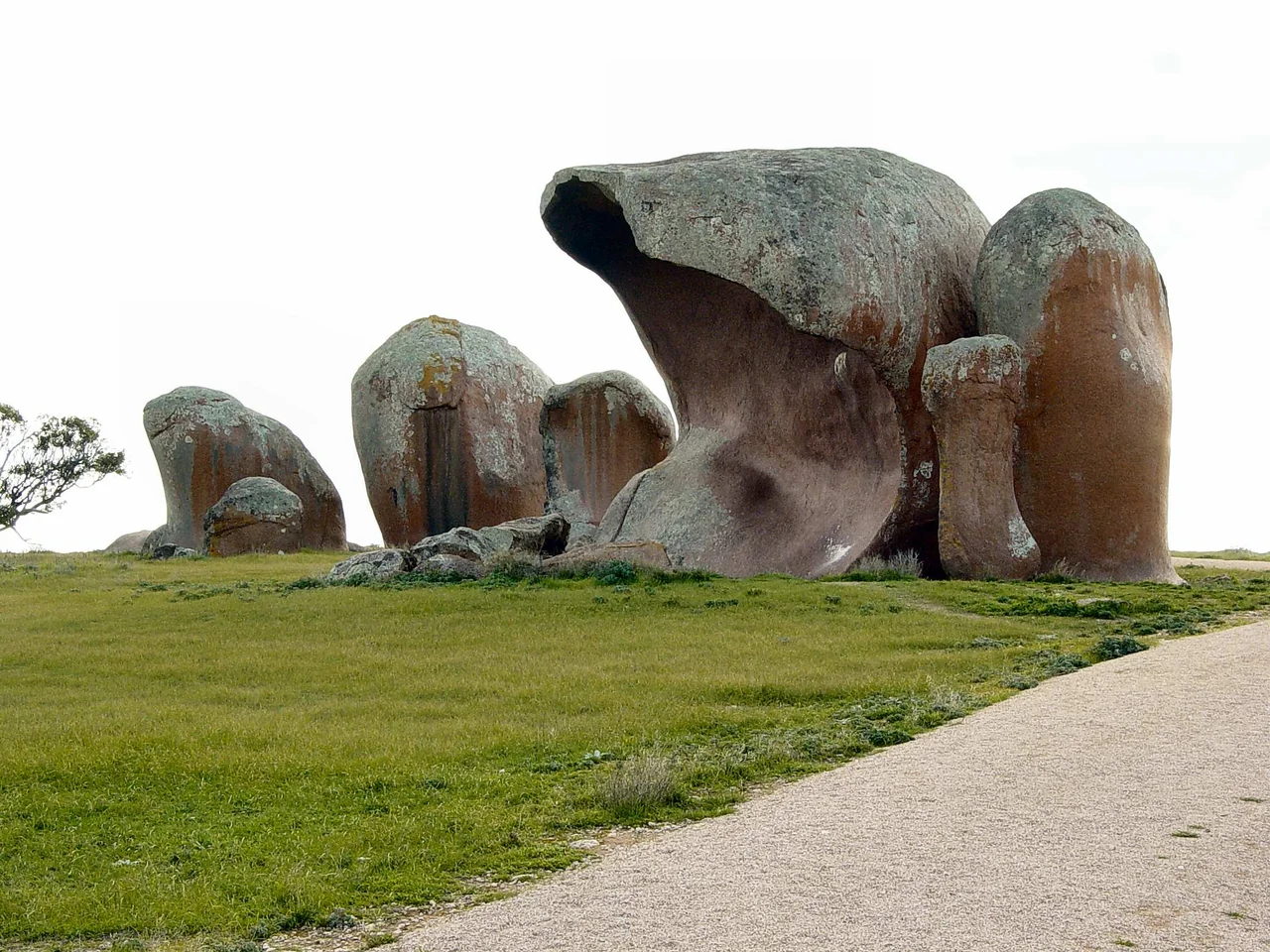

Murphy's Haystacks
A man rode past in a horse-drawn coach, glanced across the paddocks, and was impressed. Look at all that hay, he supposedly said - what a farmer, to grow so much. The pale, rounded shapes he saw standing in the distance were not haystacks at all. They were granite: a scatter of smooth pink boulders and pillars rising straight out of a wheat field, some of them taller than a house. The farm belonged to a man named Murphy, and the name the traveller's mistake gave them has stuck ever since. These are Murphy's Haystacks, on the Eyre Peninsula between Streaky Bay and Port Kenny, and they are one of the oldest things you will ever stand next to.
Older Than Almost Everything
The rock here is part of the Hiltaba Granite, and its age is genuinely difficult to hold in the mind: more than 1,500 million years. That is older than fish, older than land plants, older than nearly every living thing whose lineage walks or swims today. When this granite first crystallised, it did so kilometres underground, a deep mass of molten rock slowly cooling far below the surface. Everything you can now see and touch was once buried in the dark heart of the crust. Only across an almost unimaginable span of time did the softer rock above it wear away, lowering the land grain by grain until the hard granite core was finally exposed to sky and wind. What looks like a quirky roadside curiosity is in fact the deep basement of the continent, brought to the surface.
Carved by Water and Wind
Geologists call formations like these inselbergs - 'island mountains' that stand isolated above a worn-down plain - and the individual boulders are textbook tors. The pink colour comes from the minerals in the stone: mostly quartz and a feldspar called orthoclase, coarsely crystalline and flecked with light. Their strange rounded shapes tell a two-stage story. While still underground, the granite was attacked along its natural cracks and joints by water seeping through the soil, which rotted the rock fastest at its edges and corners. When erosion finally stripped away the surrounding material and exposed the stone, wind and weather took over, smoothing and undercutting the survivors. The result is a sculpture garden of overhangs, balanced caps and flowing curves - one dome rises roughly eight metres, leaning out over its own base.
A Working Farm and a Heritage Site
Unusually for a natural wonder, Murphy's Haystacks sits on private farmland near the locality of Mortana, and the family who own the land have long welcomed visitors for a small fee dropped in an honesty box. That arrangement gives the place an intimacy that a fenced-off national park rarely has: you walk out among the stones across working country, sheep and crops on every side, the Southern Ocean glittering in the distance. The site is listed on the South Australian Heritage Register, recognition both of its geological importance and of the role it has come to play as one of the Eyre Peninsula's best-loved landmarks. Late afternoon is the time to come, when low sun turns the granite from grey-pink to deep rose and the long shadows make the boulders look even more like a giant's forgotten harvest.
From the Air
Murphy's Haystacks stand at about 33.02 degrees south, 134.49 degrees east, inland on the Eyre Peninsula near Mortana, between Streaky Bay to the northwest and Port Kenny to the southeast. From the air they appear as a tight cluster of pale boulders and pillars set incongruously in flat, cultivated farmland a short distance back from the coast of the Great Australian Bight - small but distinctive against the surrounding tan paddocks. The nearest airfield is Streaky Bay Airport (YSKY) to the northwest, serving general aviation; the closest commercial options are Ceduna Airport (YCDU) and Port Lincoln Airport (YPLC). The granite shows best in low, raking light early and late in the day, when the pink stone and long shadows stand out sharply from above.
Nearby Stories
- Talia Station 39 km away
- Nuyts Archipelago 51 km away
- St Francis Island 79 km away
- Acraman Impact Structure 87 km away
- Ceduna Airport 95 km away
- Port Augusta 264 km away
- Baudin expedition to Australia 321 km away
- Israelite Bay 935 km away