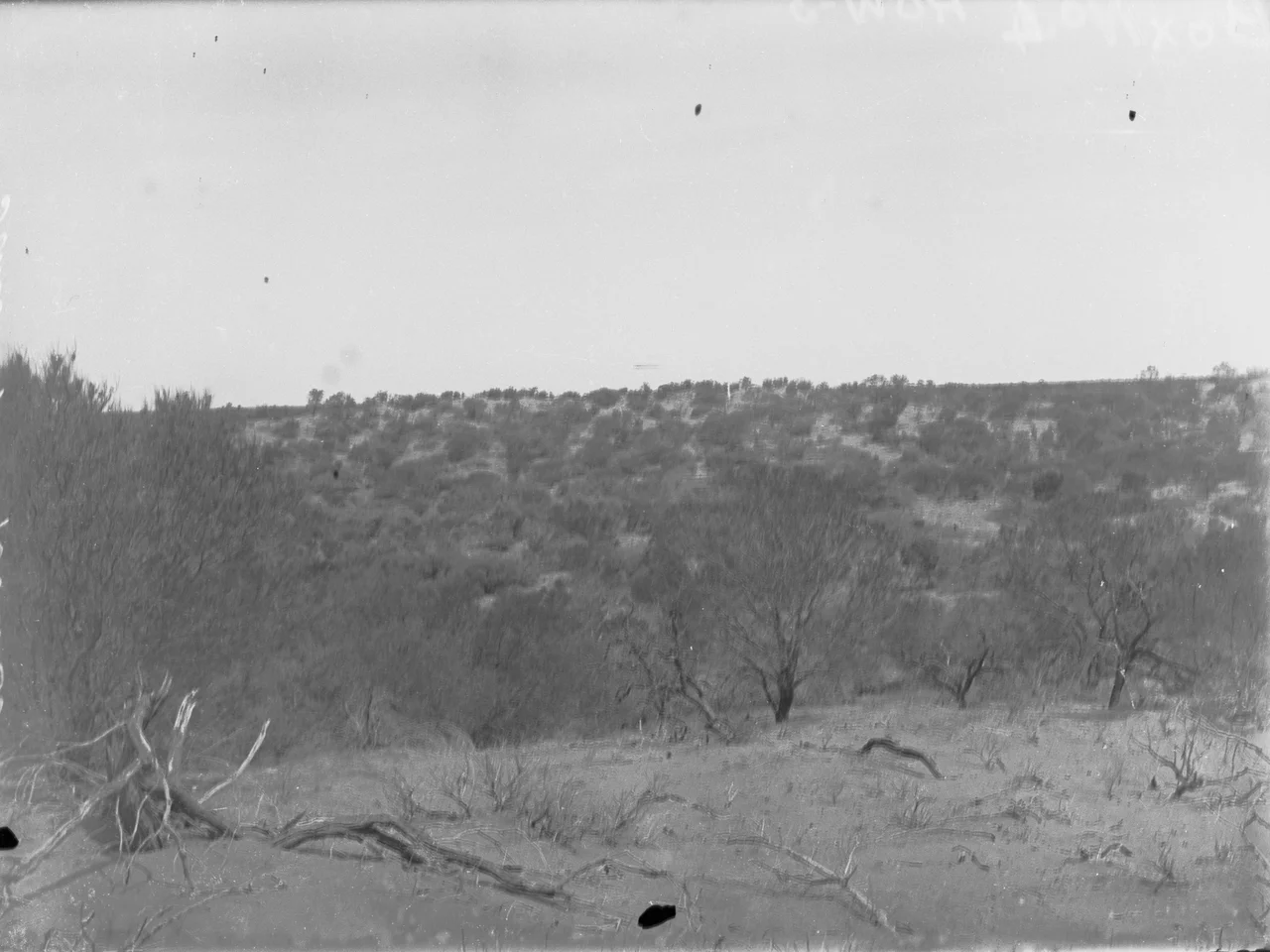

Ooldea, South Australia
For longer than anyone can count, there was water in this dry country where there should have been none. Beneath the red dunes on the eastern edge of the Nullarbor, rain that fell across a vast catchment gathered and held in the sand, and the Anangu of the Western Desert knew exactly where to find it. They called it Yooldil Kapi - the soak at Yuldea - and it was no ordinary waterhole. It was a permanent source in a place with almost no permanent water, which made it a meeting place, a ceremonial place, a hub where trading routes and Dreaming tracks crossed and people came together from across the desert. To reach Yuldea was to reach abundance in the middle of scarcity. The whole map of life out here bent toward this one soak in the dunes.
Yooldil Kapi
The Anangu had drawn on this water for countless generations, and around it they sustained a way of living attuned to one of the driest landscapes on Earth - ranging the desert, reading the country, returning to the soak. The first European to reach it, the explorer Ernest Giles in 1875, was simply led to water that desert people had always known. For the Anangu, Yuldea was not a stop on a journey but a centre: a place where families gathered, where ceremony was held, where the knowledge of the desert was carried and passed on. It had been that for thousands of years before any outsider wrote its name down. That depth of belonging is the thing to hold onto in everything that follows.
The Railway Takes the Water
Then the line came. On 17 October 1917, the two halves of the Trans-Australian Railway met at Ooldea, joining the country coast to coast - and the reason the railway came here at all was the water. Construction camps drew on the soak; later, steam locomotives crossing the Nullarbor were fed from it. In the early 1940s the demand grew heavier still, and the aquifer could not keep pace. The soak that had held for millennia was pumped dry within a few decades. A severe drought in this same era drove more desert people in toward the water just as the trains were claiming it, concentrating people and need at the very place where the supply was failing. The taking of Yuldea's water was, in the most literal sense, the taking of the centre of a world.
The Mission Years
In 1933 the United Aborigines Mission arrived; the missionary Annie Lock and a companion set up the Ooldea Mission a few miles from the railway siding, and it ran until 1952. For sixteen years from 1919, the eccentric Irish-Australian Daisy Bates kept her own camp nearby, feeding and clothing the people who came in from the desert, treating the sick, and recording their language and customs - work shaped by the assumptions of her era, though the Anangu gave her the name Kabbarli, grandmother. The anthropologist Norman Tindale also came to document the people here. These outsiders meant to help, observe or convert, but the deeper current was loss: a self-reliant desert people increasingly drawn off their country and made dependent at a single, failing point.
Dispersed from Country
What came next was harder still. In the 1950s the British and Australian governments turned the land north of here into proving grounds - nuclear tests at Maralinga and Emu Field, and the Woomera rocket range - and resumed huge tracts of Anangu country for the purpose. When the Ooldea Mission closed in 1952, split apart by a dispute inside the church, the people were moved south to a former sheep station at Yalata. They did not want to go. They were desert people, used to ranging their own country, and Yalata was an alien place near the coast - and the desert they came from was now locked inside a weapons zone they could not return to. Among them were the Pila Nguru, the Spinifex people of the Great Victoria Desert, cut off from the lands they had always known.
Handed Back
Yooldil Kapi was returned to the Anangu in 1991, and the site is now closed to the public - held by the people whose connection to it never ended, dry though the soak now is. The story did not stay buried. In 2023 the Bangarra Dance Theatre staged Yuldea, choreographed by the company's artistic director, the Wirangu and Mirning woman Frances Rings, telling the colonisation of this country from an Aboriginal perspective and carrying the memory of the soak to stages far from the desert. Ooldea today is a tiny dot on the railway, 863 kilometres west of Port Augusta. But its real meaning lies under the dunes, in the place where water once gathered and a people gathered with it - and in the descendants who remember, and are still telling it.
From the Air
Ooldea lies at 30.45°S, 131.83°E, on the eastern edge of the Nullarbor Plain along the Trans-Australian Railway, 863 km west of Port Augusta and 143 km north of the Eyre Highway. From the air the railway line is the only clear feature - the siding sits where the track crosses red dune country at the desert's edge, with the open Nullarbor stretching west and the Great Victoria Desert dunes to the north. The Maralinga Tjarutja lands and former testing areas lie north; please note the site itself is Aboriginal land, closed to the public, and should be regarded with respect. Nearest sealed airfield is Ceduna (ICAO YCDU) roughly 200 km south; the remote railway strip at Cook lies west along the line. Recommended altitude 3,000-5,000 ft. Visibility is generally excellent, though dust haze can rise over the dunes on windy days.
Nearby Stories
- British Nuclear Tests at Maralinga 8.6 km away
- Jacinth-Ambrosia Mine 16 km away
- Nullarbor Regional Reserve 57 km away
- Great Australian Bight Marine Park Whale Sanctuary 94 km away
- Murrawijinie Cave 100 km away
- Oak Valley, South Australia 100 km away
- Challenger mine 140 km away
- Nundroo, South Australia 143 km away