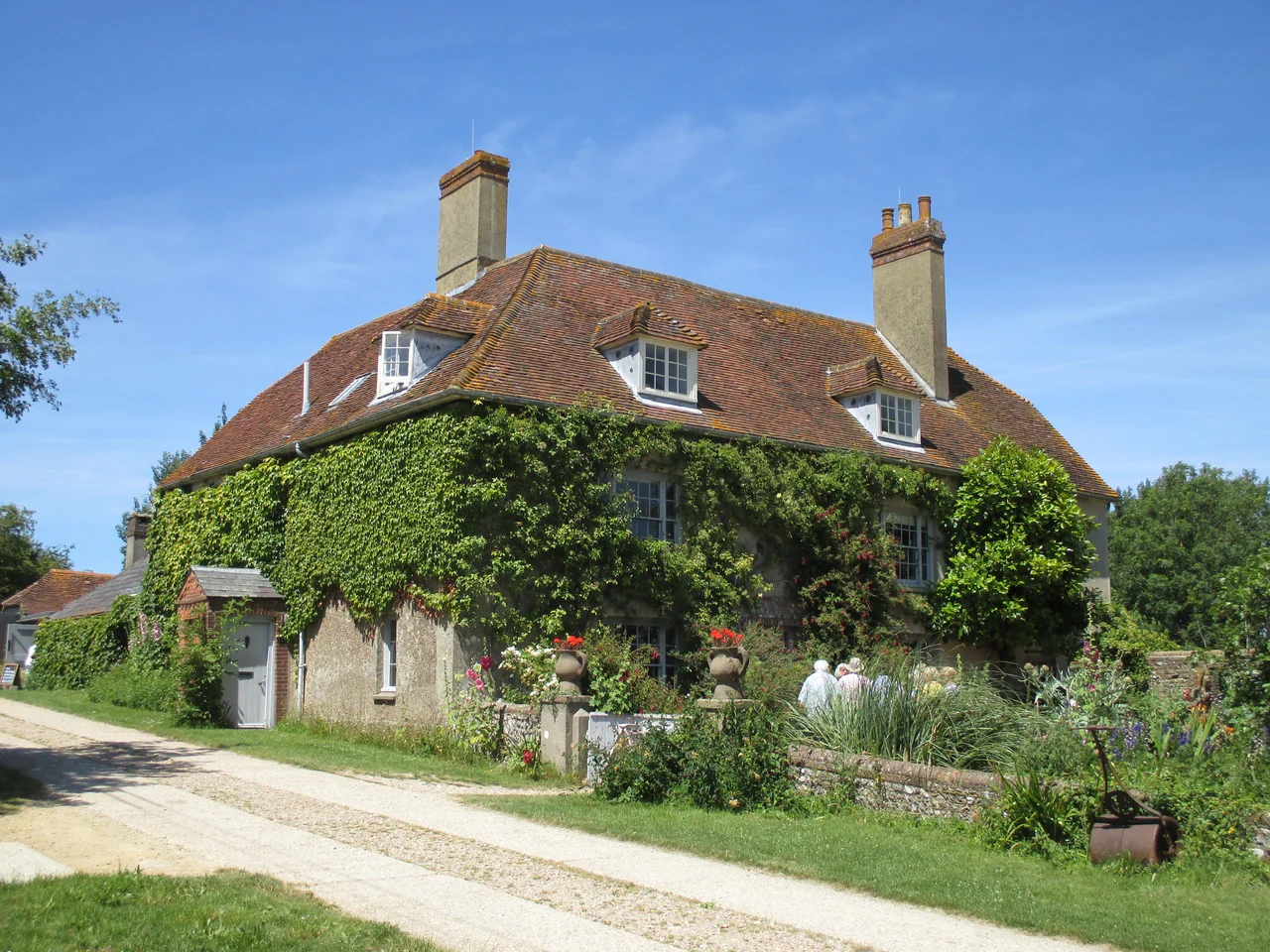

Charleston Farmhouse
Everything is painted. The fireplaces are painted. The doors are painted. The plates on the dining table are painted. The wardrobe in the spare bedroom is painted with two figures emerging from a sleeve of cobalt. In 1916, the painters Vanessa Bell and Duncan Grant moved into a Sussex farmhouse below the South Downs, and over the next half-century they and their friends - the constellation of writers and artists and economists known as the Bloomsbury Group - decorated it the way other people grow gardens. Charleston was their country house, their workshop, their refuge, and during two world wars their reason to be out of London. It is now open to the public and you can stand in their dining room, where Virginia Woolf and Maynard Keynes and E M Forster argued politics over Vanessa's painted plates, and find the house almost exactly as the painters left it.
An Unconventional Household
Vanessa Bell - older sister of Virginia Woolf, painter, and the visual centre of the Bloomsbury Group - was thirty-seven when she moved to Charleston in October 1916. With her came Duncan Grant, her lover and lifelong artistic collaborator; David Garnett, who was Grant's then-lover and would later marry Vanessa's daughter Angelica; her two young sons Julian and Quentin by her estranged husband Clive Bell; and a small staff. The trigger for the move was the First World War. Grant and Garnett were conscientious objectors. Under the terms of their exemption from military service, they were required to do agricultural work. The nearest farm willing to employ them was at Charleston, and the unconventional household followed. The structure of who was sleeping with whom, who was the parent of which child, and who was visiting for the weekend would become legendary in the next decade - and the source of more biographical scrutiny than perhaps any other house in twentieth-century English literature - but the founding logic was simple. A war and the law had forced two pacifist painters to milk cows in Sussex. Vanessa came with them. They stayed for the rest of their lives.
The Decorated House
What Bell and Grant did to Charleston - and what their friend the painter Roger Fry encouraged them to keep doing - was treat the whole interior as a single, ongoing decorative project. The walls became surfaces for figurative panels. The doors got allegorical compositions. The fireplaces were painted in Post-Impressionist colour fields with looping figures. They painted furniture they bought cheap and furniture they were given; they painted plates and lampshades and book covers and the tin trays meals were carried on. Some of the work was casual - quick studio improvisation done in an afternoon. Some was carefully composed. Almost none of it was done in pursuit of a saleable commission; it was domestic decoration as continuous artistic practice. Roger Fry had founded the Omega Workshops in London in 1913 partly to bring this Post-Impressionist sensibility to interior design, and although Omega closed in 1919 the project continued at Charleston for fifty more years. Vanessa Bell died at Charleston in 1961, Duncan Grant in 1978, having lived in the house, on and off, for the better part of six decades.
Who Came to Dinner
The visitors' book at Charleston reads like a register of early twentieth-century English intellectual life. Maynard Keynes - economist, future architect of the Bretton Woods system, then making his name as a critic of the Versailles peace settlement - lived at Charleston for considerable periods, taking a corner of the house as his country retreat. Clive Bell, Vanessa's husband, kept his own room there throughout the marriage's lengthy informal separation. Virginia and Leonard Woolf were frequent visitors from their own Sussex base at Monk's House in Rodmell, twelve miles away. E M Forster came. Lytton Strachey, the biographer whose *Eminent Victorians* in 1918 reshaped how the British saw their own nineteenth century, was a regular. Roger Fry stayed often until his death in 1934. The conversations recorded in fragments by all of them - in letters, in Virginia's diaries, in Quentin Bell's later memoirs - turned the Charleston dining room into one of the most consequential rooms of its era. They argued about war, about empire, about Victorian sexual morality, about what painting was for, and they argued at length. Keynes, sitting at the end of the table over coffee, in some real sense thought his way to *The Economic Consequences of the Peace* in this house.
Charleston as Charity
Duncan Grant outlived almost everyone. When he died in 1978 at the age of ninety-three, the question of what to do with Charleston became urgent. The interior was decoratively unique and structurally fragile - sixty years of casual painting on cheap plaster walls in a Sussex farmhouse with no central heating. A charity, the Charleston Trust, was set up in 1980 to restore and maintain the house for the public, and the work of stabilising plaster, conserving paintwork without scrubbing away the patina of decades, and rebuilding the artists' garden took six years. The house opened to the public in 1986 and has been open ever since. In September 2018 a suite of new exhibition galleries designed by Jamie Fobert Architects opened in restored barns alongside the farmhouse, along with the Threshing Barn café, the Hay Barn for events and workshops, and a permanent display of Bell and Grant's *Famous Women Dinner Service* - a set of fifty plates they painted in 1932-1934 with portraits of historical women from Sappho to Greta Garbo, a project that was its own quiet feminist commentary fifty years ahead of its moment.
The Festival and the Garden
Each May the Charleston Festival brings writers, artists, thinkers and politicians to discuss exactly the kinds of subjects that filled the dining room a hundred years ago - art, literature, ideas, the political moment. The house is in Firle, a small village in the Lewes District of East Sussex, sitting under the steep north scarp of the South Downs with views across to the long whaleback ridge of Mount Caburn. During COVID-19 the trust nearly went under: it receives no annual public funding and relies on ticket sales, the café and shop, and donations. An emergency appeal in 2020 and a Historic England grant in late 2021 kept it open. The associated controversy in 2021 - when £240,542 of Getting Building Fund money went to resurface a private access road owned by Viscount Gage, the major local landowner - reminded everyone that Charleston, however bohemian its interior, sits in a corner of Sussex where the older social geography of estate, tenant and dependent is still very much present. Inside the painted house, that conversation continues, exactly as Vanessa Bell would have wanted it to.
From the Air
Coordinates 50.8427 N, 0.1155 E, in the village of Firle in the Lewes District of East Sussex. The house sits beneath the north scarp of the South Downs, about 4 miles east of Lewes and 8 miles northwest of Eastbourne. Nearest airports: Brighton City Shoreham (EGKA) 13 nautical miles west, Lydd (EGMD) 24 nautical miles east-northeast, London Gatwick (EGKK) 26 nautical miles north-northwest. Recommended viewing altitude 1,500 to 3,000 feet AGL - the farmhouse sits in a small cluster of buildings on the lower ground south of the A27, with the long whaleback ridge of the South Downs rising sharply south of the village. Mount Caburn (146 metres) is the distinctive isolated chalk dome to the west.
Nearby Stories
- Chiddingstone Castle 4.4 km away
- Kent 4.6 km away
- Camber Castle 5.4 km away
- Surrey 13 km away
- Amberley Museum & Heritage Centre 13 km away
- Swanage Lifeboat Station 113 km away
- Le Paradis Massacre 137 km away
- Wellington Clock Tower 150 km away