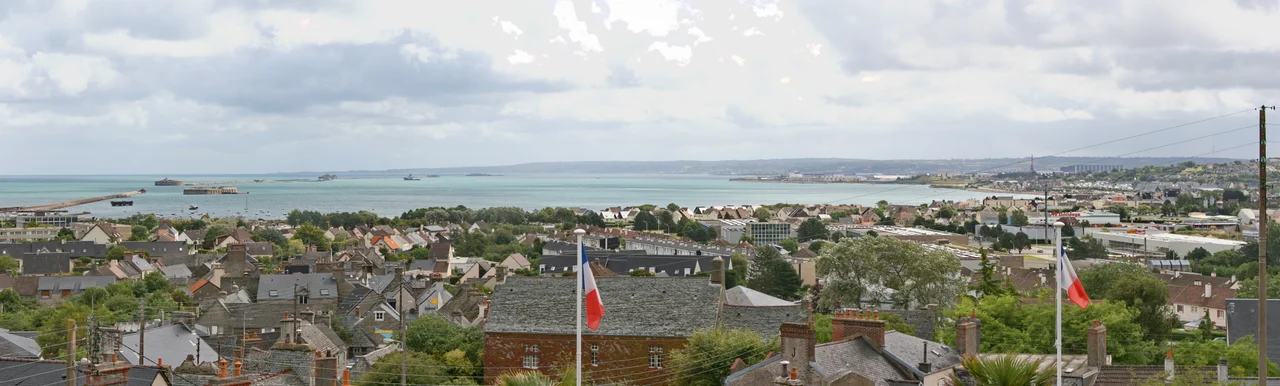

Cherbourg Harbour
Look down at Cherbourg from the air and the first thing that registers is not the city but the great curved line scratched across the Channel four kilometres offshore - the central breakwater, 3.64 kilometres long, dropped into the sea by hand over seven decades. Three kings began it, two emperors finished it, and a republic added the walls. The result is the second largest artificial harbour on Earth: 1,500 hectares of enclosed water, enough room for an entire navy, and the work of more than a hundred and thirty years.
The 5th-Century Beginning
Cherbourg's military story began long before the breakwater. Its castle dated to the 5th century, protecting the narrow neck of the Cotentin Peninsula from invasions out of the Channel. In the 17th century, the great fortification engineer Vauban - Marshal of France under Louis XIV - drew up plans to wall the town in stone. The plans were carried out and then almost immediately razed in the diplomatic shuffle that followed. The harbour's weakness was made spectacularly clear in 1692, when three of the most damaged French warships - the Soleil Royal, the Admirable, the Triomphant - ran for shelter at Cherbourg after the Battle of Barfleur. There was no proper haven for them. They were beached on the strand outside the town. English fireships went in and burned them where they lay. The Sun King's flagship died on a French beach because Cherbourg had no harbour worth the name.
Louis XVI's Commission
In 1776, Louis XVI set up a commission to pick a great strategic port for the defence of the English Channel. The candidates were Cherbourg, Ambleteuse and Boulogne. The commission included Suffren, Dumouriez (who would later govern Cherbourg), and an engineer named La Bretonnière who argued that only Cherbourg had a roadstead capable of holding 80 warships at once. He proposed a four-kilometre breakwater between île Pelée and the pointe de Querqueville - a structure larger than anything Vauban had imagined. Construction began in 1783 under a design by Louis-Alexandre de Cessart, which involved sinking 90 enormous wooden cones, each 20 metres on a side, filled with stones and linked by iron chains. The first cone was laid on 6 June 1784, and between three and four hundred boats ferried stone from the small port of Becquet to dump against the cones. On 22 June 1786 Louis XVI - who almost never left Paris and Versailles - made the journey to inspect the work and personally helped sink the ninth stone section. He would die on the guillotine seven years later. The cones did not fare much better; the first ones were ground apart by Channel storms.
Napoleon Finishes What Kings Began
Cessart's design was scrapped in 1788, and the project drifted through the upheavals of the French Revolution. Funding evaporated. La Bretonnière resigned in 1792. Work stopped completely between 1792 and 1802. Then Napoleon arrived. Planning an invasion of England, the emperor needed a great Atlantic port and ordered the harbour resumed - building up the central breakwater high enough to mount cannon. A decree of 1803 ordered the engineer Joseph Cachin to excavate a military outer harbour, which was opened on 27 August 1813 in the presence of the empress Marie-Louise. The arsenal was begun. British attacks were beaten off in 1803. Work stopped again between 1813 and 1832 with the empire's fall, then resumed under Napoleon III, who watched the central breakwater finally completed in 1853. He and his empress inaugurated the Napoleon III basin in the naval base on 7 August 1858. The eastern and western harbour walls were completed in 1895. The Petite Rade - the inner harbour - was walled in between 1899 and 1922. From the laying of the first cone to the last stone, the work spanned 138 years.
Titanic's Last European Port
On 10 April 1912, in the early evening of her maiden voyage, RMS Titanic crossed from Southampton and dropped anchor in Cherbourg's outer harbour. She was too large to come alongside the quay. Two purpose-built tenders, SS Traffic and SS Nomadic, ferried 274 passengers out to her - including John Jacob Astor IV and his pregnant young wife Madeline Astor. Many of those who boarded at Cherbourg were emigrants travelling in third class, French and Lebanese and Syrian families bound for new lives in America. Titanic stayed at Cherbourg only ninety minutes. She raised anchor and sailed for Queenstown in Ireland, then on into the North Atlantic. Five days later she hit an iceberg and broke apart in the cold dark, taking more than 1,500 lives down with her. The SS Nomadic that had ferried Cherbourg's passengers out to the great liner still survives - she is now preserved as a museum in Belfast, in the very shipyard where the Titanic was built. The pier where they boarded is still here, in the lee of the great breakwater.
What the Wall Survived
The breakwaters held through the world wars. In 1944, retreating German engineers under Rear Admiral Walter Hennecke wrecked the inner harbour with calculated thoroughness - quays dynamited, cranes toppled, mines sown across the basin floor - but the breakwaters themselves were too vast to destroy with the explosives available. The central digue still stood, and still does. Today the harbour serves ferries from Portsmouth, Poole and Rosslare; submarines and frigates of the French Navy; the cruise terminal that opened in 2006; and yachts that ride at anchor inside the great calm water the kings and emperors built. From up on the hill at the Fort du Roule, you can see all 1,500 hectares of it at once - a sea bent into the shape humans wanted it to take, with the smaller real sea pressing against the outside of the wall.
From the Air
Cherbourg Harbour spans the coast from 49.65°N, 1.62°W on the north shore of the Cotentin Peninsula. The defining feature from cruise altitude is the central breakwater (digue centrale), 3.64 km long and sited 4 km offshore, running parallel to the coast. The eastern entry is 950 m wide, the western entry 2.3 km wide. Three forts (Fort de l'Est, Fort Central, Fort de l'Ouest) sit on the central wall. Maximum depth at low tide is 13 m. Nearest airports: Cherbourg–Maupertus (LFRC) 11 km east, Caen–Carpiquet (LFRK) 90 km southeast. Best viewed at 3,000-6,000 feet AGL to take in the whole harbour structure. Expect Channel haze in mornings.
Nearby Stories
- Abbey of Saint-Sauveur-le-Vicomte 4.3 km away
- Alderney Society Museum 9.3 km away
- Channel Islands 18 km away
- Operation Donnerkeil 31 km away
- German Submarine U-672 31 km away
- D-Day: The Longest Day 59 km away
- Fishbourne Roman Palace 103 km away
- Basilica of Sainte-Therese, Lisieux 110 km away