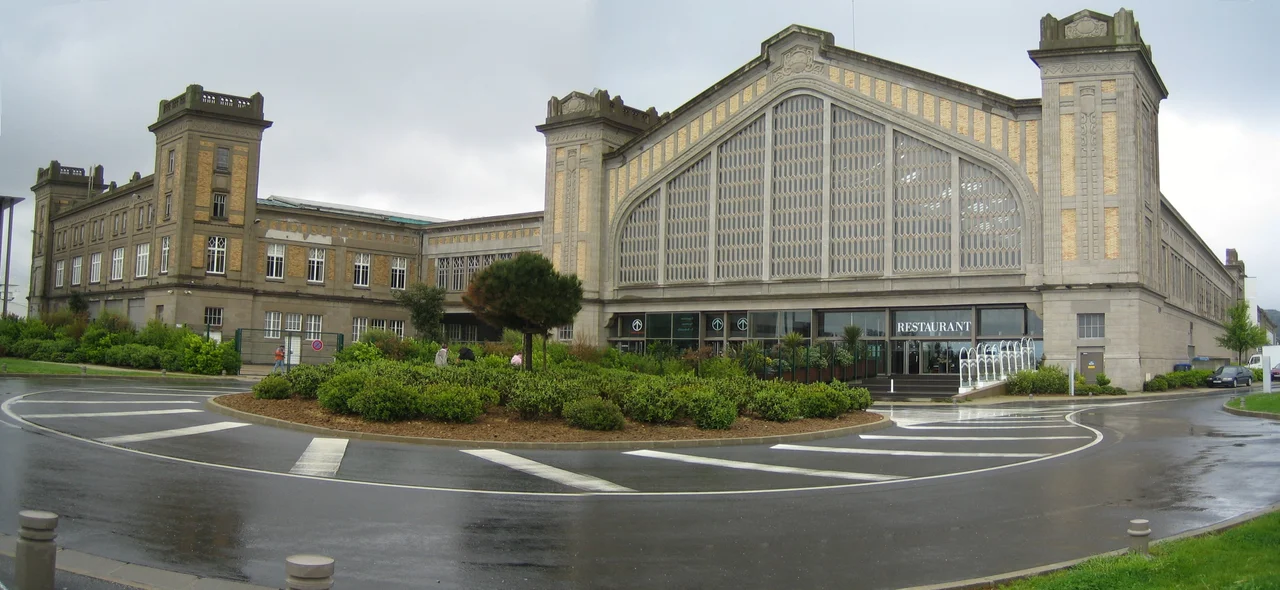

Cherbourg Maritime Station
On the evening of 10 April 1912, 274 passengers walked across a Cherbourg quay carrying their luggage and their hopes, and boarded two small tenders called SS Nomadic and SS Traffic. The tenders steamed out into the harbour and pulled alongside a black-and-white wall of steel - the largest ship ever built - and the passengers climbed up into the RMS Titanic for the only voyage she would ever make. They had walked through the original Cherbourg Maritime Station, a wooden building long since gone. Two decades later France would build something extraordinary in its place: the second largest building in the country after the Palace of Versailles, designed for the age when the great ocean liners still ruled the Atlantic.
The Last Days of the Liner
By the early 1930s, the major French shipping lines - CGT (Compagnie Générale Transatlantique) above all - were operating leviathans. SS Île de France, SS Paris, the soon-to-launch Normandie were the floating equivalents of grand hotels. To service them, France replaced Cherbourg's old wooden quay station with a structure suited to the new scale. The architect René Levavasseur designed a building 240 metres long and 93 metres wide, with thirty-four concrete arches supporting a copper and glass roof. A 70-metre clock tower rose above it. The completed station covered two hectares. At its inauguration on 30 July 1933, attended by Albert Lebrun - President of the French Republic - it was the second-largest building in France, second only to Versailles. The Gare Maritime had nine passenger footbridges leading directly onto ocean liners. Two ships could berth alongside simultaneously and empty a thousand passengers into the station in an hour. On the railway side, up to seven trains a day connected Paris Saint-Lazare in three and a half hours.
Steamer Trunks and Emigrants
In its first six years the Maritime Station handled the great pre-war traffic - the wealthy crossing the Atlantic in first-class suites with steamer trunks, the middle classes in second class, the third-class emigrants travelling the cheapest passage from old Europe to new lives in America and Canada. The building was deliberately scaled to handle them all. The transatlantique hall contained passenger concourses, a post office, the booking offices of every major shipping company. A 500-metre covered gallery ran along the hall for embarkment and disembarkment, sheltering crowds from the Norman rain. The clock tower was high enough to be seen from any approaching ship. Then the war came. The Gare Maritime saw intense activity through the early years of the German occupation, and was partially destroyed in 1944 during the Battle of Cherbourg - the very building that had welcomed peace-time travellers from America was now caught between American shells and German demolition charges.
Twilight of the Crossings
It survived. Rebuilt after 1945, the Maritime Station entered its second golden age in the 1950s and 1960s, when the great post-war liners - Liberté, France, the United States, the Queen Mary - still called at Cherbourg on the New York run. Hollywood stars came through. Honeymooners sailed for America. Cherbourg's Place Général-de-Gaulle filled with tearful farewells when the boat trains pulled out for Paris. But airliners were coming. By the early 1970s, transatlantic passenger shipping had collapsed - flights from Paris to New York took eight hours, the France herself was decommissioned in 1974, and the great liners stopped coming to Cherbourg. The station persisted with diminishing traffic through the 1970s and 1980s. In December 1989 the French government listed the buildings as historic monuments. They were the last surviving example of 1930s maritime architecture in Cherbourg. The station closed in the 1990s.
Resurrection as the Cité de la Mer
An empty building this size would have been a tragedy. In 1996 the city of Cherbourg launched an architectural competition for proposals to convert the Maritime Station into a museum of the sea. A design respectful of the original building was selected in 1997. Work began in 1999. La Cité de la Mer - the City of the Sea - opened in 2002 inside the great hall, occupying Levavasseur's concrete arches and copper roof in a way that honoured the original architecture. The centerpiece is Le Redoutable, France's first nuclear ballistic missile submarine, decommissioned and now permanently dry-docked beside the station. Visitors can climb aboard her, walk through the missile bay and the officers' wardroom, and feel what 19-year-old conscript sailors felt during long Cold War patrols. The museum also tells the story of deep-sea exploration, of the Titanic (with one gallery devoted to the disaster), of the shipwrecks that litter the Channel and the Atlantic. In 2006 a separate cruise terminal opened in the harbour nearby for the new generation of cruise ships.
Walking Where Astor Walked
Stand inside the central hall of the Cité de la Mer on a quiet weekday morning, and the dimensions still impress. The concrete arches march away into a soft greenish light from the copper-and-glass roof. The clock tower outside is still keeping time. It is easy to imagine the place full - the smell of damp wool overcoats, the steam from the boat trains, the announcer calling for the Île de France, the porters wheeling carts of luggage toward the footbridges. The 274 Titanic passengers passed this way in 1912 through an older building. But the modern Cité de la Mer keeps their memory close: in the Titanic gallery, you can read passenger lists, see the wireless equipment, look at the small personal items recovered from the seabed. Most of those who boarded at Cherbourg were emigrants in third class. They died strangers to one another in the dark Atlantic. The Maritime Station remembers them in a building they never lived to see.
From the Air
The Maritime Station (now Cité de la Mer) sits on the south shore of Cherbourg's inner harbour at 49.65°N, 1.62°W. From the air it appears as a long rectangular building with a distinctive arched roof and a tall clock tower at one end, separated from the main quay by the inner harbour basin. Le Redoutable submarine is parked alongside as an open-air exhibit. Nearest airports: Cherbourg–Maupertus (LFRC) 11 km east, Caen–Carpiquet (LFRK) 90 km southeast. Best viewed at 2,000-4,000 feet AGL. Expect Channel haze in mornings.
Nearby Stories
- Abbey of Saint-Sauveur-le-Vicomte 4.3 km away
- Alderney Society Museum 9.3 km away
- Channel Islands 18 km away
- Operation Donnerkeil 31 km away
- German Submarine U-672 31 km away
- D-Day: The Longest Day 59 km away
- Fishbourne Roman Palace 103 km away
- Basilica of Sainte-Therese, Lisieux 110 km away