
Cherbourg Naval Base
The engineers had a problem with the sea. Cherbourg sat on the wrong side of the Cotentin Peninsula, exposed to Channel weather, with a shallow roadstead that could not shelter a fleet. So in the 1780s, Louis XVI ordered them to build a coastline where none existed. They poured ninety wooden cones, each fifty meters across at the base and twenty meters tall, weighted with stones and sunk into open water to anchor a breakwater two thousand toises long. The king himself attended one of the sinkings. Storms broke the cones apart. The engineers tried again, in stone this time, and kept trying for the better part of a century.
A Coast Made by Hand
Cherbourg had been a stronghold since Roman times, one of the strongest fortresses of the Hundred Years' War, but it had never been a real port. The marshal Vauban drew up the first ambitious plans in the seventeenth century, sketching an artificial harbor and a quadrupling of the city, and they were filed away. Louis XV revived them briefly, then let them lapse. The British raid of 1758 wrecked what little had been built. Only after France joined the American Revolution did Louis XVI insist on a Channel base to rival Brest. The naval officer Louis de La Couldre de La Bretonniere proposed a jetty between the tip of Querqueville and the reefs of Ile Pelee, with a harbor dredged to twenty meters. The engineer Louis-Alexandre de Cessart won the contract with the cone scheme, the Revolution interrupted the work, and Napoleon resumed it as a launching pad for invading England. The breakwater was finally completed in 1853, seventy years after the first cone went down.
The Backbone of the City
Empress Marie-Louise opened the avant-port on 27 August 1813. The Charles X basin, 420 meters long and 18 meters deep, was inaugurated in 1829 in the presence of the Dauphin. The Napoleon III basin followed in 1858, opened by the emperor himself with Empress Eugenie at his side. By the end of the nineteenth century, four thousand workers from all over France lived around the arsenal, and the locals called it the backbone of the city. The Channel was no longer the front line against Britain, and the harbor that had been engineered for war became one of the great transatlantic stops, linking northern Europe to the eastern seaboard of the Americas. The ocean liners called here, drawn by the deep water that no natural harbor in Normandy could offer.
Norman Dunkirk
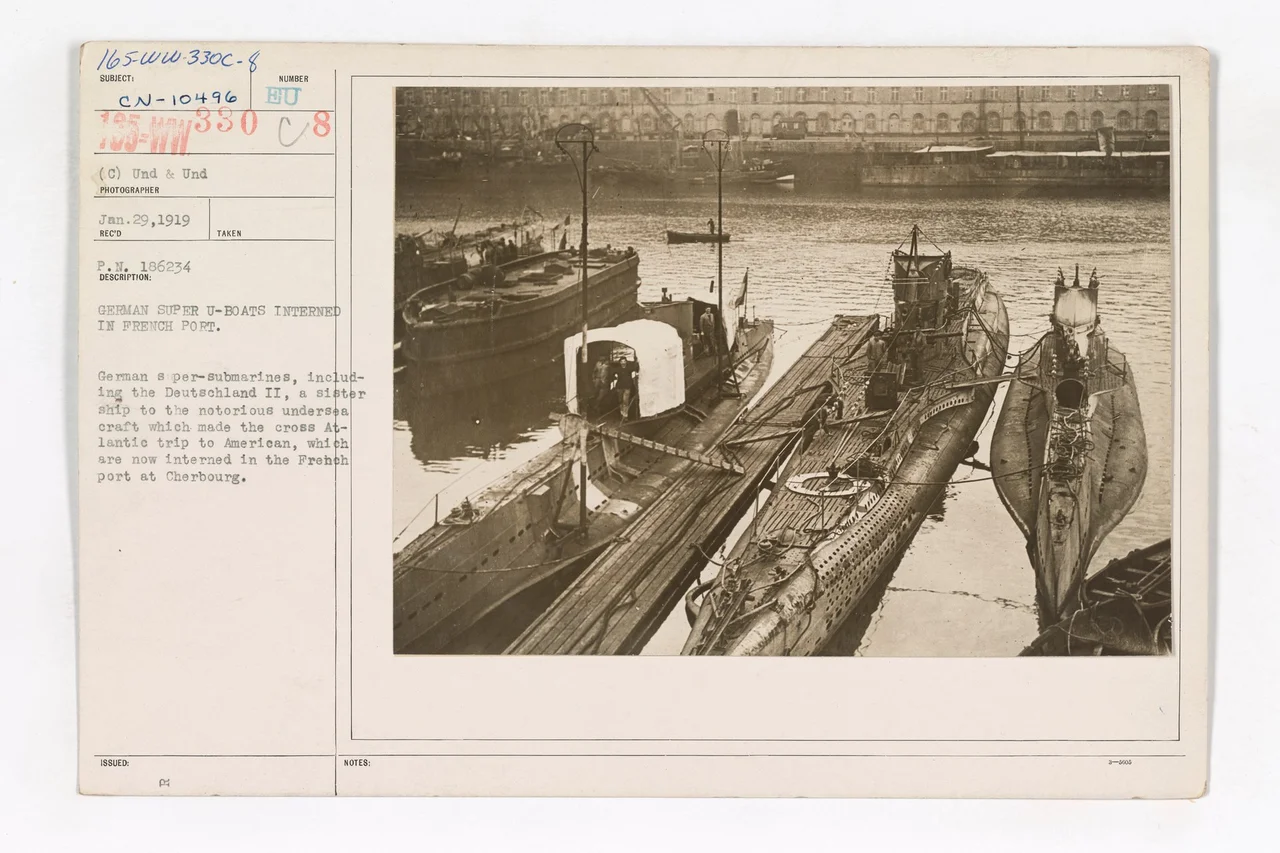
On 15 June 1940, the Luftwaffe arrived. As the German army drove westward, Cherbourg became the evacuation point for British and French soldiers who could not reach Dunkirk in time, and the press began calling it the Norman Dunkirk. Two days later the wehrmacht was at the city gates. Vice-Admiral Jules Le Bigot, the maritime prefect, made sure that three submarines under construction at the arsenal, Praya, Roland Morillot, and Martinique, would never be finished. He had them destroyed at their berths. Then he surrendered the open city to General Erwin Rommel. The forts on the breakwater, the basins built for emperors, the dockyards that employed half the town, all changed hands without a fight.
The Largest Port in the World
American troops landed at Utah Beach for a reason, and the reason was Cherbourg. The only deep-water port in the region, it was the supply line on which the whole reinforcement of Normandy would depend. US forces encircled the city on 21 June 1944. Five days of street fighting and naval bombardment broke German resistance, and on 26 June at four in the afternoon, General Karl-Wilhelm von Schlieben, Admiral Walter Hennecke, and thirty-seven thousand soldiers surrendered to General J. Lawton Collins. The forts on the breakwater held out for one more day. The Germans had spent that final week wrecking everything they could not carry away, sinking tugs and cranes in the basins, blocking the channels. Salvage crews worked through July to clear them. From August 1944 until the port of Antwerp opened in November, Cherbourg handled twice the daily tonnage of New York. Fuel arrived through the PLUTO undersea pipeline. Men and equipment left by the Red Ball Express convoys and the Toot Sweet rail line. On Christmas Eve 1944, a German submarine torpedoed a Belgian troopship off the coast, and 763 American soldiers of the 66th Infantry Division died. The city renamed its quay for Collins, and remembered.
The Quiet Specialty
Cherbourg returned to France on 14 October 1945 and was awarded the Croix de Guerre with palm. Today it is one of three naval bases of metropolitan France, alongside Brest and Toulon, occupying 120 hectares and home to thirteen ships of the Channel Flotilla, the Maritime Gendarmerie, and a clutch of support and patrol vessels with names like Flamant, Pluvier, and Cormoran. The arsenal still builds submarines. The Suffren-class nuclear boats start here, as do the diesel-electric Scorpene-class hulls that France sells abroad. Since 2000 the navy has leased part of the yards to private firms, the building of cones-and-stones jetty quietly turned into a quieter industry of welding pressure hulls in covered sheds.
From the Air
Cherbourg Naval Base sits at 49.65 deg N, 1.63 deg W on the northern tip of the Cotentin Peninsula. The artificial breakwater enclosing the rade is unmistakable from altitude, a long curved line of stone in open water with forts at each end. Cherbourg-Maupertus Airport (LFRC) lies eight kilometers east. The Channel Islands are visible to the northwest in clear weather.
Nearby Stories
- Abbey of Saint-Sauveur-le-Vicomte 4.3 km away
- Alderney Society Museum 9.3 km away
- Channel Islands 18 km away
- Operation Donnerkeil 31 km away
- German Submarine U-672 31 km away
- D-Day: The Longest Day 59 km away
- Fishbourne Roman Palace 103 km away
- Basilica of Sainte-Therese, Lisieux 110 km away