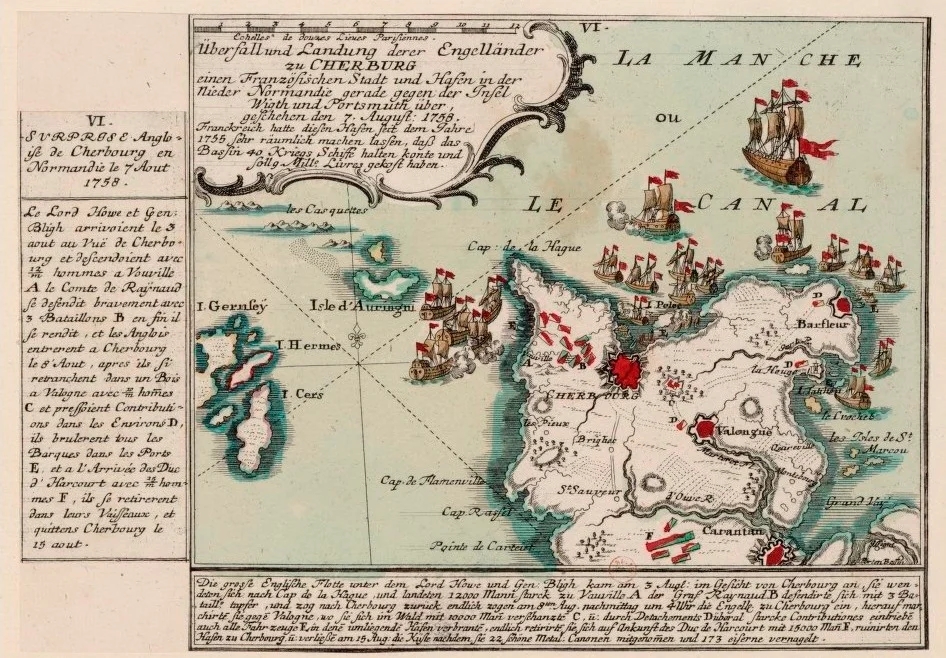

Cherbourg Raid
The bell ringers had been told. When the British sails came over the horizon on 7 August 1758, Cherbourg already knew. It had been threatened for days, watched from the offing while warships cruised the Normandy coast and pretended to consider Le Havre, then Caen, then nothing at all. Lieutenant General Thomas Bligh had with him a small army and a brief from London: do enough damage to draw French troops away from Germany, where Britain's allies were losing badly. The wind cooperated. The landing at Urville-Nacqueville beach went smoothly. The small French force defending the town fell back, and by nightfall the British held the half-finished port that Louis XV had spent so much money on.
A Policy Called Descents
The Seven Years' War had spread Britain's allies thin. Prussia, Hanover, and Brunswick were under pressure in central Europe, and the Duke of Brunswick asked London for relief. The British did not want to send infantry into Germany, but they had a navy, and they had a strategy already in motion. They called it the policy of descents, brief amphibious raids against the French coast, designed to force France to garrison every harbor and divert resources from the German front. The First Lord of the Admiralty, George Anson, assembled a force in southern England. A raid on Rochefort in 1757 had taken an offshore island but lost its nerve at the town. A raid on Saint-Malo in June 1758 burned shipping but did not capture the place. Cherbourg was the third attempt, and it carried more weight because Prince Edward, the younger brother of the future George III, had been sent along to lend the operation royal prestige.
Seven Days Ashore
Bligh commanded the troops. Richard Howe, later to win his name at the Glorious First of June, commanded the warships offshore. Once Cherbourg fell, the British set to work systematically destroying what Vauban and his successors had been building for decades. They blew up fortifications. They burned the basin under construction. They tore up the port works, smashed the magazines, hauled away or spiked the cannon they could find. Then on 16 August, having stayed exactly a week, they reembarked and sailed away. The whole operation had cost very little. The damage to Cherbourg's military future was substantial. The news, when it reached London, was the kind of dispatch the newspapers loved: the first successful British landing of any size on French soil since the Hundred Years' War, four centuries earlier.
The Sequel That Failed
William Pitt the Elder, the war's architect in London, was a believer in descents and pushed for more. Bligh sailed again in September, this time against Saint-Malo, and the project came apart in poor weather. He could land only part of his force, and a stronger French army drove them back to the boats at the Battle of Saint Cast. The British took heavy casualties getting away. The policy of descents was suspended afterward, and the government redirected more troops to fight directly in Germany. The raids had still done their work. They had unnerved the French, who realized that even the coast of Normandy was no longer safe, and they spent the war thereafter looking over their shoulders. France even sketched plans for a major invasion of Britain to put an end to the harassment, but the naval defeats of 1759 made that impossible.
What the Raid Built
Pictures of the Cherbourg raid hung in London drawing rooms for a generation, alongside scenes of Quebec and Plassey, as one of the small triumphs of a war that had gone unexpectedly well. The political effect outlasted the physical damage. When Louis XVI began rebuilding Cherbourg twenty years later, after France joined the American Revolution, the engineers and their patrons all remembered what an unfortified Channel coast had cost them. The breakwater scheme, the dredged basins, the deep arsenal, the great wall of stone that would take until 1853 to finish, were the answer to one week in August 1758. Every empire learns its lessons the hard way. Cherbourg, more than most places, was built by the lessons it taught.
From the Air
The 1758 landing beach at Urville-Nacqueville lies just west of Cherbourg at 49.66 deg N, 1.71 deg W. The harbor itself, the focus of the raid, sits at 49.64 deg N, 1.63 deg W. Cherbourg-Maupertus Airport (LFRC) is the nearest field. The coastline is dramatic from low altitude, granite cliffs and pebble beaches stretching west toward Cap de la Hague.
Nearby Stories
- Abbey of Saint-Sauveur-le-Vicomte 4.3 km away
- Alderney Society Museum 9.3 km away
- Channel Islands 18 km away
- Operation Donnerkeil 31 km away
- German Submarine U-672 31 km away
- D-Day: The Longest Day 59 km away
- Fishbourne Roman Palace 103 km away
- Basilica of Sainte-Therese, Lisieux 110 km away