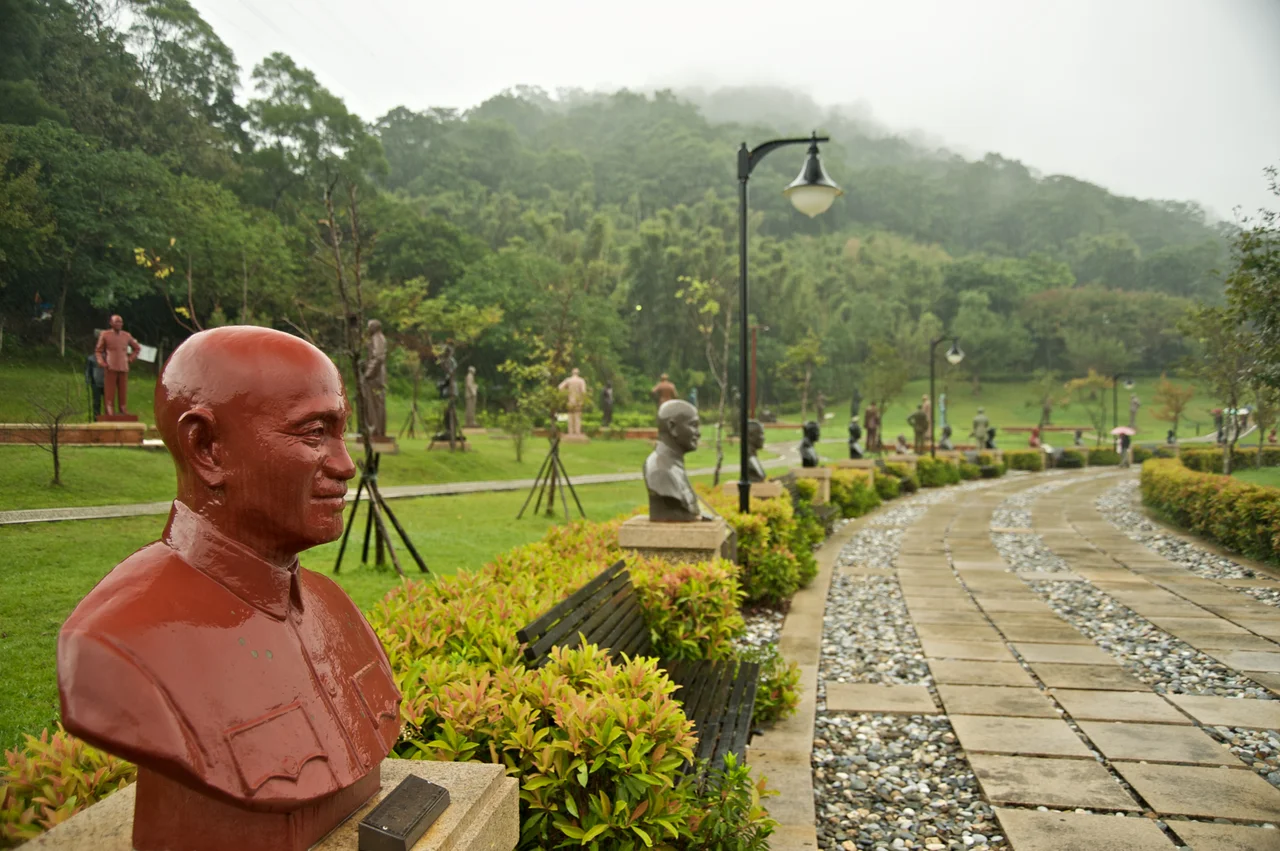

Chiang Kai-shek Statues
In Cihu, a hillside park in Taoyuan City, roughly 150 bronze figures of the same man stand in various poses -- seated, standing, on horseback, in military uniform, in civilian dress. Expat residents call it the Garden of the Generalissimos. The statues arrived here not as a planned collection but as political refugees, removed from parks, schools, and military bases across Taiwan during a decades-long reckoning with the legacy of Chiang Kai-shek.
A Cult in Bronze
During the decades of Kuomintang rule that followed the Republic of China's retreat to Taiwan in 1949, statues of Chiang Kai-shek were erected across the island. They appeared in public squares, school courtyards, military installations, and city parks -- usually cast in bronze alloy, though materials varied by location. The statues were part of a broader effort to establish Chiang's authority and the Nationalist government's legitimacy on an island it had not originally governed. Chiang had lost mainland China to the Communists during the Chinese Civil War, and the statues reinforced the narrative that the ROC -- and its leader -- remained the rightful government of all China. They watched over daily life with the steady gaze of a man who intended to return to the mainland. He never did.
The Democratic Wind
Removals began quietly in 1999 but gained force in 2007 under the independence-minded Democratic Progressive Party administration of President Chen Shui-bian. The DPP argued that the statues symbolized authoritarian rule and a cult of personality incompatible with democracy. The Kuomintang countered that the removals were an attempt to sever Taiwan's Chinese heritage and distort history. When Defense Minister Lee Jye carried out government orders to remove statues from military bases, the KMT revoked his party membership. In March 2007, the removal of a large seated bronze Chiang from Kaohsiung's Cultural Center sparked clashes between protesters and police. The statue's fate became national news.
Wounds and Regeneration
The Kaohsiung statue arrived at Cihu in 79 segmented pieces. A plan to send it to Chiang's ancestral home of Xikou in mainland China was considered but abandoned. Instead, local artist Guo Shao-zong partially reassembled the figure -- deliberately leaving gaps and missing pieces visible. Unveiled on March 15, 2008, the resulting work was titled Wounds and Regeneration, and it became one of the most visited sculptures in the park. The name captures something essential about Taiwan's relationship with these statues: they represent wounds that cannot simply be erased, and the attempt to process them is itself a form of renewal. Meanwhile, at the Chiang Kai-shek Memorial Hall in Taipei, the giant statue inside was temporarily surrounded by kites representing "a democratic wind" -- neither removed nor ignored, but recontextualized.
Campus by Campus, City by City
The removals continued piecemeal. National Taiwan Normal University moved its Chiang statue in 2011 after debate stretching back to 1987. National Cheng Kung University followed in 2013. During 228 Incident commemorations in 2016, Chiang statues at National Chengchi University were vandalized, prompting a resolution to remove all of them from campus. In 2017, the Yangmingshan statue was beheaded in retaliation for the earlier beheading of a statue of Japanese engineer Yoichi Hatta. City by city, mayors made their own decisions: Chiayi removed its statues in 2014, Tainan in 2015, and Taoyuan sent its school and office statues to Cihu. Each removal reignited the same debate -- authoritarian symbol or cultural heritage -- with no consensus in sight.
The Generalissimos Endure
Many Chiang statues remain across Taiwan, continuing to watch over public squares, schools, and parks. The tension they embody -- between honoring history and perpetuating an authoritarian legacy -- is not unique to Taiwan. The relocation to Cihu has been suggested as a model for other countries grappling with contested monuments, including the debate over Confederate statuary in the United States. What makes Taiwan's approach distinctive is the refusal to resolve the question cleanly. The statues are neither destroyed nor celebrated. They stand in a hillside park, visited by tourists -- many from mainland China -- in a setting that is part memorial, part museum, and part open question about what a democracy owes to the memory of its dictators.
From the Air
Coordinates: 24.84N, 121.29E. The Cihu Memorial Sculpture Garden is located in Daxi District, Taoyuan City, adjacent to the Cihu Mausoleum. From the air, the hillside park is identifiable by its open layout near a lake. Nearby airports: RCTP (Taoyuan International Airport, ~20 km northeast). Best viewed at 2,000-4,000 feet. The garden and mausoleum complex are set amid forested hills along the Dahan River valley.
Nearby Stories
- Tamsui 4.6 km away
- Hakka Round House 12 km away
- Smangus 14 km away
- Dapu Incident 19 km away
- 2022 Chinese Military Exercises Around Taiwan 47 km away
- Sinking of MV Sewol 1079 km away
- Yellow Sea 1130 km away
- Twin Forts of Romblon 1338 km away