
Hakka Round House
The Hakka people have a long history of building in circles. In the mountains of Fujian province on China's southeastern coast, their ancestors raised tulou — massive round earthen fortresses, sometimes five stories tall, housing entire extended families behind walls thick enough to absorb both bandit raids and the passing of centuries. When Miaoli County decided to build a new cultural center honoring its Hakka heritage in Houlong Township, the designers reached back to that ancestral form. The result, which opened in October 2014, is not a replica of a Fujian tulou. It is something more deliberate: a contemporary building that wears an ancient silhouette.
Why Circles? The Architecture of Belonging
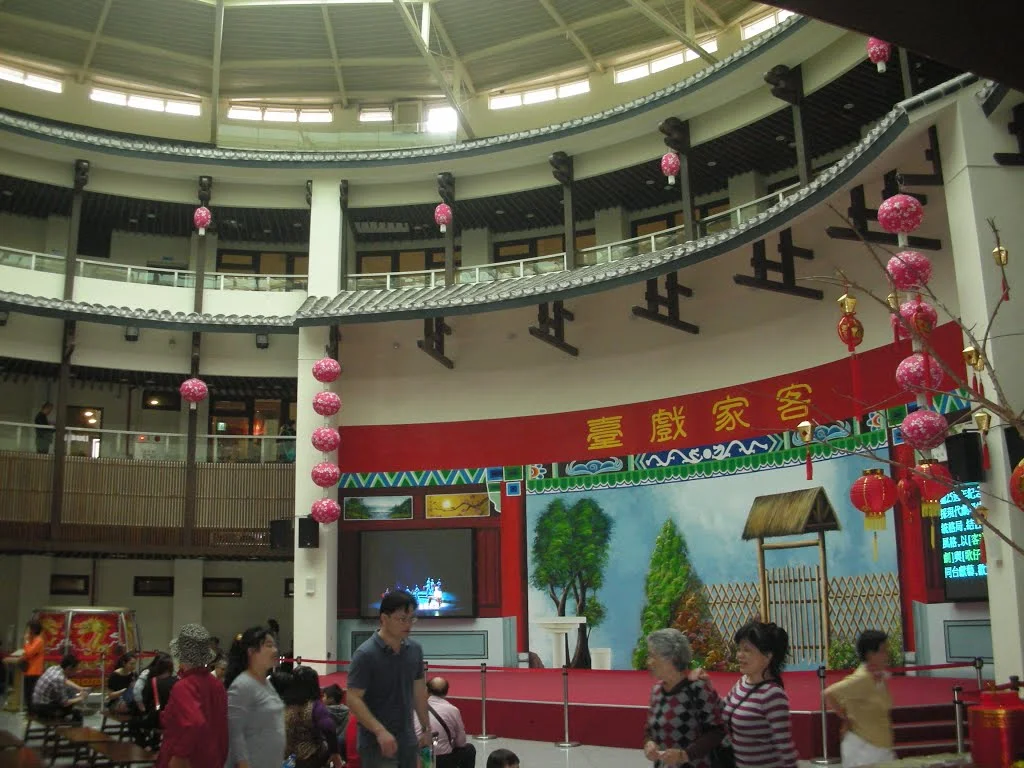
The Hakka are one of Taiwan's largest ethnic groups, descendants of migrants who moved from central China to Fujian and Guangdong provinces before crossing the Taiwan Strait, often under difficult circumstances, across several centuries. They brought with them the tulou tradition — buildings designed not just for shelter but for collective defense and communal living, where every family in the clan occupied a slice of the circle and no single household held a more prominent position than another. The Hakka Round House in Houlong translates this egalitarian geometry into a public institution. The building's circular floor plan creates a ground-level performance hall that faces inward, where visitors gather at the center. Ring-shaped trails wrap around the exterior. An arc-shaped observation deck offers views of the surrounding landscape. Water paths run through the grounds. The designers kept the form but changed the function: where the original tulou enclosed and defended, this building opens outward to welcome.
Four Floors of Story
The Hakka Round House descends as much as it rises. Below ground level, a multimedia viewing room introduces visitors to Hakka history and culture through film and interactive displays — a deliberate choice to begin underground, in the foundation of things. The ground floor holds the round exhibition and performance hall, a flexible space used for concerts, theatrical presentations, and community events. The floor above houses gallery exhibitions on Hakka material culture, textiles, tools, and domestic life. At the very top, DIY classrooms give visitors hands-on access to Hakka crafts — weaving, dyeing, food preparation. The building spans 1,385 square meters of land and encloses a total floor area of 3,476 square meters. Its construction cost NT$130 million, funded by the Miaoli County Government, which opened the facility in October 2014. The county later faced financial pressures that led, in 2015, to plans to tender the building's operations to a private operator — a tension between cultural ambition and fiscal reality that many Taiwanese county-level institutions have navigated.
Hakka Identity, Woven Into Brick
The material choice for the Round House is deliberately grounded: brick, not glass and steel. Brick echoes the earthen walls of the original tulou, though in a contemporary structural form rather than rammed earth. In Miaoli County, Hakka culture runs deep. The county is home to one of the highest concentrations of Hakka speakers in Taiwan, and the language — distinct from Mandarin and Taiwanese Hokkien — is still heard in markets, temples, and family kitchens throughout the region. The Round House serves as a gathering point for that identity: a place where the Hakka story can be told on its own terms, in its own architectural language, to visitors who may be encountering this community for the first time. The building's signature silhouette, visible from the surrounding farmland and foothills, has become a recognizable landmark in an area not usually known for architectural landmarks.
Getting There, Getting Oriented
Houlong Township occupies the coast of northern Miaoli County, where the land is low and the sea close. The Round House is accessible from two rail connections: Miaoli Station on the Taiwan High Speed Rail for travelers arriving from Taipei or Taichung, and Fengfu Station on the Taiwan Railway for local and regional trains. The surrounding landscape shifts between flat agricultural land near the coast and the forested hills that press down from the east — the same terrain that shaped Hakka settlement patterns across Taiwan for generations. Visitors arriving from Fengfu Station pass through a patchwork of rice paddies and small orchards before the round form of the building appears above the low horizon. The effect is pleasingly surprising: a circle where you expect only a rectangle.
From the Air
The Hakka Round House is located at 24.6035°N, 120.8234°E in Houlong Township, Miaoli County, Taiwan. From the air at 2,000–4,000 feet, the building's distinctive circular form is visible against the flat agricultural lowlands of the Houlong plain, with forested hills rising to the east. The Taiwan Strait coastline lies several kilometers to the west. Nearest major airport: RCMQ (Taichung International Airport), approximately 55 km to the south-southeast. The High Speed Rail corridor running north-south through Miaoli County is a useful aerial orientation marker.
Nearby Stories
- Fengyuan Museum of Lacquer Art 1.6 km away
- Chiang Kai-shek Statues 6.3 km away
- Smangus 7.6 km away
- Taroko National Park 11 km away
- Hsinchu Museum of Military Dependents Village 21 km away
- Taiwan Strait 31 km away
- Taixi, Yunlin 62 km away
- China Airlines Flight 611 82 km away