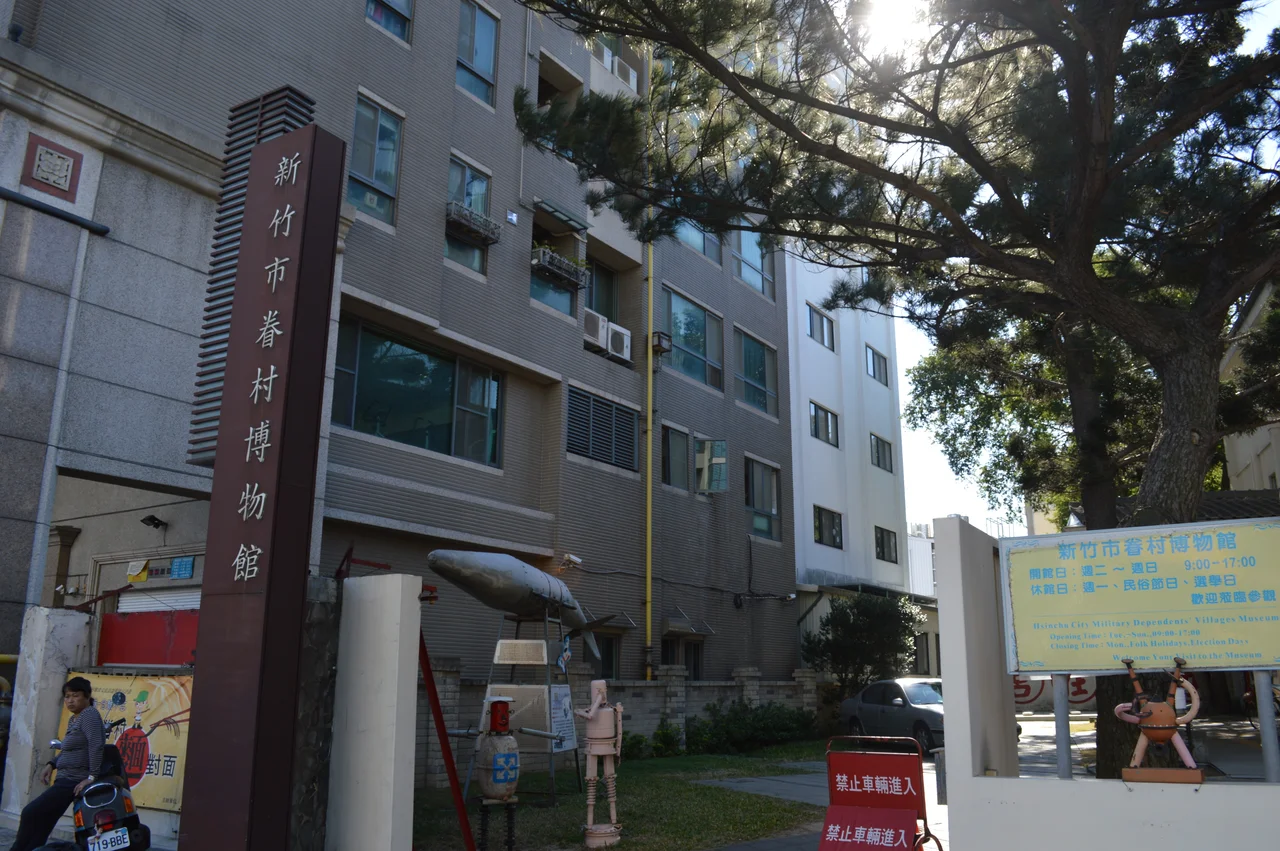

Hsinchu Museum of Military Dependents Village
In the last months of 1949, something extraordinary happened along the coast of Taiwan: families arrived by the hundreds of thousands, carrying almost nothing. They were soldiers and their dependents — men who had fought under the Nationalist banner, women who had followed husbands into exile, children who would grow up speaking dialects their Taiwanese-born neighbors had never heard. The government built clusters of simple houses to shelter them, and those clusters became a world unto themselves: the juancun, Taiwan's military dependents' villages. The Hsinchu Museum of Military Dependents Village exists so that world is not forgotten.
The Great Crossing
When the Chinese Civil War ended in Communist victory in 1949, the Nationalist government of Chiang Kai-shek retreated across the Taiwan Strait. The scale of what followed was staggering. According to historical statistics, between 1945 and 1950, nearly two million soldiers and civilians made the crossing from mainland China to Taiwan — men and women from every province, every dialect group, every social class. They brought with them the foods, customs, and regional identities of a continental nation compressed into a subtropical island. Hsinchu, a city in northwestern Taiwan with a large military presence, was deeply shaped by this migration. At its peak, the city held 47 juancun villages — one of the highest concentrations anywhere on the island. The residents of each village often came from the same province or military unit, re-creating fragments of a China they would never return to.
A Life Between Walls
Life inside the juancun was a particular kind of existence: insular, communal, and suspended between a past that could not be revisited and a future that remained uncertain for decades. The houses were modest — thin-walled, close together, never quite enough. But within those constraints, communities formed. Neighbors shared food across courtyard walls. Children played in alleyways that bore the names of distant cities: Nanjing Lane, Sichuan Road. The older residents spent years expecting to return home. As decades passed and that return became first unlikely and then impossible, the juancun evolved. Children born in Taiwan became Taiwanese, even as they carried their parents' accents and recipes. The juancun developed a distinct hybrid culture — part mainland nostalgia, part island improvisation — that produced writers, filmmakers, and musicians who drew on that particular tension between belonging and displacement.
What the Museum Holds
The museum opened on 28 December 2002, established by the Cultural Affairs Bureau of the Hsinchu City Government. It occupies preserved village structures in the North District of Hsinchu, within walking distance north of Hsinchu Station on the Taiwan Railway. Inside, the collection includes historical relics, photographs, household objects, and architectural details that document what juancun life looked like and felt like. Exhibitions rotate regularly, bringing different angles to a history that touches millions of Taiwanese families — both those with mainland roots and those who grew up beside the villages as neighbors. The museum is not a monument to a military campaign. It is a record of ordinary life under extraordinary circumstances: the kitchen where someone cooked their mother's Shandong dumplings, the bedroom where a child fell asleep hearing Shanghainese lullabies, the courtyard where a community mourned losses it could name and ones it could not.
Memory and Reconciliation
The juancun story sits at the intersection of several painful histories: a civil war, a forced displacement, and decades of political tension between Taiwan and the mainland. For a long time, the communities that built the juancun occupied an uneasy position in Taiwanese society — seen by some as outsiders, as the remnants of a government that had imposed martial law for nearly four decades. The museum's existence is itself a gesture toward complexity. It does not paper over those tensions. But it asks visitors to see the human dimension of a massive political rupture: the grandmother who kept a photograph of a village she left at twenty and never saw again, the veteran who wrote letters home for thirty years before he understood there was no one left to receive them. Hsinchu's 47 villages have largely been demolished or redeveloped. The museum is one of the few physical places where that vanished world can be touched.
Arriving by Air
Flying into northern Taiwan, the city of Hsinchu appears on the coast of the Taiwan Strait, its grid of streets giving way to the denser, older neighborhoods of the North District near the railway station. The museum sits close to the historic station building, itself a Japanese-era landmark from 1913. From the air, the flat coastal plain where Hsinchu spreads gives little hint of the layered migrations that shaped it — but the city's character, its food culture, its dialects, were all bent by the arrival of those nearly two million people across two decades. Taoyuan International Airport (RCTP), the main international gateway into northern Taiwan, lies roughly 35 kilometers northeast at an elevation of about 33 meters. Pilots approaching RCTP on clear days can see the full sweep of the western coastal plain — the very terrain where so many people arrived with everything they owned in a single bag and began, improbably, to make a new home.
From the Air
The museum is located at 24.8142°N, 120.9669°E in the North District of Hsinchu City, Taiwan, at roughly 20 meters elevation. Hsinchu sits on Taiwan's northwestern coast; the city and its historic railway station are visible on clear days from cruising altitude over the Taiwan Strait approach. Nearest major airport: Taoyuan International (RCTP), approximately 35 km northeast. The coastal plain between Hsinchu and Taoyuan is where many juancun villages were concentrated during the post-1949 resettlement period.
Nearby Stories
- Former Residence of Chang Hsueh-liang (Hsinchu County) 3.8 km away
- Dawulun Fort 7.3 km away
- Cherry Orchard Cemetery 8.4 km away
- 2022 Chinese Military Exercises Around Taiwan 17 km away
- Suao 21 km away
- 2015 New Taipei Water Park Fire 28 km away
- Gaomei Lighthouse 33 km away
- Gaomei Wetlands 63 km away