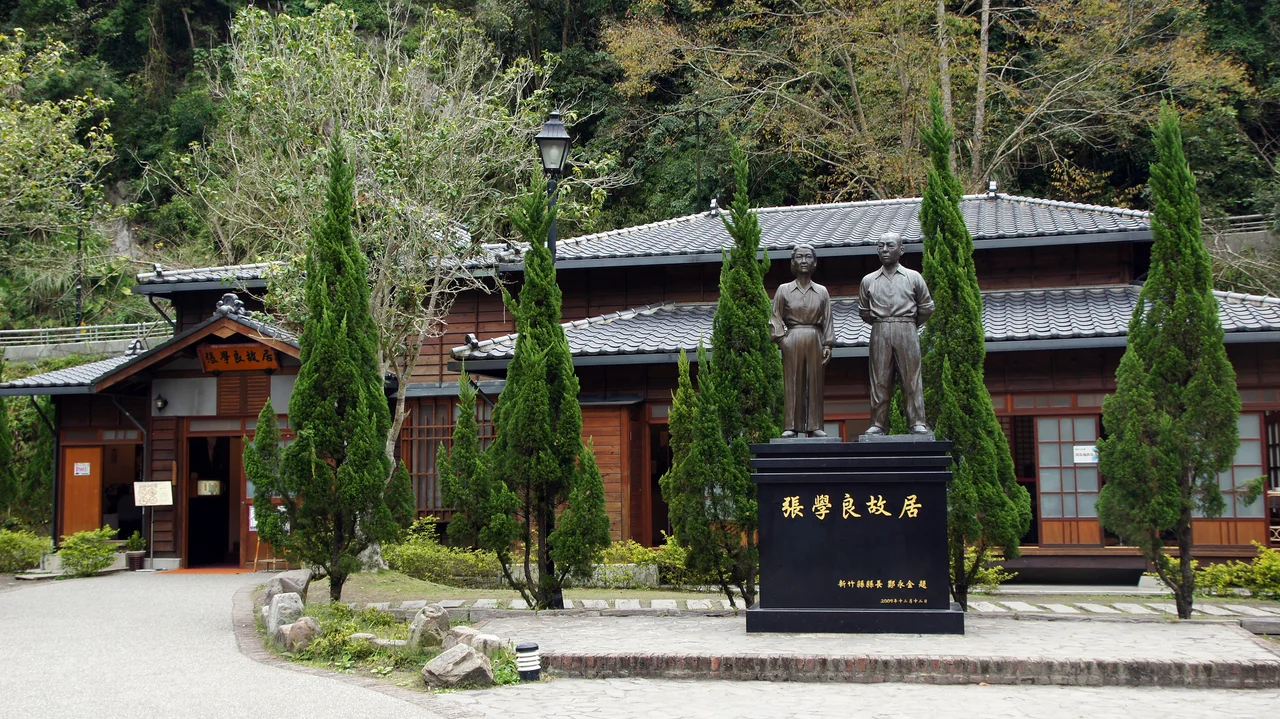

Former Residence of Chang Hsueh-liang (Hsinchu County)
On December 12, 1936, Chang Hsueh-liang ordered his soldiers to seize Chiang Kai-shek at dawn. The generalissimo — architect of the Nationalist government, commander of millions — was taken from his bed at Huaqing Hot Springs outside Xi'an and held by a warlord half his age who demanded that the civil war against the Communists stop, and that China unite against Japan instead. The kidnapping worked. What it cost Chang Hsueh-liang was the rest of his life. He voluntarily escorted Chiang back to Nanjing, surrendered himself to military justice, and began what would become more than fifty years under house arrest. One of those years — a long, quiet stretch of them — was spent in a small guarded residence in Qingquan, an Atayal village in the mountains of Hsinchu County.
The Young Marshal
Chang Hsueh-liang inherited his title and his position. His father, Zhang Zuolin, was the dominant warlord of Manchuria, known as the Old Marshal. In June 1928, Japanese Kwantung Army officers blew up Zhang Zuolin's railway car at Huanggutun — a murder designed to destabilize Manchuria and provoke further Japanese expansion. The son who took command afterward was twenty-seven years old and had grown up in the corridors of warlord politics. He became the Young Marshal, and in 1928 he declared allegiance to the Nationalist government, formally completing Chiang Kai-shek's Northern Expedition. Three years later, Japan seized Manchuria — the homeland Chang had pledged to Chiang — while Chiang continued prioritizing the destruction of the Communists over resistance to the invaders. By 1936, Zhang Xueliang's Northeastern Army had been sitting in Xi'an for years, ordered to fight Chinese rather than Japanese. The frustration had reached its limit.
Xi'an, December 1936
The Xi'an Incident lasted thirteen days. Chang Hsueh-liang and General Yang Hucheng presented Chiang Kai-shek with eight demands: stop the civil war, release political prisoners, form a united front against Japan. Zhou Enlai arrived from the Communist side to negotiate. Madame Chiang Soong Mei-ling flew in from Nanjing. On Christmas Day, Chiang was released. He gave oral assurances rather than a written document. Chang Hsueh-liang chose to accompany Chiang back to Nanjing — a decision almost universally regarded afterward as the gravest error of his life. He was court-martialed, sentenced, pardoned, and placed under house arrest. His co-conspirator Yang Hucheng was imprisoned for thirteen years and executed in 1949. The incident itself achieved something: the Second United Front between Nationalists and Communists against Japan followed shortly after. The war Chang had demanded came. He would not see any of it freely.
Qingquan
The mountains around Qingquan are what most people imagine when they think of Taiwan's interior — Atayal territory, steep ridges, river valleys deep in forest, a world that feels genuinely remote even now. The original structure where Chang was held was a Japanese-era police dormitory, repurposed as his guarded residence. He arrived in Hsinchu County in 1946 and remained until 1957. Whatever solitude those years offered existed alongside constant surveillance. In 1963, a landslide destroyed the original building during a typhoon. The loss was physical but also symbolic — a house that held a man who had remade Chinese history, erased by the same mountain it sat beneath. The current structure opened to the public on December 12, 2008, the seventy-second anniversary of the Xi'an Incident, with President Ma Ying-jeou attending the ceremony. It was later renovated and reopened on September 20, 2014.
The House and What It Holds
The reconstructed residence spans roughly 150 square meters — a modest scale that makes the history it contains feel compressed. Chang's old furniture is on display inside. Two of his nieces donated more than 500 photographs that now line the walls, tracing a life from the warlord's son in Manchuria to the elderly man who would eventually leave Taiwan at the age of ninety-one to visit family in the United States. A bronze statue of Chang and his wife stands outside the entrance. He settled in Hawaii in 1995 and died there on October 14, 2001, aged one hundred. The biography told by those photographs covers an empire lost, a kidnapping planned, a war demanded, a punishment served, a century survived. The house itself is quiet and small and sits in a mountain village that was never meant to hold someone of his significance.
Confinement as History
Chang Hsueh-liang's house arrest lasted more than fifty years in total — years in mainland China before Taiwan, years in Taiwan before his departure. Most assessments describe the Xi'an Incident as a pivotal moment: it forced Chiang's hand toward a united front that the war would require. History credited Chang with a role in making that possible. History also left him under guard while it unfolded. He could have fled during negotiations. He chose not to. He escorted Chiang home because, he later said, he wanted to show sincerity and take responsibility. Whether that choice was noble or naive was a question he lived with for the remainder of his long life. The residence in Qingquan is one stop on a biography that spanned a century of Chinese and Taiwanese history — a small building that marks a long pause in the life of a man who, in two weeks in December 1936, briefly held the outcome of a continent in his hands.
From the Air
The Former Residence of Chang Hsueh-liang is located in Qingquan (Wufeng Township), Hsinchu County, at approximately 24.58°N, 121.10°E, in the mountainous interior of northern Taiwan. The site sits in a river valley surrounded by steep ridges, roughly 35 km east of Hsinchu city. The nearest major airport is RCTP (Taiwan Taoyuan International Airport), approximately 60 km to the northwest. The Shei-Pa National Park peaks, including Xueshan and Mount Dabajian, are visible to the northeast in clear conditions. This is mountain terrain; the area sits at an elevation of approximately 1,000 meters, with surrounding peaks considerably higher. Pilots overflying should maintain minimum safe altitude of 10,000 feet or higher given the terrain.
Nearby Stories
- 2021 Hualien Train Derailment 6.6 km away
- Cherry Orchard Cemetery 7.6 km away
- Leofoo Village Theme Park 8 km away
- Taichung Power Plant 12 km away
- Nanao (Taiwan) 18 km away
- Hehuanshan 19 km away
- Gaomei Lighthouse 24 km away
- 2022 Chinese Military Exercises Around Taiwan 53 km away