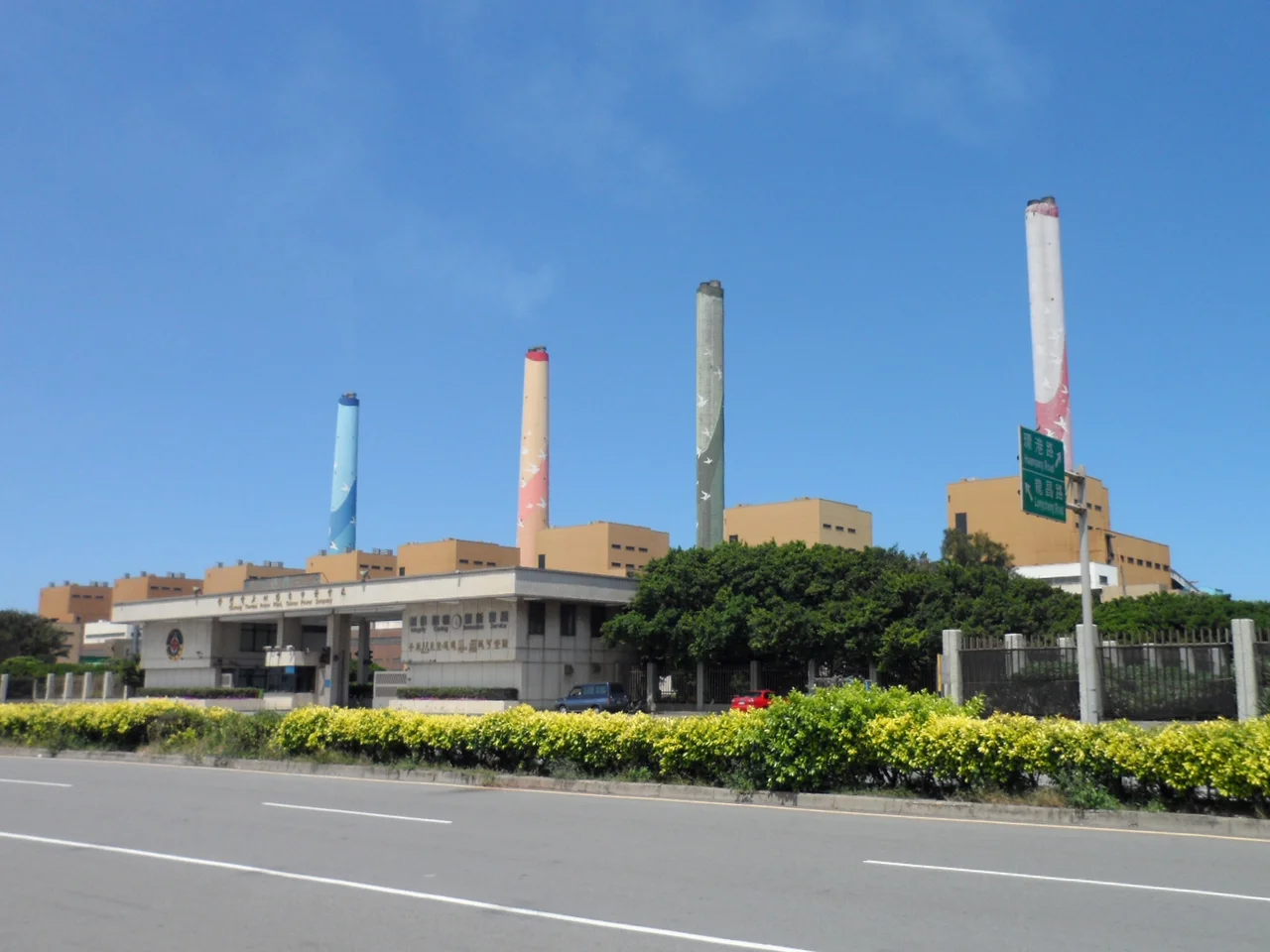

Taichung Power Plant
The smoke is visible from twenty miles out. On the coast of Longjing District, just west of Taichung, ten massive smokestacks rise from a complex that covers enough reclaimed land to qualify as its own industrial neighborhood. The Taichung Power Plant is the fourth-largest coal-fired power station on Earth, with an installed coal capacity of 5,500 megawatts and a total capacity, including gas and wind units, of 5,824 megawatts. It is also, depending on who you ask, either the backbone of Taiwan's electrical grid or one of the primary reasons central Taiwan has some of the worst air quality in the country.
Ten Units, Three Decades
The plant grew in stages. Four coal-fired units, each rated at 550 megawatts, were commissioned in 1991 and 1992. Four more followed in 1996 and 1997. By the time units 9 and 10 were installed in 2005 and 2006, the plant had expanded onto land reclaimed by depositing its own ash, a detail that captures the circular logic of coal power in miniature: the waste from burning coal created the ground on which more coal would be burned. The eight older units alone consume approximately 12 million tonnes of bituminous coal and 2.5 million tonnes of sub-bituminous coal per year, much of it shipped from Indonesia. Coal arrives by sea, unloaded by six ship unloaders and distributed through a complex conveyor system to coal yards or directly to the generating units.
The Price of Power
In 2018, the Taichung Power Plant was estimated to be one of the ten most carbon-polluting coal-fired power plants in the world, emitting approximately 29.9 million tonnes of carbon dioxide. In December 2015, as Taiwan's scientific community warned about rising lung cancer rates, it was claimed that the Taichung Power Plant, together with the Sixth Naphtha Cracking Plant of the Formosa Plastics Group, accounted for roughly seventy percent of air pollution in central Taiwan. The emissions include large quantities of sulfur oxides. In November 2017, the Taichung city government ordered a 24 percent reduction in coal consumption starting in January 2018, a mandate that signaled a political shift toward treating the plant as a public health problem rather than purely an energy asset.
Engineering on an Industrial Scale
The plant's scale is staggering even by power industry standards. Each of its ten units features a drum-type, water-cooled boiler with a dry bottom furnace and a tandem-compound steam turbine with four-flow exhaust and single reheat. The generators are supercritical steam, high power density machines connected to the national grid through a 345-kilovolt switchyard. Designed for base load service, the plant can perform daily startup and shutdown cycles when needed. Fire detection systems run the length of every conveyor belt, monitoring for the heat that coal dust and friction can generate. Despite these precautions, a fire broke out on the conveyor in June 2021, taking three hours to extinguish. Generator trips in August 2017 caused temporary power reductions of over 500 megawatts each, reminders that even the largest machines are vulnerable.
The Transition Ahead
Taiwan's energy future is being negotiated, in part, at this plant. Plans call for two new gas-fired combined cycle units, each with 1.3 gigawatts of capacity, to come online by 2025 and 2026. Simultaneously, two to four coal-fired units are scheduled for decommissioning by 2030, aligning with the government's air quality improvement policy. The shift from coal to gas will not eliminate emissions, but it will substantially reduce the sulfur oxides and particulate matter that have made central Taiwan's air a political issue. For now, the plant continues to burn. The lights stay on in Taichung, and the smokestacks continue to mark the coast like industrial sentinels. Whether they represent progress or its cost depends entirely on where you stand.
From the Air
Located at 24.21°N, 120.48°E on the coast of Longjing District, Taichung, on Taiwan's central-western shoreline. The power plant complex is unmistakable from the air: ten large smokestacks, extensive coal yards, and a harbor for coal ships on reclaimed coastal land. Nearest airports: Taichung International Airport (RCMQ) approximately 15 km to the northeast. Best viewed at 3,000-6,000 ft AGL. The plant's coastal location and industrial scale make it one of the most prominent visual landmarks along Taiwan's western coast. Note: haze and reduced visibility are common in the area due to industrial emissions.
Nearby Stories
- Formosan Aboriginal Culture Village 4.4 km away
- Xiluo Bridge 12 km away
- 1916–1917 Nantou Earthquakes 20 km away
- Former Residence of Chang Hsueh-liang (Hsinchu County) 23 km away
- Tongxiao Shrine 28 km away
- China Airlines Flight 611 29 km away
- Mudouyu Lighthouse 32 km away
- Battle of Xiapi 1117 km away