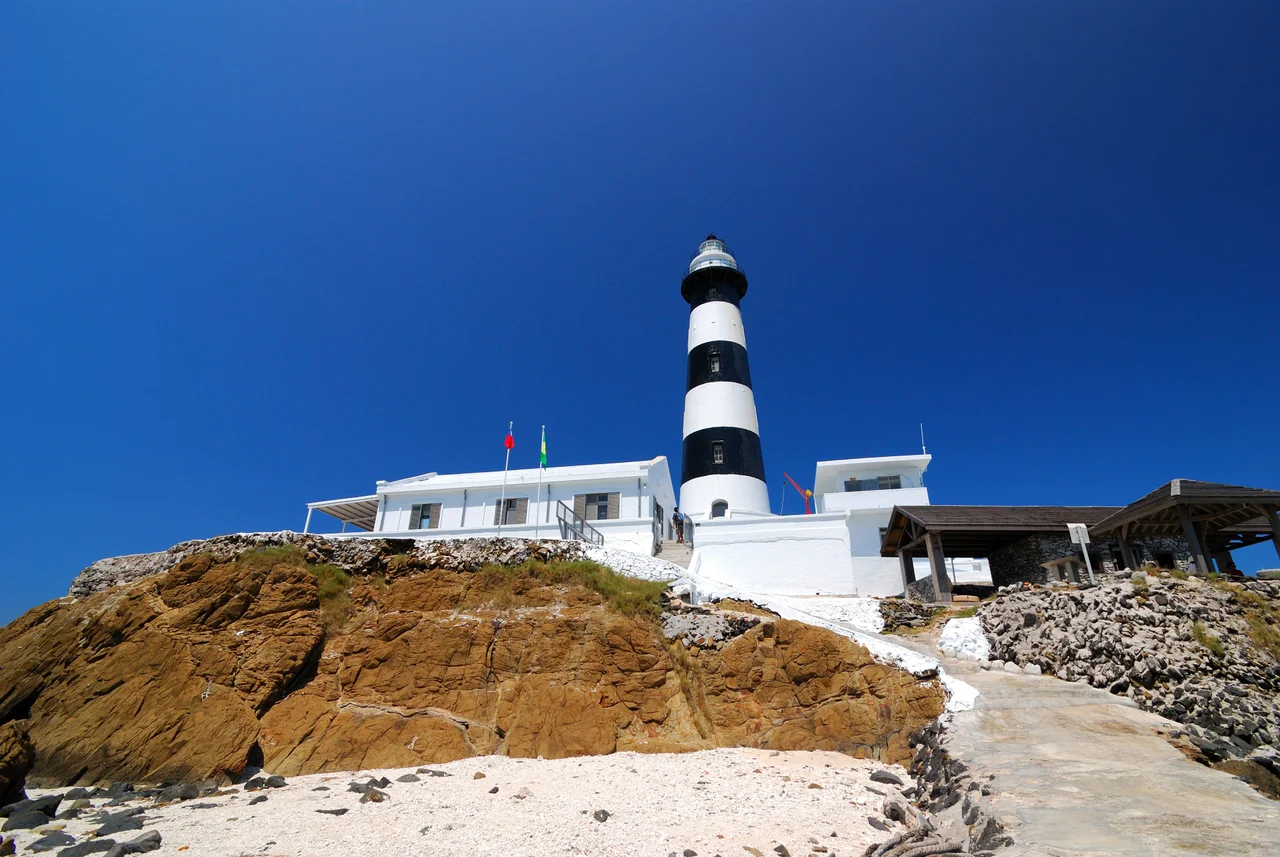

Mudouyu Lighthouse
Mudou Island has no power grid. No mains electricity runs to this small outcrop in the Penghu archipelago, adrift in the Taiwan Strait between the island and the Chinese mainland. And yet, since 1902, a light has swept the sea from the top of a 39.9-meter tower there — the tallest lighthouse in Taiwan — powered entirely by its own generators, drinking water collected off its own roof. The Mudouyu Lighthouse was built to endure, and it has.
First Light Under Japanese Rule
When Japan took control of Taiwan in 1895, it inherited a coastline that seafarers already knew to be treacherous. The Penghu islands — scattered volcanic remnants rising from shallow, current-swept water — had claimed ships for centuries. The colonial administration moved quickly to improve maritime safety, and Mudouyu Lighthouse, completed in 1902, was the first lighthouse they built on Taiwanese soil. Its placement on Mudou Island, in Baisha Township on the northern edge of the Penghu group, put a beacon precisely where mariners needed one: at the northern approach to the archipelago, where the Taiwan Strait narrows and currents grow unpredictable.
Iron Against the Sea
The engineers who designed Mudouyu faced a particular problem. The Taiwan Strait is one of the windiest stretches of water in East Asia, especially in winter, when the northeast monsoon drives sustained gales across the open water. A stone or brick structure might crack and erode. Instead, they chose cast iron — strong, resistant to salt spray, capable of holding its shape under the kind of forces that unmoor lesser things. The result is a tower that rises nearly forty meters above the island, painted in bold black and white horizontal stripes that make it visible not only at night but in daylight, serving as a daymark for ships navigating by sight. The stripes are practical and iconic in equal measure.
A Self-Sufficient Sentinel
With no connection to the mainland power grid — and no prospect of one on an island this remote — the lighthouse was designed from the start for self-sufficiency. Three generators provide electricity for the light and the station's equipment. Rainwater, captured from the rooftop and channeled into cisterns, supplies the keepers. It is a closed system on a small rock in the sea, and it works. This kind of engineered isolation was common in the era of staffed lighthouses, but Mudouyu represents it in particularly pure form. The island's only residents, for much of its modern history, were the lighthouse keepers themselves.
Remote but Reachable
The Penghu islands have become an increasingly popular destination for Taiwanese travelers — the shallow turquoise water, the basalt columns, the relative coolness compared to the mainland city summers. Mudou Island sits within the Penghu National Scenic Area, and the lighthouse draws visitors curious to see Taiwan's tallest in person. Getting there requires a boat from Baisha, a short crossing across water that turns luminous green over the sand. Up close, the lighthouse is larger than photographs suggest. The cast-iron body has weathered more than a century of salt wind with something close to equanimity. The black-and-white stripes remain stark against the sky.
A Light That Still Burns
Many historic lighthouses around the world have been decommissioned as GPS and satellite navigation made physical lights redundant. Mudouyu continues to operate. Ships still move through the Taiwan Strait in enormous numbers — one of the busiest shipping lanes on the planet — and the lighthouse provides a physical reference point that mariners continue to use. The rotating beam sweeps the sea at night as it has since 1902, first under Japanese colonial administration, then under the Republic of China. More than twelve decades of unbroken service from an island with no power plant, no paved roads, and a population that has rarely exceeded a handful of lighthouse keepers and their families.
From the Air
The Mudouyu Lighthouse stands at 23.7864°N, 119.60°E on Mudou Island in the Penghu archipelago, approximately 50 km west of Taiwan's main island. At 39.9 meters tall, it is visible from the air in clear weather. Nearest airport is RCQC (Magong Airport, Penghu), approximately 25 km to the south-southeast. Approach from the northwest offers the best view of the black-and-white striped tower against the island. The surrounding shallow water appears distinctly turquoise at lower altitudes. Winds can be strong, particularly November through March during the northeast monsoon.
Nearby Stories
- Southern Branch of the National Palace Museum 11 km away
- Wude Airfield 13 km away
- Fangyuan Lighthouse 19 km away
- Daodong Tutorial Academy 27 km away
- Taichung Power Plant 80 km away
- Nanxiong Formation 436 km away
- Heyuan 457 km away
- Battle of Xiapi 1147 km away