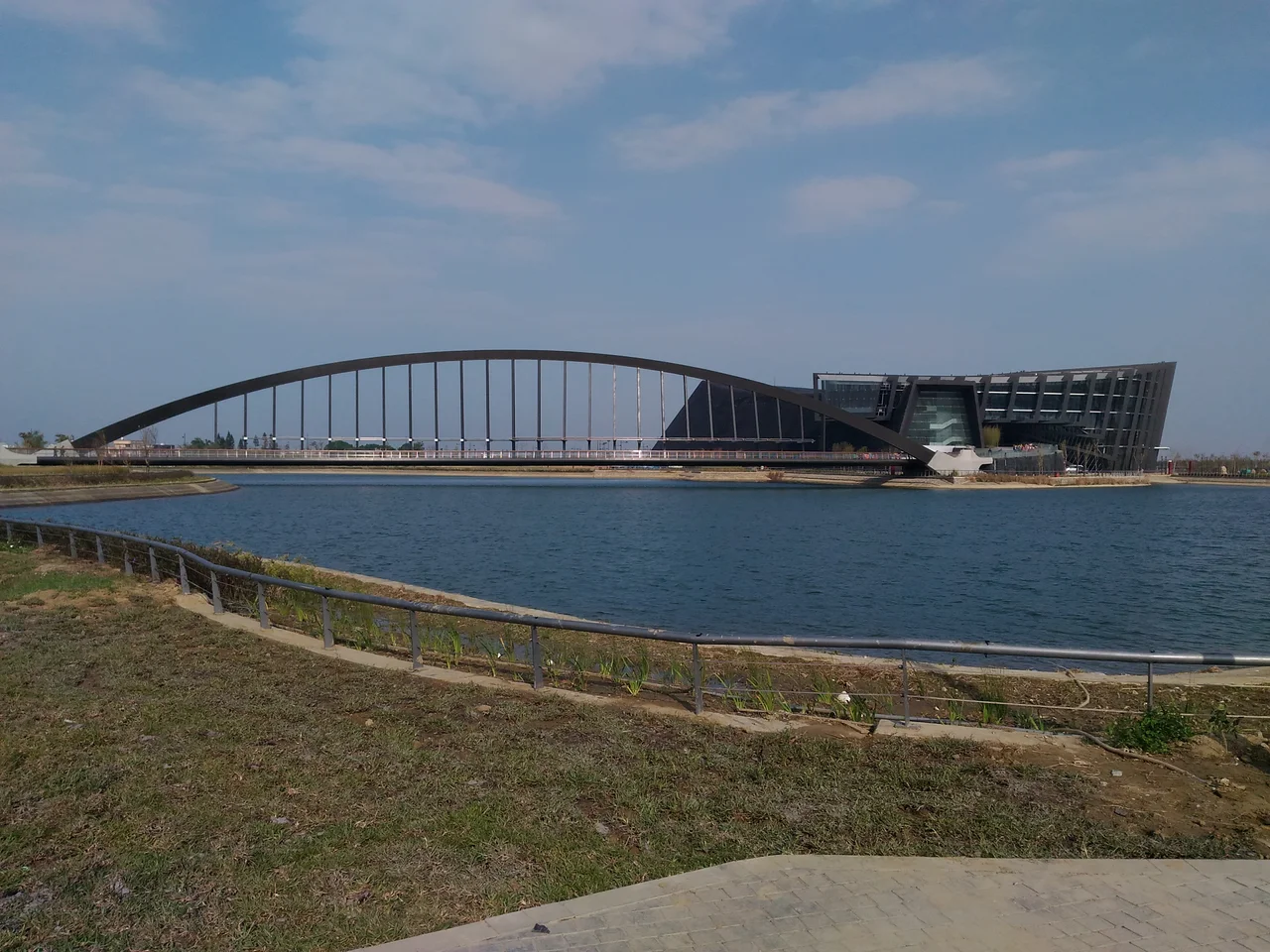

Southern Branch of the National Palace Museum
The museum starts with the bridge. The Zhimei Bridge — 142 meters of single-span steel arch with 25 curved ribs of varying lengths and angles — crosses a lake before you reach the building itself, which is fair preparation for what follows: a structure designed to make you feel the weight of intention before you encounter the content. The Southern Branch of the National Palace Museum sits in Taibao City, Chiayi County, on a 70-hectare campus that was nearly a decade in the making. The idea originated in a government commitment to cultural equity: the National Palace Museum in Taipei had long concentrated Taiwan's greatest cultural treasures in the north. The Executive Yuan approved the southern branch on 31 December 2004 as the Asian Arts and Culture Museum, with a mandate to bring the collection's reach — and the prestige that comes with it — to a part of the island that felt underserved by national cultural institutions.
The Shape of Brush on Paper
The main building of the Southern Branch of the National Palace Museum was designed around a single metaphor: the three classical brush forms of East Asian ink painting. The strokes — distinct in their movement, pressure, and direction — correspond architecturally to the three forms that make up the structure, and the building's designers tied each form to one of three ancient Asian civilizations: China, India, and Persia. The resulting shape is unusual from any angle, and from the air the building reads as a complex interlocking of curved and angular volumes that resist easy categorization as either traditional or modernist. The museum is spread across 20 hectares of the campus's 70 total hectares; the remaining 50 are park, water features, and landscape. The main entrance is elevated at 11 meters above ground level, which means arriving at the museum requires ascending — a spatial gesture that reinforces the building's ambition. It is also certified as a green building under Taiwan's standards.
Built for the South
The groundbreaking ceremony on 6 February 2013 was hosted by President Ma Ying-jeou; the beam-raising ceremony on 5 June 2014 by Vice President Wu Den-yih. These are the kinds of ceremonial markers that governments attach to institutions they consider consequential, and the attendance of senior political figures signaled what the project was supposed to mean: a correction of a long-standing imbalance between Taiwan's north and south in access to national cultural resources. The museum opened for a trial period on 28 December 2015. Within months, water leakage problems in the main hall caused a closure in mid-April 2016; the museum reopened on 23 August 2016 after repairs. The construction cost was NT$7.934 billion — a figure that reflects both the ambition of the campus and the political commitment behind it. Large public cultural projects of this scale are rarely without complications. What matters is that the institution survived them and is open.
Three Gardens, Three Worlds
The 50-hectare park that surrounds the main building is not incidental. It is, in its own way, as considered as the architecture. The park is divided into three distinct gardens — the Waterscape Garden, the Tropical Garden, and the Festival Garden — each with its own character and its own relationship to the museum's larger mission of representing Asian art and culture across geographic and historical boundaries. The Waterscape Garden centers on the lake that the Zhimei Bridge crosses; the Tropical Garden engages with the subtropical environment of southern Taiwan's climate; the Festival Garden provides event and performance space. A bird-viewing platform, a waterfront stage, and a memorial stone for the museum's establishment are among the features distributed across the landscape. The park is, in effect, the first exhibition — before you reach the building, you have already been asked to think about how landscape, climate, and human design coexist.
Asian Treasures, Asian Scope
The National Palace Museum in Taipei is renowned for its collection of Chinese imperial art — the pieces evacuated from the mainland by the Nationalist government in 1949. The Southern Branch's mandate was deliberately broader: Asian art and culture, not solely Chinese imperial heritage. The permanent exhibition rooms address National Treasures, Asian Textiles, and decorative patterns in pottery, drawing from collections that span the geographic breadth the building's architecture already implies. The museum also maintains a children's creative center. In 2025 the museum opened an exhibition centering on Kublai Khan and the Mongol Yuan Dynasty — a period that connected China, Persia, India, and the steppe in exactly the kind of trans-Asian cultural exchange that the institution was built to explore. Temporary exhibitions bring the museum into regular renewal, so what's on view changes with the seasons.
Open to Everyone
On 21 December 2017, the Southern Branch of the National Palace Museum opened a Muslim prayer room — the first such facility in any Taiwanese museum. The gesture is characteristic of the institution's stated mandate. A museum dedicated to Asian art and culture that draws visitors from across the Muslim world — from Southeast Asia, South Asia, Central Asia, the Middle East — needs to accommodate those visitors' religious practice if it is serious about the breadth it claims. The museum also hosts the Indian Festival of Light and Muslim Culture Day as annual events. The Zhimei Bridge, the ink-painting architecture, the three gardens, the prayer room, the Yuan Dynasty exhibition: each of these elements is an argument that the institution makes, repeatedly, that Asian cultural heritage is not a single tradition but a network of intersecting ones, and that a museum in southern Taiwan can be a credible place to engage with all of them.
From the Air
The Southern Branch of the National Palace Museum is located at approximately 23.473°N, 120.293°E in Taibao City, Chiayi County, Taiwan — roughly 15 km west-southwest of central Chiayi City. From the air at 2,000 to 3,500 feet, the 70-hectare campus is one of the most visually distinctive sites in the Chiayi plain: the three-form main building is visible, and the lake with the arching Zhimei Bridge is a clear landmark from the north or east. The nearest airport is Chiayi Airport (RCKU), approximately 10 km to the northeast. The campus lies just east of the Taiwan High Speed Rail corridor, and the Chiayi HSR Station is the practical access point for visitors arriving by high-speed rail. Approach from the east for the best view of the building and the lake together.
Nearby Stories
- Paiyun Lodge 1.2 km away
- Wushantou Reservoir 4.3 km away
- 1999 Jiji Earthquake 6.5 km away
- Xiluo 7.4 km away
- Bunun Cultural Museum 27 km away
- TransAsia Airways Flight 222 28 km away
- Mudouyu Lighthouse 29 km away
- Daya Bay 551 km away
Sources
- Southern Branch of the National Palace Museum - Wikipedia
- Southern Branch of Taiwan Palace Museum / KRIS YAO | ARTECH - ArchDaily
- Southern Branch of the National Palace Museum - Pedestrian Bridge - TCT Industrials
- A Cultural Rebalancing Act - The National Palace Museum's Southern Branch - Taiwan Panorama