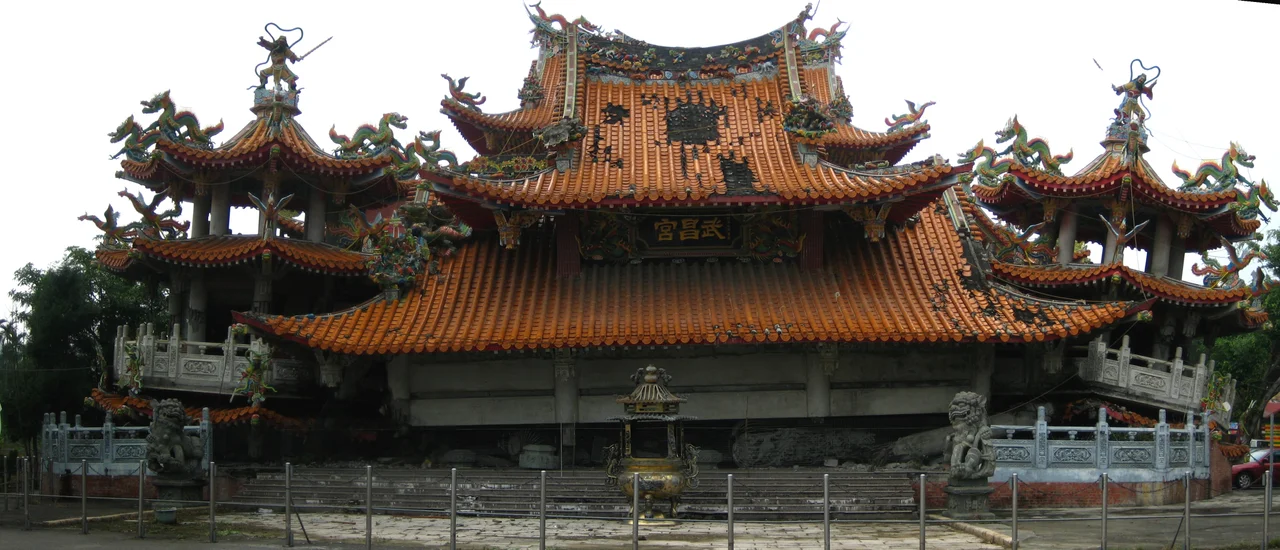

1999 Jiji Earthquake
At 1:47 in the morning on September 21, 1999, most of Taiwan was asleep. Within seconds, a fault rupture 100 kilometers long ripped through the western foothills of the Central Mountain Range, releasing a magnitude 7.7 earthquake centered near the small town of Jiji in Nantou County, just 9.2 kilometers southwest of Sun Moon Lake. The energy unleashed was roughly equivalent to the yield of the Tsar Bomba, the largest nuclear device ever detonated. Taiwan's most extensive seismic monitoring network in the world recorded ground motion of 3 meters per second at one station -- the highest measurement ever taken in any earthquake anywhere. By the time the shaking stopped, 2,415 people were dead, more than 11,000 were seriously injured, and over 100,000 buildings lay in ruins. Taiwanese would come to know it simply as 9-21.
A Nation Jolted Awake
The quake struck in an unusual location. Taiwan experiences most of its seismic activity off its eastern coast, where the Philippine Sea and Eurasian tectonic plates collide along the island's offshore subduction zones. But the Chelungpu Fault ran through the densely populated western foothills, through cities and farming communities that had never prepared for this kind of violence. In Nantou County, closest to the epicenter, 886 people died and over 23,000 buildings collapsed entirely. Taichung County, just to the north, fared even worse in absolute numbers: 1,154 dead, more than 16,000 structures flattened. The quake cut power across much of the island, automatically shutting down all three of Taiwan's nuclear power plants and plunging communities into darkness. Within a month, the Central Weather Bureau recorded 12,911 aftershocks. On September 26, a magnitude 6.8 aftershock brought down buildings already weakened by the mainshock, killing three more people.
Pillars of Newspaper and Plastic
In Taipei, 170 kilometers from the epicenter, the 12-story Tunghsing Building pancaked into rubble. Eighty-seven people died. When investigators dug through the wreckage, they discovered something that enraged the nation: the building's structural pillars and beams had been stuffed with plastic bottles and newspaper instead of proper reinforcement. Five people were indicted. Across Taiwan, public fury turned toward shoddy construction practices that had long been tolerated. Builders and architects of collapsed modern structures were detained, their assets frozen and passports seized. One design flaw stood out repeatedly -- "soft stories," where open ground floors in high-rise buildings provided little structural support, causing the lowest level to collapse first and triggering catastrophic pancake failures above. The disaster forced Taiwan to fundamentally rethink its building codes and enforcement, transforming construction standards for an entire generation.
Rescue Against the Odds
The military mobilized the same day. Conscripted soldiers fanned out across shattered mountain communities, clearing roads, distributing emergency supplies, and pulling survivors from the rubble. Helicopters evacuated the injured from remote areas and dropped food to villages cut off by 132 landslides triggered during the quake and its aftershocks. Over 700 international rescue workers from more than 20 countries eventually arrived, though Taiwan's complicated diplomatic status initially slowed the response -- the United Nations, adhering to its "One China Policy," hesitated to act without Beijing's approval. A Russian rescue flight was refused permission to cross Chinese airspace en route to Taiwan. Despite these obstacles, remarkable stories of survival emerged. Nearly 130 hours after the earthquake, two brothers were pulled alive from the ruins of the Tunghsing Building. They had survived on water sprayed from fire hoses, rotten fruit, and their own urine.
Aftershocks Economic and Political
The earthquake's ripple effects extended far beyond Taiwan's borders. At the time, Taiwan manufactured a significant proportion of the world's computer memory chips. The six-day shutdown of Hsinchu Science Park caused RAM prices to triple on global markets. With the island still recovering from the 1997 Asian financial crisis, economists estimated the total damage at roughly 10 percent of Taiwan's entire gross domestic product that year -- some NT$300 billion, or US$10 billion. Private donations to the government disaster fund totaled NT$33.9 billion, an extraordinary outpouring of solidarity. The political fallout was equally dramatic: public dissatisfaction with the government's response contributed to the defeat of the ruling Kuomintang in the 2000 presidential election, ending over half a century of KMT governance.
Memory Carved in Stone
The quake literally reshaped the land. The entire island elongated about 1.5 meters along its north-south axis and compressed east-west. In Wufeng, a township in southern Taichung County, Guangfu Junior High School sat directly on the fault line and was so thoroughly destroyed that it now serves as the 921 Earthquake Museum, a national memorial site. In Shigang District, a permanent fault shift damaged the Shigang Dam so severely that nearby roads had to be rebuilt with inclines to accommodate the new terrain -- locals humorously nicknamed the resulting slopes "Singapore," a pun in Chinese. The Taiwan Chelungpu-fault Drilling Project later drilled research boreholes into the fault, producing breakthrough discoveries including the first measurement of an earthquake slip zone and evidence that underground water movement partly caused the rupture. Every September 21 at 9:21 AM, a drill message is now sent to every mobile phone in Taiwan, ensuring the island never forgets.
From the Air
Coordinates: 23.772°N, 120.982°E, near Jiji, Nantou County, central Taiwan. The epicenter lies 9.2 km southwest of Sun Moon Lake. The Chelungpu Fault trace is visible from altitude as a linear scar running roughly north-south through the western foothills. Nearby airports: Taichung (RCMQ), approximately 50 km northwest. The 921 Earthquake Museum in Wufeng is identifiable from the air. The Central Cross-Island Highway, badly damaged and still partially closed, is visible cutting east-west through the mountains.
Nearby Stories
- Changhua Roundhouse 4.7 km away
- Beidou, Changhua 8.8 km away
- 1951 East Rift Valley Earthquakes 11 km away
- Kagi Shrine 14 km away
- 2021 Hualien Train Derailment 16 km away
- Yushan Weather Station 17 km away
- Hehuanshan 20 km away
- Mavulis Island 273 km away