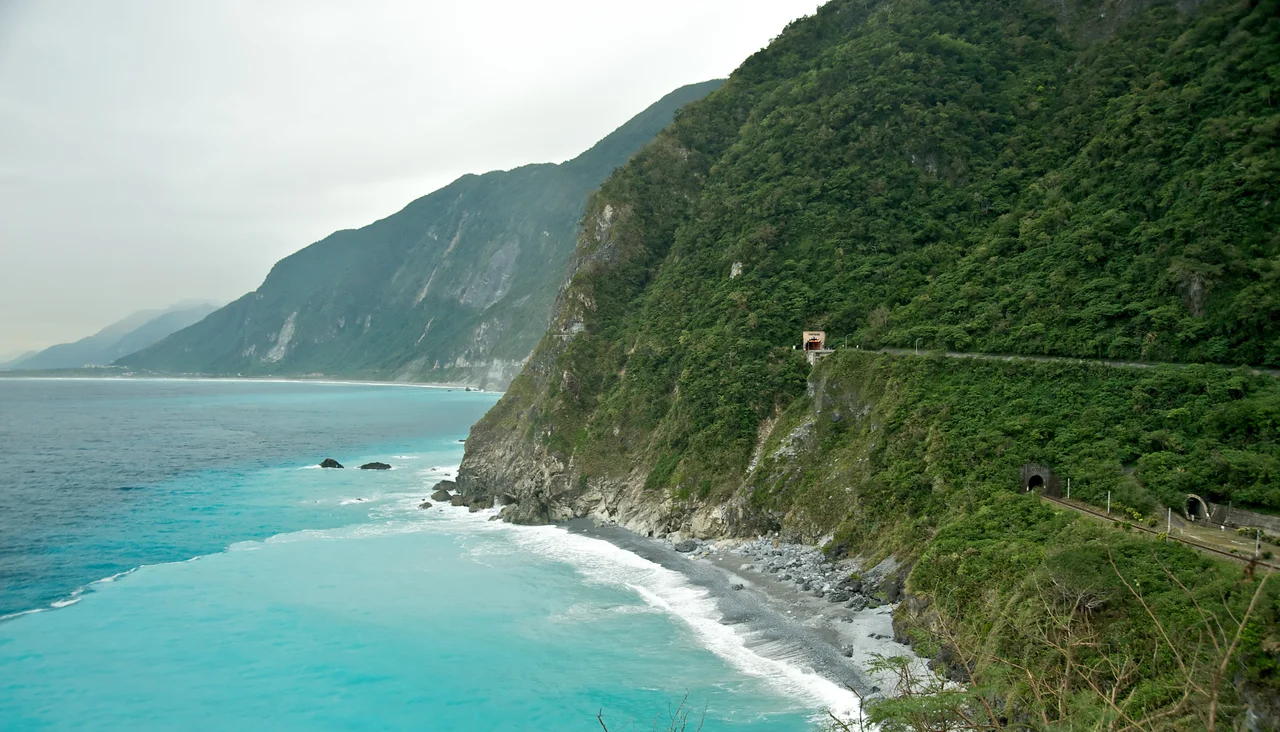

2021 Hualien Train Derailment
The train drivers had 6.9 seconds. That was the gap between the moment they spotted the construction truck on the tracks ahead - a crane truck that had rolled down a hillside slope after its parking brake failed - and the moment Taroko Express Train No. 408 struck it at full speed just outside Qingshui Tunnel. At the velocity the train was traveling, stopping was physically impossible. The collision partially derailed the lead cars, and then the train entered the tunnel.
What followed, on the morning of April 2, 2021, was Taiwan's deadliest rail disaster in decades. Forty-nine people died - 47 passengers, the driver, and the assistant driver. Another 202 were injured. The mangled carriages, compressed by the tunnel walls as they piled into each other, trapped 72 people in wreckage that rescue workers would spend hours cutting through.
A Truck That Should Not Have Moved
The sequence that produced the disaster began with a construction crane truck parked on a road above the railway line near the northern entrance to Qingshui Tunnel in Hualien County. The truck's driver, Lee Yi-hsiang, and his assistant had been working at a construction site adjacent to the tracks. The truck got stuck in bushes near a hairpin turn, and the two men attempted an improvised tow to free it. The method failed. The truck rolled downhill, crossed the slope, and came to rest on the railway tracks.
Neither man notified the railway of the obstruction. An earlier train had passed through the same section at 09:13 that morning without incident. A photograph taken at 09:21 showed the truck still parked on the road above. Sometime between 09:21 and 09:28, it rolled onto the tracks. At 09:28, Train No. 408 struck it. The entire window of preventable disaster lasted no more than fifteen minutes.
Inside the Tunnel
Car number 8, at the front of the train, took the initial impact. The collision partially derailed the train before it entered the tunnel, and then the tunnel walls did the rest. As derailed carriages scraped against the tunnel's concrete interior, they crumpled and compressed. Cars 7 and 8 sustained the worst damage and accounted for most of the fatalities. The front six carriages ended up trapped inside the tunnel, with the last car only partially inside.
Among the 490 passengers were classes from an elementary school and a university traveling for the Tomb Sweeping Day holiday weekend. Four students died: a six-year-old kindergarten girl and three university students. Thirty-two others from the school and university groups were injured, including a teacher. More than 150 emergency personnel - search and rescue teams, military units, Coast Guard, and National Airborne Service Corps - converged on the site. Removing the fourth carriage from the tunnel took until late afternoon.
Failures Laid Bare
The investigation by the Taiwan Transportation Safety Board revealed a cascade of failures extending far beyond a single truck. Lee Yi-hsiang, it emerged, held a dual role that was illegal under Taiwan's Construction Industry Act: he was both the site safety manager and the owner of one of the construction companies working the project. He had concealed this conflict of interest. The construction site lacked adequate safety barriers to prevent vehicles from reaching the tracks. No surveillance cameras monitored the area.
The TTSB's findings pointed to systemic negligence. In November 2020, the board had already published a damning report on the collapse of the Nanfang'ao Bridge, another infrastructure failure linked to poor maintenance oversight. The pattern was clear: Taiwan's rapid infrastructure development had outpaced its safety inspection capacity. In 2022, Lee was sentenced to prison - initially seven years and ten months, later increased on appeal to twelve years and six months. Contractors were ordered to pay NT$23 million in compensation, and victims' families received NT$150 million from the government.
The Horn at 09:28
The aftermath reshaped Taiwan's approach to rail safety. Minister of Transportation Lin Chia-lung resigned. Premier Su Tseng-chang ordered inspections of all bridges and infrastructure nationwide. The Taiwan Railways Administration reviewed its procedures for contractor oversight and construction site management near active rail lines. Restrictions on standing-room tickets were considered, given that the high casualty count was partly attributable to a fully loaded holiday train.
On the first anniversary, April 2, 2022, every train in Taiwan blew its horn for thirty seconds at 09:28 - the exact moment of the derailment. The sound carried across platforms and railway crossings from Taipei to Kaohsiung, a nationwide acknowledgment of the forty-nine people who died because a truck rolled fifteen minutes before a train arrived. On the third anniversary, a memorial concert and light show was held at Taipei Main Station. The tunnel itself, part of the scenic coastal route between Yilan and Hualien, remains in service. Trains pass through it daily, at speed, as they always have.
From the Air
Located at 24.22°N, 121.69°E on Taiwan's rugged eastern coast, near the northern entrance to Qingshui Tunnel along the coastal railway between Yilan and Hualien. The site sits at the base of Qingshui Cliff, where mountains rise steeply from the Pacific Ocean. From the air, the Suhua Highway and the parallel railway line are visible threading along the narrow coastal strip. Hualien Airport (RCYU) is approximately 30km to the south. Taipei Songshan Airport (RCSS/TSA) is about 100km to the northwest. The terrain is extremely steep with cliffs dropping directly to the sea; expect turbulent conditions near the mountain walls. Taroko National Park lies immediately to the south.
Nearby Stories
- Hehuanshan 1.5 km away
- Nanao (Taiwan) 3.1 km away
- Mount Dabajian 4.8 km away
- 1951 East Rift Valley Earthquakes 12 km away
- 1999 Jiji Earthquake 35 km away
- Sinking of MV Sewol 1142 km away
- Yellow Sea 1206 km away
- Sibuyan Island 1278 km away