.jpg)
Changhua Roundhouse
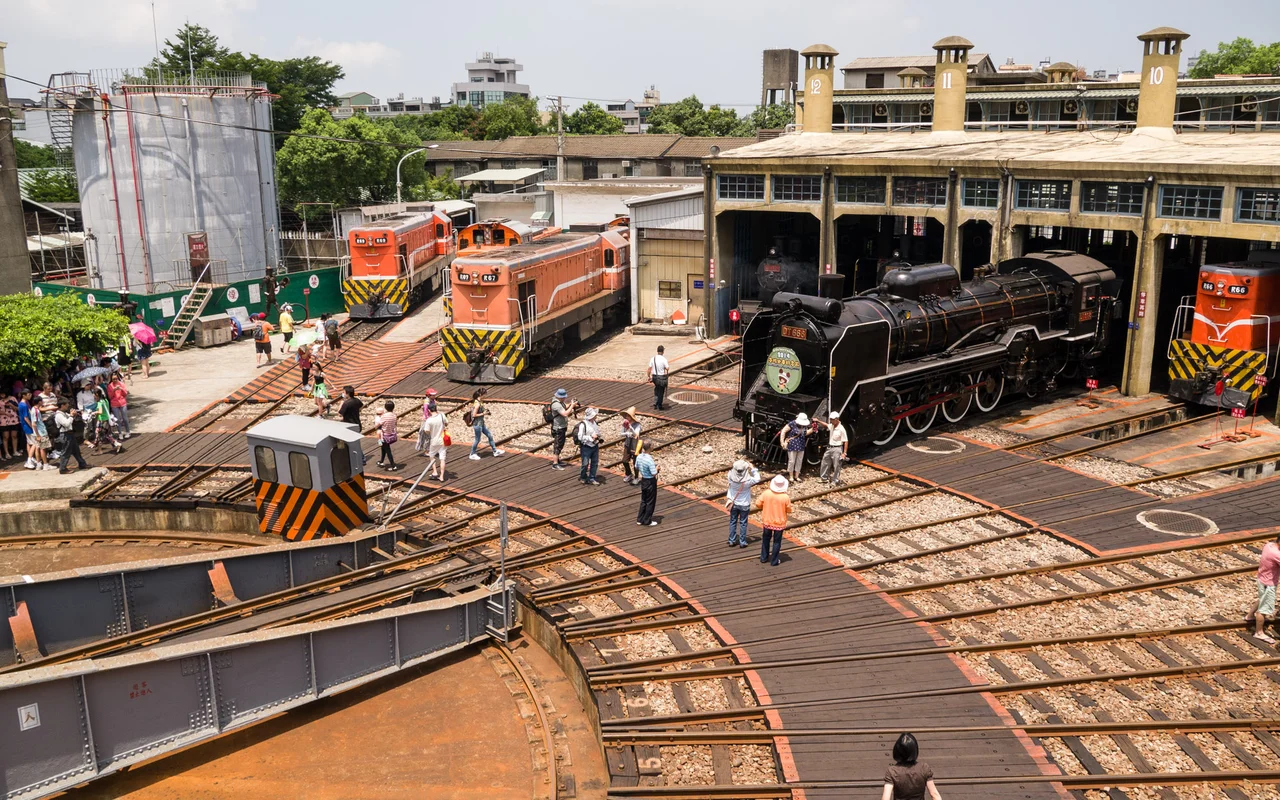
From directly above, the Changhua Roundhouse looks like a partially opened fan. Twelve stalls radiate outward from a central turntable, each one a bay for a locomotive, the whole structure forming a graceful arc just north of Changhua railway station. Built in 1922 during the Japanese colonial era, it is the only surviving railway roundhouse in Taiwan. The other five that once existed on the island were demolished decades ago. That this one remains is the result of a 1994 fight between a government that wanted to tear it down and a community that said no.
A Century on the Turntable
The roundhouse was completed in October 1922, coinciding with the opening of the Coastal Line section of Taiwan's West Coast Line, connecting Zhunan to Changhua. At first, the building had only six stalls. Demand grew quickly: eight stalls by 1923, ten by 1924, twelve by 1933. During World War II, Allied bombing damaged stalls 5 and 6, but the structure survived. As Taiwan's railways evolved, so did the roundhouse. In 1970, the arrival of R20 diesel locomotives required platforms to be fitted in stalls 1 through 7 for maintenance. A decade later, when E100 electric locomotives entered service, stalls 1 and 2 were adapted again. The roundhouse was never frozen in amber. It changed with each generation of rail technology, absorbing the new while retaining its original form.
Saved by Stubbornness
By the 1990s, Taiwan's railways needed larger maintenance facilities, and the Changhua Roundhouse was slated for demolition to make way for a modern depot. Local residents and heritage advocates fought the plan. Their argument was simple: this was the last one. Every other roundhouse in Taiwan had already been destroyed. Demolishing Changhua's would eliminate the final physical link to an era of railway history. The pushback succeeded. The depot was built south of Changhua railway station instead, and on 25 October 2000, the roundhouse was officially designated a county monument. The government's rationale cited the building's unique architecture and its significance in Taiwanese railway history, a formal acknowledgment of what the community had been saying all along.
Steam and Steel, Still Breathing
The roundhouse is not a museum in the conventional sense. It remains operational, still used by Taiwan Railway for maintaining and storing rolling stock. Visitors can watch the turntable in action, rotating locomotives between stalls like a mechanical dance. As of 2020, the roundhouse displays two steam locomotives: CK124, a CK120 class engine derived from the Japanese National Railways Class C12 design, and DT668, a DT650 class locomotive based on the JNR Class D51. These machines, built to haul freight and passengers through Taiwan's mountainous interior, sit in the same stalls that sheltered their predecessors a century ago. The fan-shaped building that houses them is both archive and workshop, a place where history is maintained in the most literal sense.
The Shape of Persistence
Railway roundhouses were once common infrastructure across the world, essential to the age of steam when locomotives could not easily reverse direction and needed to be turned on a central table. Most were demolished as diesel and electric traction made them obsolete. In Taiwan, the pattern was absolute: five roundhouses destroyed, one saved. The Changhua Roundhouse endures because people valued it before the government did. It stands as evidence that heritage preservation is not always a top-down process. Sometimes it begins with residents who refuse to sign off on a demolition permit, who insist that a building matters not because it is efficient but because it is irreplaceable. The turntable still turns. The fan still opens. That is the point.
From the Air
Located at 24.09°N, 120.54°E directly north of Changhua railway station in Changhua City, Changhua County. The roundhouse's distinctive fan shape is visible from altitude, with twelve stalls radiating from a central turntable. Nearest airports: Taichung International Airport (RCMQ) approximately 20 km to the north. Best viewed at 1,500-3,000 ft AGL to appreciate the fan-shaped layout. The roundhouse sits within the urban area of Changhua City, adjacent to the railway yard, which provides good contrast for identification.
Nearby Stories
- Formosan Aboriginal Culture Village 4.4 km away
- Xiluo Bridge 12 km away
- 1916–1917 Nantou Earthquakes 20 km away
- Former Residence of Chang Hsueh-liang (Hsinchu County) 23 km away
- Tongxiao Shrine 28 km away
- China Airlines Flight 611 29 km away
- Mudouyu Lighthouse 32 km away
- Battle of Xiapi 1117 km away